Agostini M, Alexander A, Araujo G, Bakalyarov A M, Balata M, Barabanov I, Baudis L, Bauer C, Belogurov S, Bettini A, Bezrukov L, Biancacci V, Bossio E, Bothe V, Brugnera R, Caldwell A, Calgaro S, Cattadori C, Chernogorov A, Chiu P-J, Comellato T, D'Andrea V, Demidova E V, Marco N Di, Doroshkevich E, Fomina M, Gangapshev A, Garfagnini A, Gooch C, Grabmayr P, Gurentsov V, Gusev K, Hakenmüller J, Hemmer S, Hofmann W, Huang J, Hult M, Inzhechik L V, Csáthy J Janicskó, Jochum J, Junker M, Kazalov V, Kermaïdic Y, Khushbakht H, Kihm T, Kilgus K, Kirpichnikov I V, Klimenko A, Knöpfle K T, Kochetov O, Kornoukhov V N, Krause P, Kuzminov V V, Laubenstein M, Lindner M, Lippi I, Lubashevskiy A, Lubsandorzhiev B, Lutter G, Macolino C, Majorovits B, Maneschg W, Marshall G, Misiaszek M, Morella M, Müller Y, Nemchenok I, Neuberger M, Pandola L, Pelczar K, Pertoldi L, Piseri P, Pullia A, Ransom C, Rauscher L, Redchuk M, Riboldi S, Rumyantseva N, Sada C, Sailer S, Salamida F, Schönert S, Schreiner J, Schütz A-K, Schulz O, Schwarz M, Schwingenheuer B, Selivanenko O, Shevchik E, Shirchenko M, Shtembari L, Simgen H, Smolnikov A, Stukov D, Sullivan S, Vasenko A A, Veresnikova A, Vignoli C, Sturm K von, Wester T, Wiesinger C, Wojcik M, Yanovich E, Zatschler B, Zhitnikov I, Zhukov S V, Zinatulina D, Zschocke A, Zuber K, Zuzel G
Department of Physics and Astronomy, University College London, London, UK.
Physik-Institut, Universität Zürich, Zürich, Switzerland.
Eur Phys J C Part Fields. 2024;84(9):940. doi: 10.1140/epjc/s10052-024-13020-0. Epub 2024 Sep 18.
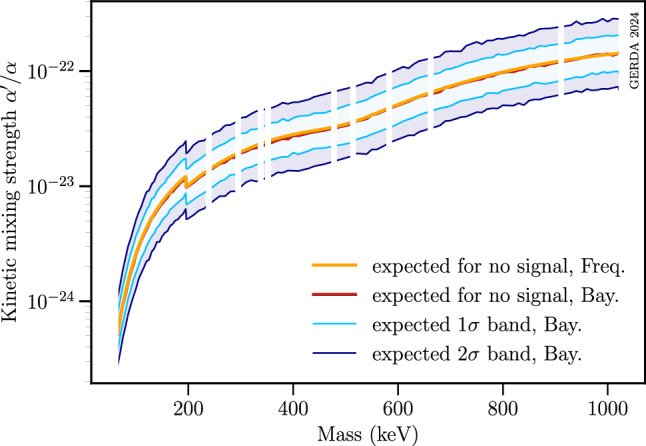
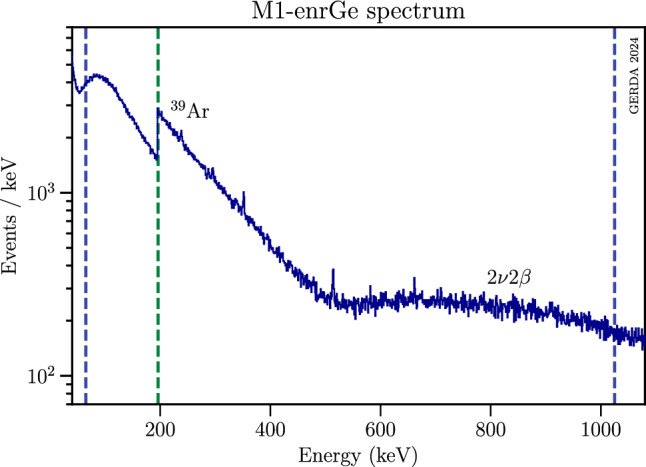
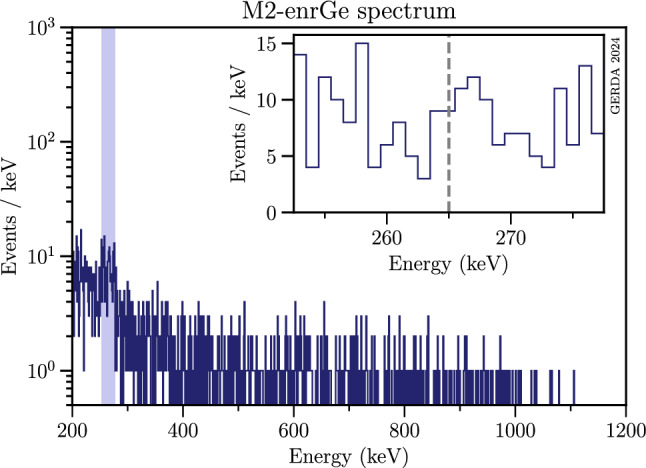
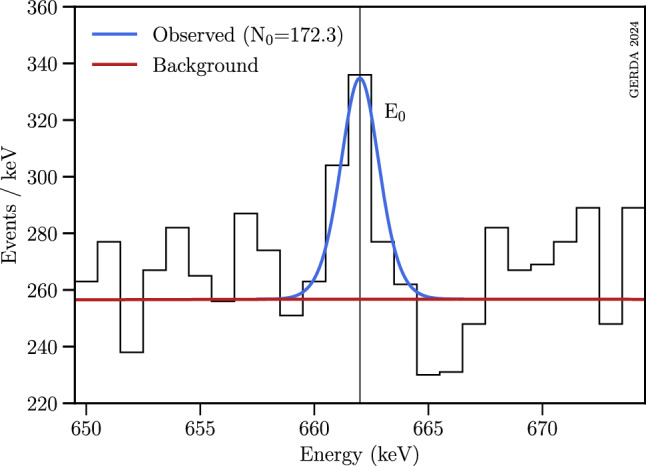
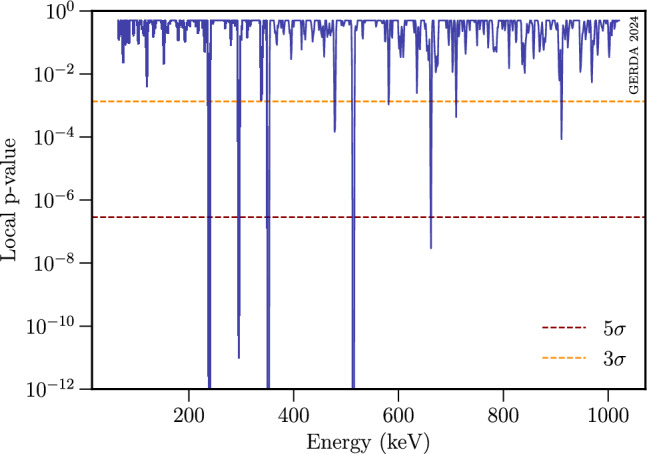
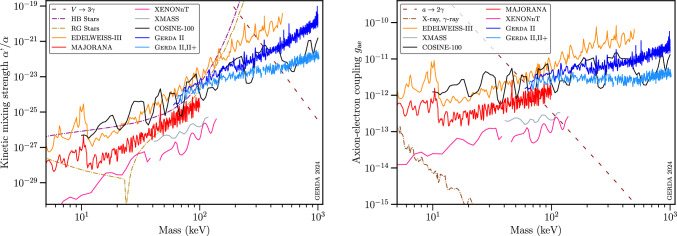
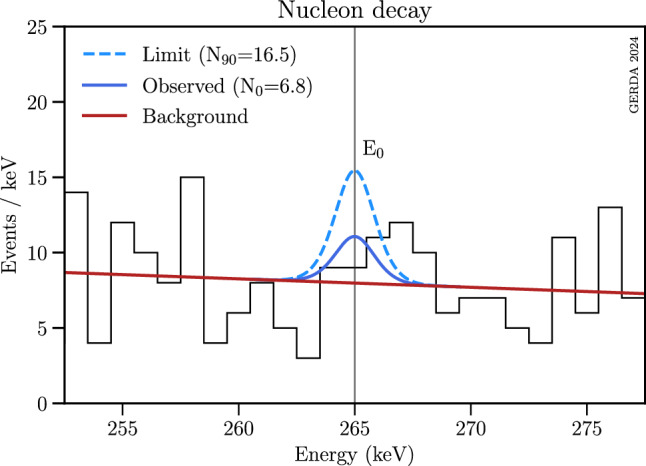
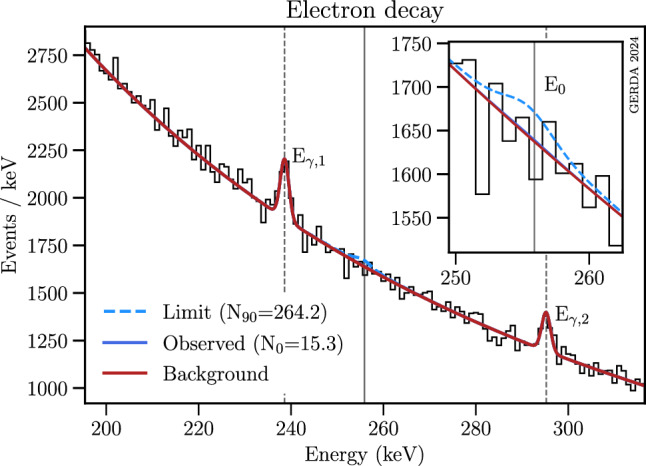
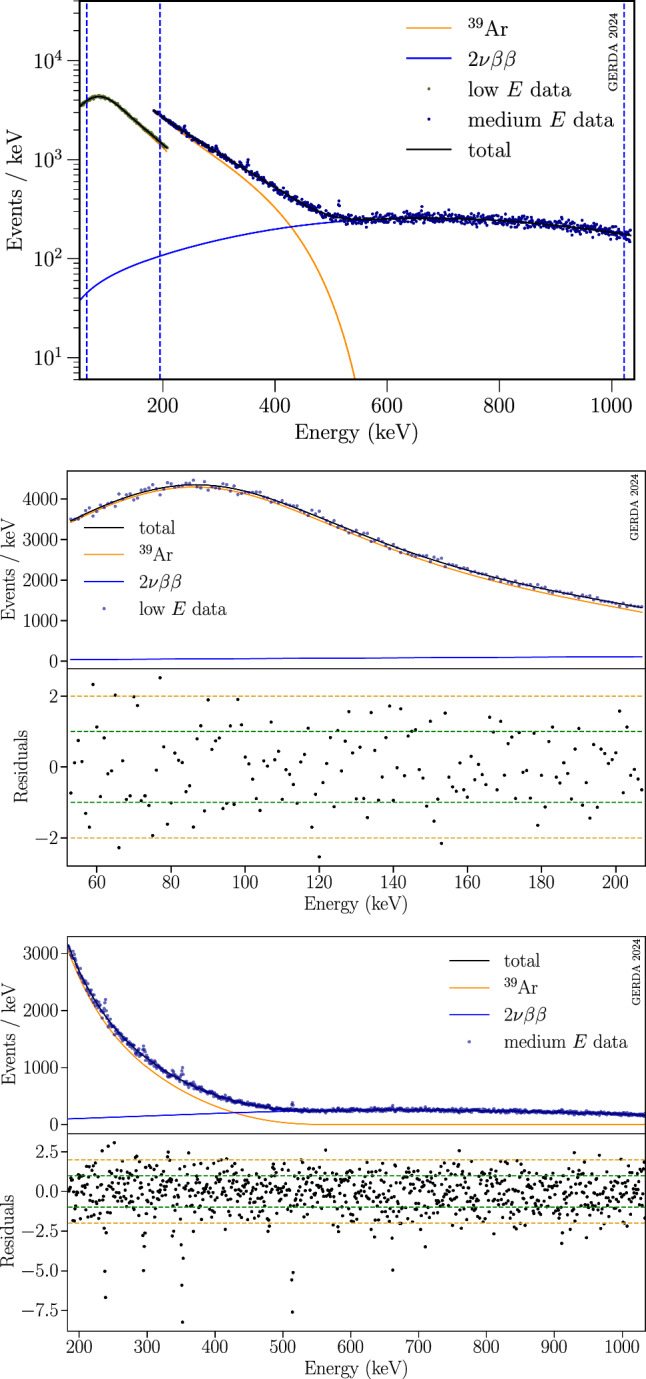
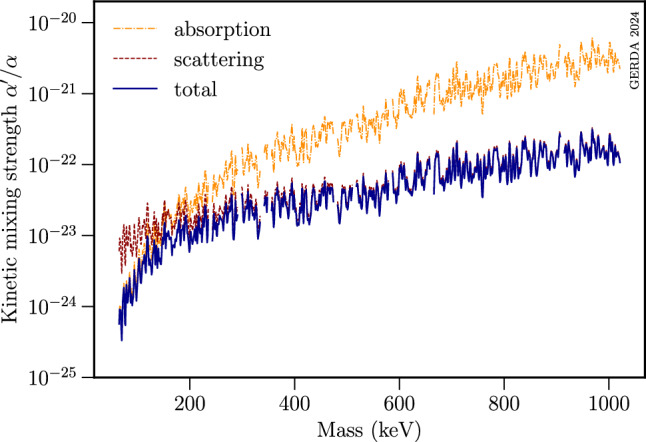
A search for full energy depositions from bosonic keV-scale dark matter candidates of masses between 65 and 1021 keV has been performed with data collected during Phase II of the GERmanium Detector Array (Gerda) experiment. Our analysis includes direct dark matter absorption as well as dark Compton scattering. With a total exposure of 105.5 kg years, no evidence for a signal above the background has been observed. The resulting exclusion limits deduced with either Bayesian or Frequentist statistics are the most stringent direct constraints in the major part of the 140-1021 keV mass range. As an example, at a mass of 150 keV the dimensionless coupling of dark photons and axion-like particles to electrons has been constrained to and at 90% credible interval (CI), respectively. Additionally, a search for peak-like signals from beyond the Standard Model decays of nucleons and electrons is performed. We find for the inclusive decay of a single neutron in Ge a lower lifetime limit of years and for a proton years at 90% CI. For the electron decay a lower limit of years at 90% CI has been determined.
The online version contains supplementary material available at 10.1140/epjc/s10052-024-13020-0.
利用锗探测器阵列(GERDA)实验第二阶段收集的数据,对质量在65至1021 keV之间的玻色子keV尺度暗物质候选体的全能量沉积进行了搜索。我们的分析包括直接暗物质吸收以及暗康普顿散射。在总曝光量为105.5千克年的情况下,未观察到高于背景的信号证据。用贝叶斯或频率统计推导得出的排除极限是140 - 1021 keV质量范围大部分区域内最严格的直接限制。例如,在质量为150 keV时,暗光子和类轴子粒子与电子的无量纲耦合在90%可信区间(CI)分别被限制为 和 。此外,还对超出标准模型的核子和电子衰变产生的峰状信号进行了搜索。我们发现在90% CI下,对于单个中子在 锗中的包容性衰变,寿命下限为 年,对于质子为 年。对于电子衰变 ,在90% CI下确定了下限为 年。
在线版本包含可在10.1140/epjc/s10052 - 024 - 13020 - 0获取的补充材料。