Paulo Bruno S, Recchia Michael J J, Lee Sanghoon, Fergusson Claire H, Romanowski Sean B, Hernandez Antonio, Krull Nyssa, Liu Dennis Y, Cavanagh Hannah, Bos Allyson, Gray Christopher A, Murphy Brian T, Linington Roger G, Eustaquio Alessandra S
Department of Pharmaceutical Sciences, College of Pharmacy, University of Illinois at Chicago Chicago IL 60607 USA
Center for Biomolecular Sciences, College of Pharmacy, University of Illinois at Chicago Chicago IL 60607 USA.
Chem Sci. 2024 Sep 13;15(40):16567-81. doi: 10.1039/d4sc03594a.
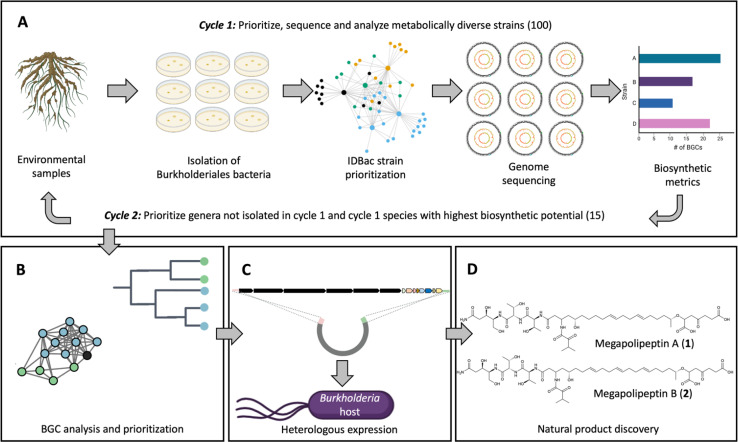
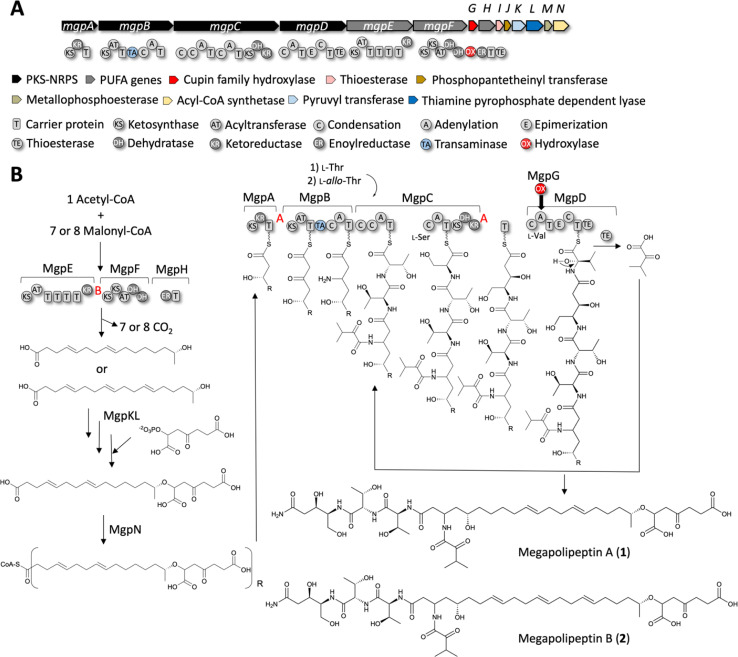
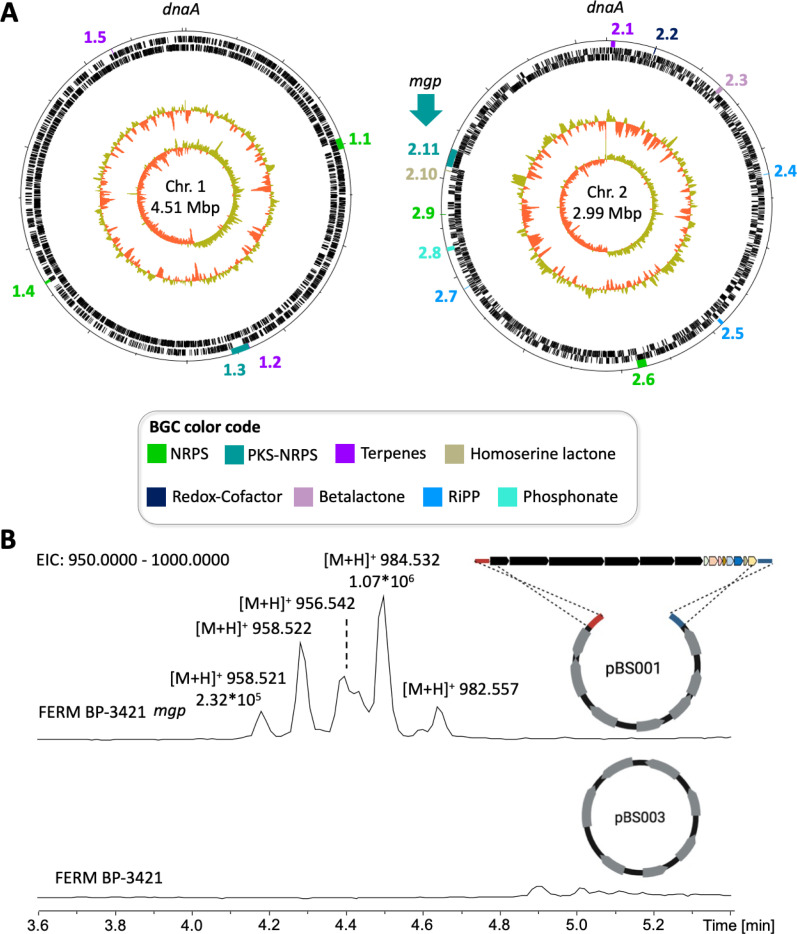
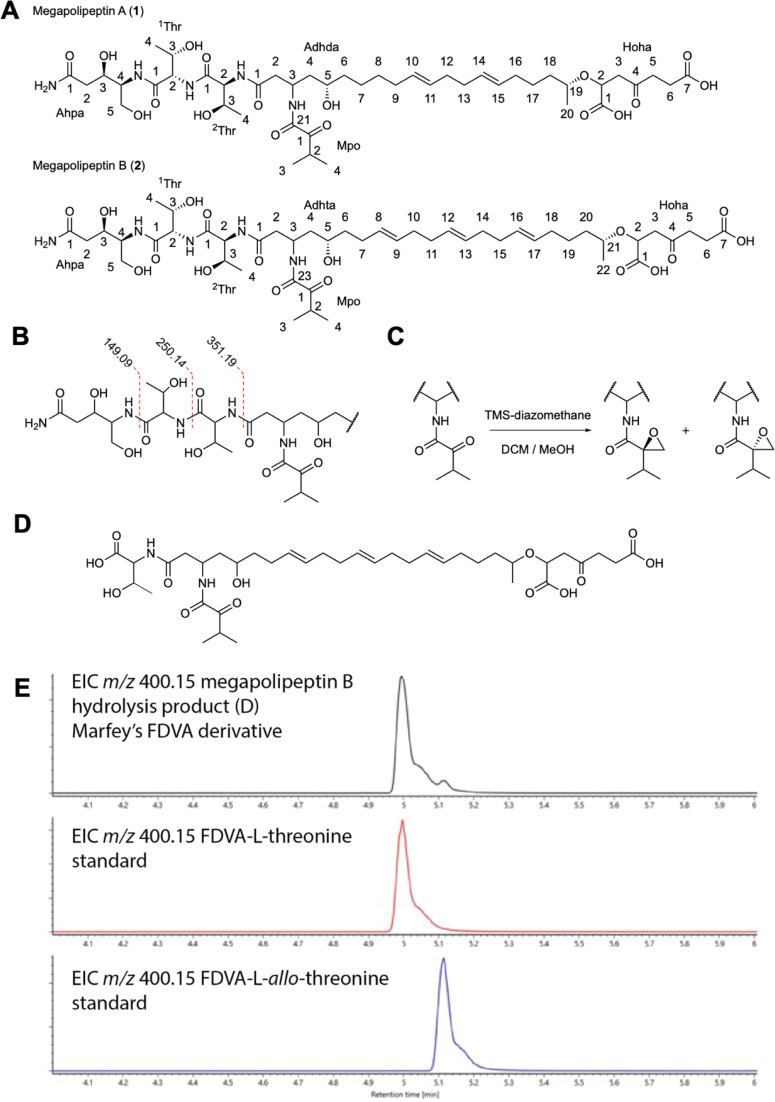
bacteria have emerged as a promising source of structurally diverse natural products that are expected to play important ecological and industrial roles. This order ranks in the top three in terms of predicted natural product diversity from available genomes, warranting further genome sequencing efforts. However, a major hurdle in obtaining the predicted products is that biosynthetic genes are often 'silent' or poorly expressed. Here we report complementary strain isolation, genomics, metabolomics, and synthetic biology approaches to enable natural product discovery. First, we built a collection of 316 rhizosphere-derived Burkholderiales strains over the course of five years. We then selected 115 strains for sequencing using the mass spectrometry pipeline IDBac to avoid strain redundancy. After predicting and comparing the biosynthetic potential of each strain, a biosynthetic gene cluster that was silent in the native and producers was cloned and activated by heterologous expression in a sp. host, yielding megapolipeptins A and B. Megapolipeptins are unusual polyketide, nonribosomal peptide, and polyunsaturated fatty acid hybrids that show low structural similarity to known natural products, highlighting the advantage of our genomics-driven and synthetic biology-enabled pipeline to discover novel natural products.
细菌已成为结构多样的天然产物的一个有前景的来源,这些天然产物有望发挥重要的生态和工业作用。就从现有基因组预测的天然产物多样性而言,这个目在排名中位列前三,因此值得进一步开展基因组测序工作。然而,获取预测产物的一个主要障碍是生物合成基因往往是“沉默的”或表达不佳。在此,我们报告了互补的菌株分离、基因组学、代谢组学和合成生物学方法,以实现天然产物的发现。首先,我们在五年时间里构建了一个由316株根际伯克霍尔德氏菌属菌株组成的集合。然后,我们使用质谱流程IDBac选择了115株菌株进行测序,以避免菌株冗余。在预测并比较了每个菌株的生物合成潜力后,一个在天然生产者和生产者中沉默的生物合成基因簇通过在一个宿主中进行异源表达而被克隆并激活,产生了巨多肽菌素A和B。巨多肽菌素是不寻常的聚酮化合物、非核糖体肽和多不饱和脂肪酸的杂合物,与已知天然产物的结构相似性较低,突出了我们基于基因组学驱动和合成生物学的流程在发现新型天然产物方面的优势。