Chen Jianwei, Sun Wenqian, Zhu Youjia, Zhao Feng, Deng Shuixiang, Tian Mi, Wang Yao, Gong Ye
Department of Critical Care Medicine, Huashan Hospital, Fudan University, Shanghai 200040, China.
J Intensive Med. 2024 Apr 1;4(4):442-452. doi: 10.1016/j.jointm.2024.01.008. eCollection 2024 Oct.
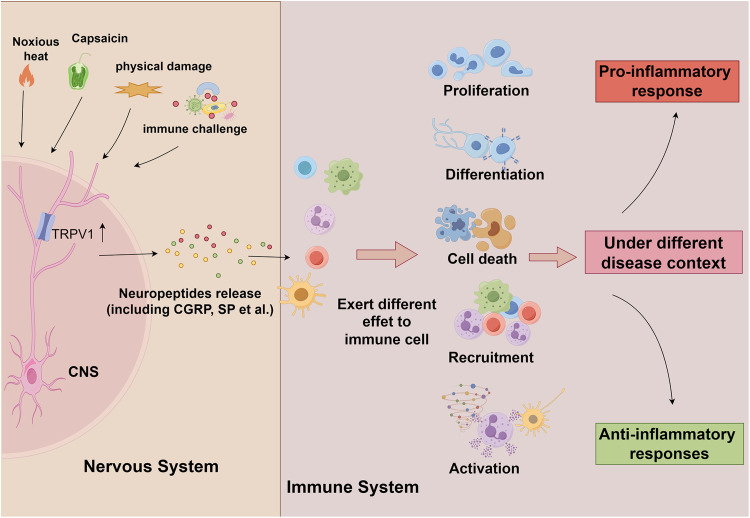
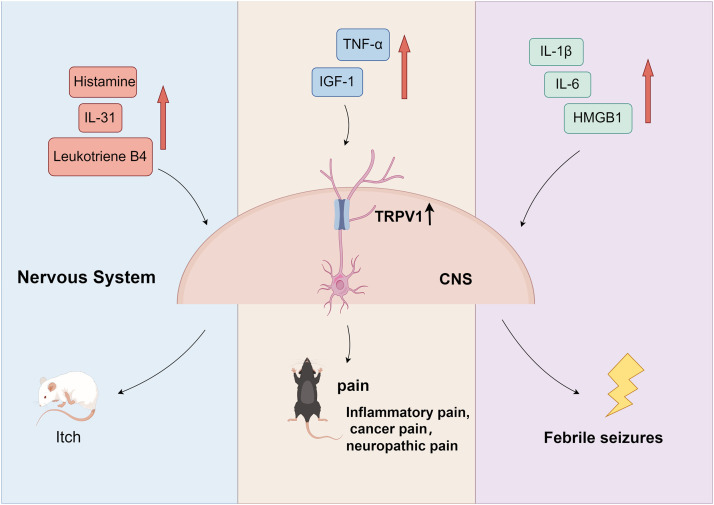
The nervous and immune systems are crucial in fighting infections and inflammation and in maintaining immune homeostasis. The immune and nervous systems are independent, yet tightly integrated and coordinated organizations. Numerous molecules and receptors play key roles in enabling communication between the two systems. Transient receptor potential vanilloid subfamily member 1 (TRPV1) is a non-selective cation channel, recently shown to be widely expressed in the neuroimmune axis and implicated in neuropathic pain, autoimmune disorders, and immune cell function. TRPV1 is a key bridge in neuroimmune interactions, allowing for smooth and convenient communication between the two systems. Here, we discuss the coordinated cross-talking between the immune and nervous systems and the functional role and the functioning manner of the TRPV1 involved. We suggest that TRPV1 provides new insights into the collaborative relationship between the nervous and immune systems, highlighting exciting opportunities for advanced therapeutic approaches to treating neurogenic inflammation and immune-mediated diseases.
神经系统和免疫系统在对抗感染和炎症以及维持免疫稳态方面至关重要。免疫系统和神经系统相互独立,但又是紧密整合与协调的组织。众多分子和受体在促成这两个系统之间的通信中发挥着关键作用。瞬时受体电位香草酸亚家族成员1(TRPV1)是一种非选择性阳离子通道,最近研究表明其在神经免疫轴中广泛表达,并与神经性疼痛、自身免疫性疾病及免疫细胞功能有关。TRPV1是神经免疫相互作用中的关键桥梁,使两个系统之间能够顺畅便捷地通信。在此,我们讨论免疫系统和神经系统之间的协同交互作用以及所涉及的TRPV1的功能作用和运作方式。我们认为,TRPV1为神经系统和免疫系统之间的协作关系提供了新的见解,凸显了治疗神经源性炎症和免疫介导疾病的先进治疗方法的令人兴奋的机会。