Das Subrata, Bhattacharya Namrata, Mahata Ritu, Ghosh Sudip, Bhar Anindya Sundar, Srivastava Pragati
Department of Obstetrics and Gynaecology, ESI PGI MSR, ESIC Medical College and ESIC Hospital and ODC (EZ), Kolkata, West Bengal, India.
Department of Community Medicine, Burdwan Medical College, Burdwan, West Bengal, India.
Int J Appl Basic Med Res. 2024 Jul-Sep;14(3):162-168. doi: 10.4103/ijabmr.ijabmr_81_24. Epub 2024 Aug 24.
Ovarian reserve and hence ovarian response has a key role in assisted reproductive technology and predicting response to gonadotrophins in controlled ovarian hyperstimulation. Various tools, namely follicle-stimulating hormone (FSH), anti-Mullerian hormone (AMH), antral follicle count (AFC), estradiol, etc., have been studied to discover the best determinant of ovarian reserve. The aim of our study is to correlate different reproductive hormones with age of women to estimate ovarian reserve and to evaluate reliable marker for aiding infertility treatment.
It is an observational study performed for 6 months, with 88 women (aged 21-39 years) having a complaint of infertility, enrolled in the infertility clinic of a tertiary care hospital. Baseline scan for AFC was done for every patient and their blood was sent for serum FSH, AMH analysis. Statistical procedures were employed to determine the association between age and reproductive hormones (i.e. FSH and AMH) as independent variables and AFC as a dependent variable.
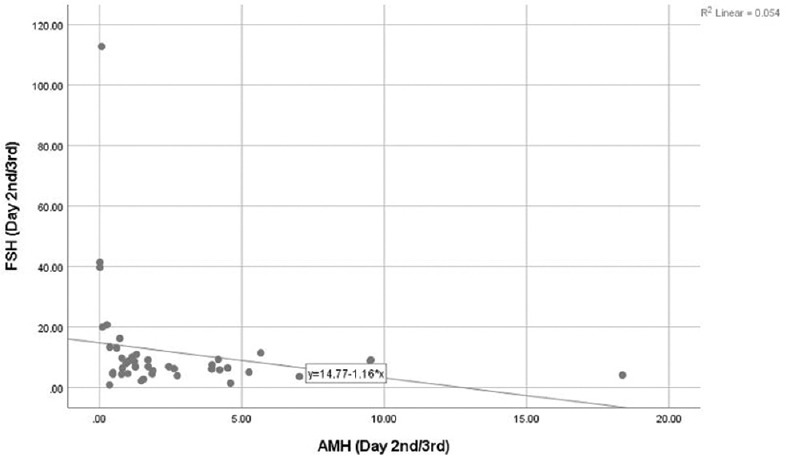
A strong negative correlation was noted between FSH and AMH and between age and AMH ( = -0.492 and = -0.498, respectively). A weak negative correlation was seen between AMH and total AFC ( = -0.241). A moderate positive correlation was seen on comparing age and FSH ( = 0.331), whereas no correlation was seen on comparing FSH with AFC and AMH with AFC. The presence of ovarian cyst did not affect AMH or AFC but reduced FSH values significantly.
In the quest to determine a panel test for ovarian reserve testing we conclude, FSH and AFC should perform fairly in poor resource and low socioeconomic setting. The combination of FSH with AMH and AFC might aid in better determination of ovarian reserve in tertiary centers with available resources.
卵巢储备以及由此产生的卵巢反应在辅助生殖技术中起着关键作用,并且在控制性卵巢刺激中预测对促性腺激素的反应。人们已经研究了各种工具,即促卵泡激素(FSH)、抗苗勒管激素(AMH)、窦卵泡计数(AFC)、雌二醇等,以发现卵巢储备的最佳决定因素。我们研究的目的是将不同的生殖激素与女性年龄相关联,以评估卵巢储备,并评估有助于不孕症治疗的可靠标志物。
这是一项为期6个月的观察性研究,88名年龄在21 - 39岁之间、有不孕问题的女性被纳入一家三级护理医院的不孕门诊。对每位患者进行AFC的基线扫描,并采集血液进行血清FSH、AMH分析。采用统计方法确定年龄与生殖激素(即FSH和AMH)作为自变量以及AFC作为因变量之间的关联。
FSH与AMH之间以及年龄与AMH之间存在强负相关(分别为r = -0.492和r = -0.498)。AMH与总AFC之间存在弱负相关(r = -0.241)。年龄与FSH比较呈中度正相关(r = 0.331),而FSH与AFC以及AMH与AFC比较无相关性。卵巢囊肿的存在不影响AMH或AFC,但显著降低FSH值。
在寻求确定卵巢储备检测的综合检测方法时,我们得出结论,在资源匮乏和社会经济水平较低的环境中,FSH和AFC应该表现良好。在有可用资源的三级中心,FSH与AMH和AFC的联合使用可能有助于更好地评估卵巢储备。