Department of Neurosurgery, Ruijin Hospital, Shanghai Jiaotong University School of Medicine, Shanghai 200025, China.
Department of Neurosurgery, Shanghai Tenth People's Hospital, Tongji University School of Medicine, Shanghai 200072, China.
Theranostics. 2024 Sep 3;14(14):5698-5724. doi: 10.7150/thno.97057. eCollection 2024.
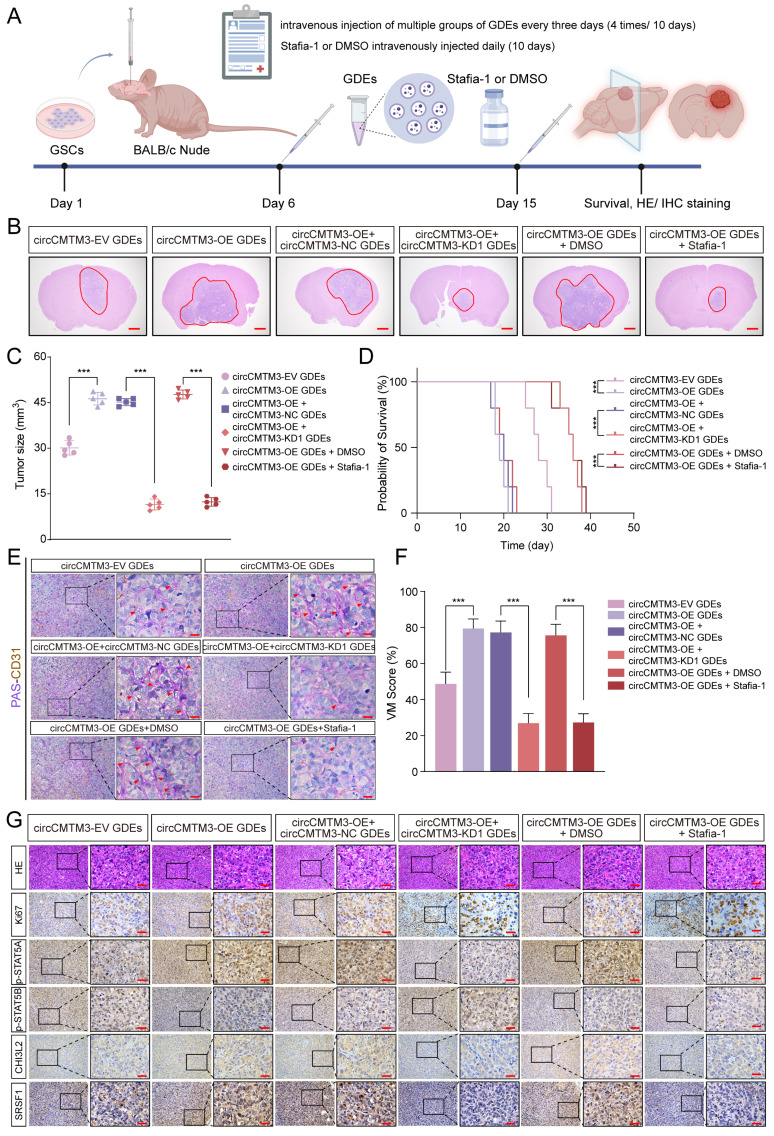
Glioblastoma (GBM) is characterized by abundant neovascularization as an essential hallmark. Vasculogenic mimicry (VM) is a predominant pattern of GBM neovascularization. However, the biological functions of circRNAs prompting VM formation in GBM remains unclarified. The circular RNA circCMTM3 was identified through high-throughput sequencing and bioinformatics analysis. The expression of circCMTM3 in exosomes in glioma tissues and cells was verified via RT-qPCR and FISH. In vitro and in vivo assays, such as EdU, MTS, Transwell, and tube formation assays were performed to investigate functional roles of circCMTM3. Meanwhile, in situ tumorigenesis assay were implemented to explore the influences of circCMTM3 on the GBM progression. Additionally, RNA pull-down, RIP, ChIP, and dual-luciferase reporter gene assays were executed to confirm the underlying regulation mechanism of circCMTM3. CircCMTM3, as a novel circular RNA, was packaged into exosomes derived from glioblastoma stem cells (GSCs), which facilitates the phenotypic transition of differentiated glioma cells (DGCs) to VM. Mechanistically, exosomal circCMTM3 is internalized by DGCs and disrupt the ubiquitination degradation of STAT5A and STAT5B by E3 ubiquitin ligase CNOT4. Additionally, through molecular scaffold function of circCMTM3, STAT5A is activated and triggers transcriptional regulation of target genes including the pro-vasculogenic factor CHI3L2 and the RNA-binding protein SRSF1. Subsequently, circCMTM3/STAT5A/SRSF1 positive feedback loop sustainably enhances VM formation and accelerates tumor progression in GBM. Exosomal circCMTM3 possessing growth factor-mimetic property activates the JAK2/STAT5A pathway via non-canonical manner, and promotes VM formation in GBM. The molecular communications between GSCs and DGCs offers a therapeutic strategy for targeting the neovascularization of GBM.
胶质母细胞瘤(GBM)的一个重要特征是丰富的新生血管形成。血管生成拟态(VM)是 GBM 新生血管形成的主要模式。然而,circRNA 促使 GBM 中 VM 形成的生物学功能仍不清楚。通过高通量测序和生物信息学分析,鉴定出环状 RNA circCMTM3。通过 RT-qPCR 和 FISH 验证了 circCMTM3 在胶质瘤组织和细胞外泌体中的表达。通过 EdU、MTS、Transwell 和管形成实验等体外和体内实验研究 circCMTM3 的功能作用。同时,进行原位成瘤实验探讨 circCMTM3 对 GBM 进展的影响。此外,还进行了 RNA 下拉、RIP、ChIP 和双荧光素酶报告基因实验以证实 circCMTM3 的潜在调控机制。circCMTM3 作为一种新型环状 RNA,被包装到源自神经胶质瘤干细胞(GSCs)的外泌体中,促进了分化的神经胶质瘤细胞(DGCs)向 VM 的表型转变。在机制上,外泌体 circCMTM3 被 DGCs 内化,并通过 E3 泛素连接酶 CNOT4 破坏 STAT5A 和 STAT5B 的泛素化降解。此外,通过 circCMTM3 的分子支架功能,激活 STAT5A,并触发包括促血管生成因子 CHI3L2 和 RNA 结合蛋白 SRSF1 在内的靶基因的转录调控。随后,circCMTM3/STAT5A/SRSF1 正反馈循环可持续增强 VM 形成并加速 GBM 中的肿瘤进展。具有生长因子模拟特性的外泌体 circCMTM3 通过非经典途径激活 JAK2/STAT5A 通路,促进 GBM 中的 VM 形成。GSCs 和 DGCs 之间的分子通讯为靶向 GBM 新生血管提供了一种治疗策略。