Sustainable Food Processing Laboratory, Institute of Food, Nutrition, and Health, Department of Health Science and Technology, ETH Zurich, Zurich, Switzerland.
Univ Brest, INRAE, Laboratoire Universitaire de Biodiversité et Écologie Microbienne, UMT ACTIA 19.03 ALTER'iX, Quimper, France.
Appl Environ Microbiol. 2024 Oct 23;90(10):e0229923. doi: 10.1128/aem.02299-23. Epub 2024 Sep 23.
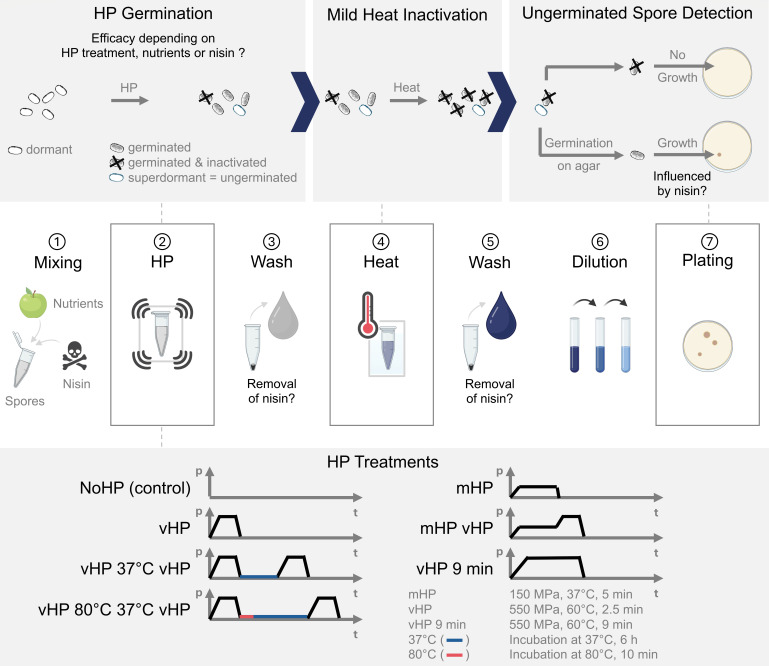
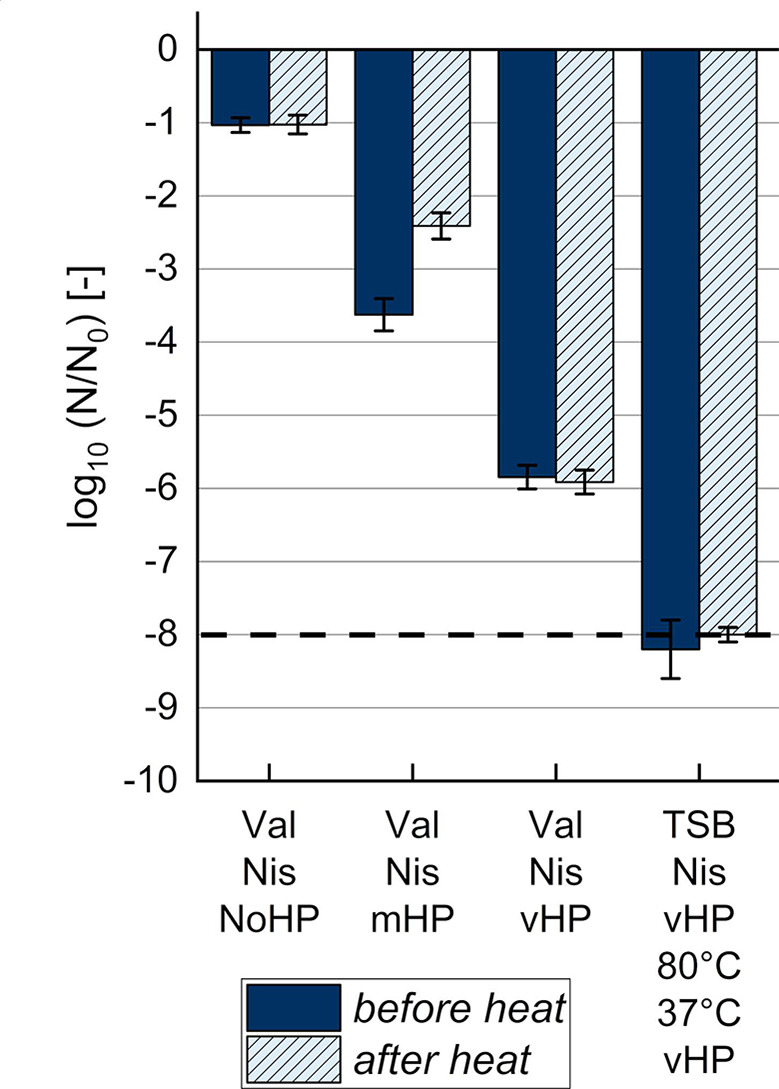
The major challenge in employing high pressure (HP) at moderate temperature for sterilization is the remarkable resistance of bacterial spores. High isostatic pressure can initiate spore germination, enabling subsequent inactivation under mild conditions. However, not all spores could be triggered to germinate under pressure at temperatures ≤80°C so far. In this study, germination treatment combinations were evaluated for spores involving moderate HP (150 MPa, 37°C, 5 min), very HP (vHP, 550 MPa, 60°C, 2.5 or 9 min), simple and complex nutrient germinants [L-valine, L-alanine, and tryptic soy broth (TSB)], nisin, and incubation at atmospheric pressure (37°C). The most effective combinations for resulted in a reduction of culturable dormant spores by 8 log units. The combinations involved nisin, a nutrient germinant (L-valine or TSB), a first vHP treatment (550 MPa, 60°C, 2.5 min), incubation at atmospheric pressure (37°C, 6 h), and a second vHP treatment (550 MPa, 60°C, 2.5 min). Such treatment combination with L-valine reduced spores by only 2 log units. thus, proved to be substantially more HP-resistant compared to , validating previous studies. Despite combining different germination mechanisms, complete germination could not be achieved for either species. The natural bacteriocin nisin did seemingly not promote HP germination initiation under chosen HP conditions, contrary to previous literature. Nevertheless, nisin might be beneficial to inhibit the growth of HP-germinated or remaining ungerminated spores. Future germination experiments might consider that nisin could not be completely removed from spores by washing, thereby affecting plate count enumeration.
Extremely resistant spore-forming bacteria are widely distributed in nature. They infiltrate the food chain and processing environments, posing risks of spoilage and food safety. Traditional heat-intensive inactivation methods often negatively affect the product quality. HP germination-inactivation offers a potential solution for better preserving sensitive ingredients while inactivating spores. However, the presence of ungerminated (superdormant) spores hampers the strategy's success and safety. Knowledge of strategies to overcome resistance to HP germination is vital to progress mild spore control technologies. Our study contributes to the evaluation and development of mild preservation processes by evaluating strategies to enhance the HP germination-inactivation efficacy. Mild preservation processes can fulfill the consumers' demand for safe and minimally processed food.
在中温下使用高压 (HP) 进行灭菌的主要挑战是细菌孢子的显著抗性。高静压可以引发孢子萌发,从而在温和条件下实现随后的失活。然而,到目前为止,并非所有孢子都能在温度≤80°C 的压力下被触发萌发。在这项研究中,评估了涉及 moderate HP(150 MPa,37°C,5 min)、very HP(vHP,550 MPa,60°C,2.5 或 9 min)、简单和复杂营养发芽剂 [L-缬氨酸、L-丙氨酸和胰蛋白酶大豆肉汤 (TSB)]、乳链菌肽和在大气压(37°C)下孵育的 孢子的发芽处理组合。对于 ,最有效的组合导致可培养休眠孢子减少 8 个对数单位。涉及乳链菌肽、营养发芽剂(L-缬氨酸或 TSB)、第一次 vHP 处理(550 MPa,60°C,2.5 min)、在大气压下孵育(37°C,6 h)和第二次 vHP 处理(550 MPa,60°C,2.5 min)的组合。这样的处理组合用 L-缬氨酸处理可使 孢子减少 2 个对数单位。因此,与之前的研究一致,与 相比, 被证明具有更高的 HP 抗性。尽管结合了不同的发芽机制,但对于任何一种物种都不能完全实现发芽。天然细菌素乳链菌肽在所选 HP 条件下似乎没有促进 HP 发芽起始,与之前的文献相反。然而,乳链菌肽可能有利于抑制 HP 发芽或未发芽的孢子生长。未来的发芽实验可能需要考虑到乳链菌肽不能通过洗涤从孢子中完全去除,从而影响平板计数计数。
具有极强抗性的孢子形成细菌广泛分布于自然界中。它们渗透食物链和加工环境,对变质和食品安全构成威胁。传统的高温密集型灭活方法通常会对产品质量产生负面影响。HP 发芽-失活为更好地保存敏感成分同时灭活孢子提供了一种潜在的解决方案。然而,未发芽(超休眠)孢子的存在阻碍了该策略的成功和安全性。了解克服 HP 发芽抗性的策略对于推进温和孢子控制技术至关重要。我们的研究通过评估增强 HP 发芽-失活功效的策略,为评估和开发温和保存工艺做出了贡献。温和的保存过程可以满足消费者对安全和低加工食品的需求。