• 文献检索
  • 文档翻译
  • 深度研究
  • 学术资讯
  • Suppr Zotero 插件Zotero 插件
  • 邀请有礼
  • 套餐&价格
  • 历史记录
应用&插件
Suppr Zotero 插件Zotero 插件浏览器插件Mac 客户端Windows 客户端微信小程序
定价
高级版会员购买积分包购买API积分包
服务
文献检索文档翻译深度研究API 文档MCP 服务
关于我们
关于 Suppr公司介绍联系我们用户协议隐私条款
关注我们

Suppr 超能文献

核心技术专利:CN118964589B侵权必究
粤ICP备2023148730 号-1Suppr @ 2026

文献检索

告别复杂PubMed语法,用中文像聊天一样搜索,搜遍4000万医学文献。AI智能推荐,让科研检索更轻松。

立即免费搜索

文件翻译

保留排版,准确专业,支持PDF/Word/PPT等文件格式,支持 12+语言互译。

免费翻译文档

深度研究

AI帮你快速写综述,25分钟生成高质量综述,智能提取关键信息,辅助科研写作。

立即免费体验

现场模拟培训对产后稳定和复苏质量的影响——前后对照、非对照质量改进研究。

Impact of in situ simulation training on quality of postnatal stabilization and resuscitation-a before-and-after, non-controlled quality improvement study.

机构信息

Division of Neonatology, Department of Paediatrics and Adolescent Medicine, Medical University of Graz, Auenbruggerplatz 34/2, 8036, Graz, Austria.

Paediatric Simulation Group Graz, Department of Paediatrics and Adolescent Medicine, Medical University of Graz, Graz, Austria.

出版信息

Eur J Pediatr. 2024 Nov;183(11):4981-4990. doi: 10.1007/s00431-024-05781-3. Epub 2024 Sep 23.

DOI:10.1007/s00431-024-05781-3
PMID:39311967
原文链接:https://pmc.ncbi.nlm.nih.gov/articles/PMC11473610/
Abstract

UNLABELLED

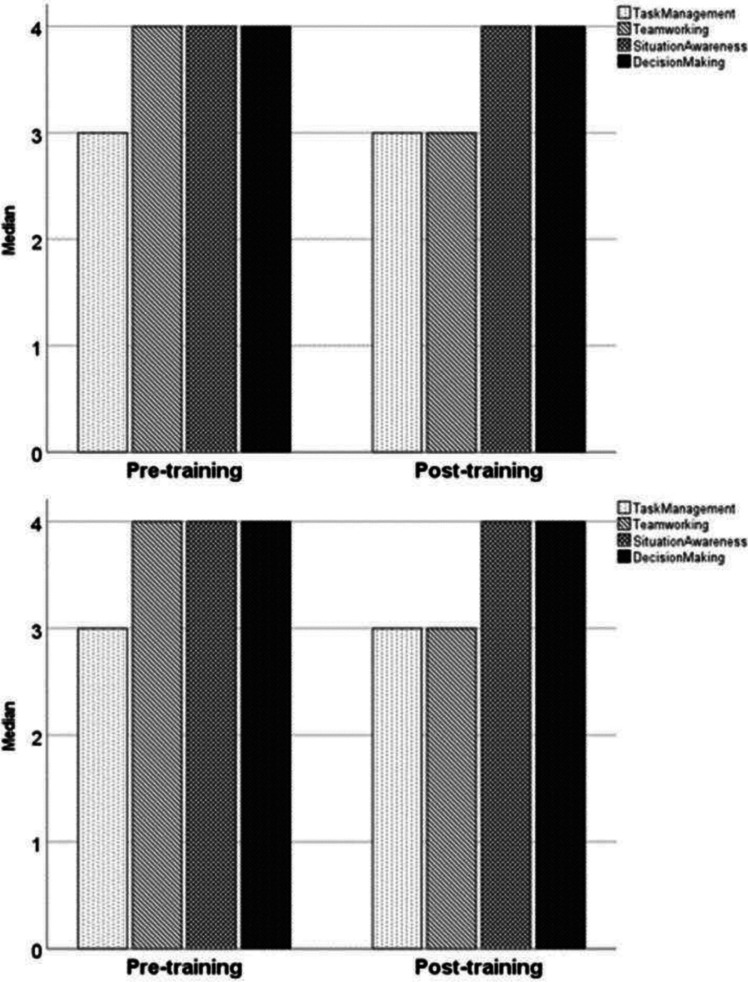
This study aimed to evaluate the impact of in situ simulation-based training on quality indicators of patient care at a level IV neonatal intensive care unit. A before-and-after, non-controlled quality improvement study was performed at the Division of Neonatology, Medical University of Graz. The educational intervention comprised a period of 4 months, with structured in situ simulation training delivered regularly for neonatal providers and nurses in interprofessional teams. The primary study outcome was the quality of non-technical skills and team interaction during actual postnatal stabilization and resuscitation. This was assessed using video recording during two 2-month observational phases before (pre-training) and after the educational intervention (post-training). Delivery room video recordings were assessed by two external, blinded neonatologists using the Anaesthetists' Non-Technical Skills (ANTS) score. Furthermore, we collected clinical patient data from video-recorded neonates during the pre- and post-training periods, and training participants' individual knowledge of neonatal resuscitation guidelines was assessed using a before- and after-questionnaire. A total of 48 healthcare professionals participated in 41 in situ simulation trainings. The level of non-technical skills and team interaction was already high in the pre-training period, and it did not further improve afterwards. Nonetheless, we observed a significant increase in the teamwork event "evaluation of plans" (0.5 [IQR 0.0-1.0] versus 1.0 [1.0-2.0], p = 0.049). Following the educational intervention, training participants' knowledge of neonatal resuscitation guidelines significantly improved, although there were no differences in secondary clinical outcome parameters.

CONCLUSION

We have successfully implemented a neonatal in situ simulation training programme. The observed improvement in one teamwork event category in the post-training period demonstrates the effectiveness of the training curriculum, while also showing the potential of in situ simulation training for improving postnatal care and, ultimately, patient outcome.

WHAT IS KNOWN

• In situ simulation-based training is conducted in the real healthcare environment, thus promoting experiential learning which is closely aligned with providers' actual work. • In situ simulation-based training may offer an additional benefit for patient outcomes in comparison to other instructional methodologies.

WHAT IS NEW

• This observational study investigated translational patient outcomes in preterm neonates before and after delivery of high-frequency in situ simulation-based training at a level IV neonatal intensive care unit. • There was a significant increase in the frequency of one major teamwork event following the delivery of in situ simulation-based training, indicating a notable improvement in the non-technical skills domain, which is closely linked to actual team performance.

摘要

目的

本研究旨在评估四级新生儿重症监护病房(NICU)中基于现场模拟的培训对患者护理质量指标的影响。在格拉茨医科大学新生儿科进行了一项前后非对照的质量改进研究。教育干预包括 4 个月的时间,以结构化的现场模拟培训定期为新生儿提供者和护士提供,以跨专业团队的形式进行。主要研究结果是实际出生后稳定和复苏期间非技术技能和团队互动的质量。这是通过在教育干预前(培训前)和后(培训后)的两个 2 个月观察阶段期间的视频记录来评估的。使用麻醉师非技术技能(ANTS)评分,由两名外部、盲目的新生儿科医生评估产房视频记录。此外,我们还从培训前和培训后的视频记录中收集了视频记录中新生儿的临床患者数据,使用培训前和培训后的问卷评估了培训参与者对新生儿复苏指南的个人知识。共有 48 名医疗保健专业人员参加了 41 次现场模拟培训。在培训前,非技术技能和团队互动的水平已经很高,之后并没有进一步提高。尽管如此,我们观察到团队合作事件“评估计划”的显著增加(0.5 [IQR 0.0-1.0] 与 1.0 [1.0-2.0],p=0.049)。教育干预后,培训参与者对新生儿复苏指南的知识显著提高,尽管次要临床结局参数没有差异。

结论

我们已经成功实施了新生儿现场模拟培训计划。在培训后观察到的一个团队合作事件类别的改善表明了培训课程的有效性,同时也展示了现场模拟培训在提高出生后护理和最终改善患者结局方面的潜力。

已知内容

·现场模拟培训是在实际医疗环境中进行的,因此促进了与提供者实际工作密切相关的体验式学习。

·与其他教学方法相比,现场模拟培训可能为患者结局提供额外的益处。

新内容

·本观察性研究在四级 NICU 中进行现场模拟培训前后,调查了早产儿的翻译患者结局。

·现场模拟培训后,一个主要团队合作事件的发生频率显著增加,表明非技术技能领域有了显著改善,这与实际团队表现密切相关。
https://cdn.ncbi.nlm.nih.gov/pmc/blobs/463c/11473610/5738307106e4/431_2024_5781_Fig2_HTML.jpg
https://cdn.ncbi.nlm.nih.gov/pmc/blobs/463c/11473610/038bdeec32bb/431_2024_5781_Fig1_HTML.jpg
https://cdn.ncbi.nlm.nih.gov/pmc/blobs/463c/11473610/5738307106e4/431_2024_5781_Fig2_HTML.jpg
https://cdn.ncbi.nlm.nih.gov/pmc/blobs/463c/11473610/038bdeec32bb/431_2024_5781_Fig1_HTML.jpg
https://cdn.ncbi.nlm.nih.gov/pmc/blobs/463c/11473610/5738307106e4/431_2024_5781_Fig2_HTML.jpg

相似文献

1
Impact of in situ simulation training on quality of postnatal stabilization and resuscitation-a before-and-after, non-controlled quality improvement study.现场模拟培训对产后稳定和复苏质量的影响——前后对照、非对照质量改进研究。
Eur J Pediatr. 2024 Nov;183(11):4981-4990. doi: 10.1007/s00431-024-05781-3. Epub 2024 Sep 23.
2
Effectiveness of simulation-based interprofessional education on teamwork and communication skills in neonatal resuscitation.基于模拟的跨专业教育对新生儿复苏中团队合作和沟通技巧的有效性。
BMC Med Educ. 2024 May 31;24(1):602. doi: 10.1186/s12909-024-05581-1.
3
Using video to assess and improve patient safety during simulated and actual neonatal resuscitation.利用视频评估和改善模拟及实际新生儿复苏过程中的患者安全。
Semin Perinatol. 2019 Dec;43(8):151179. doi: 10.1053/j.semperi.2019.08.008. Epub 2019 Aug 10.
4
Simulation-Based Training Program to Improve Cardiopulmonary Resuscitation and Teamwork Skills for the Urgent Care Clinic Staff.基于模拟的培训计划,以提高紧急护理诊所工作人员的心肺复苏和团队合作技能。
Mil Med. 2022 May 3;187(5-6):e764-e769. doi: 10.1093/milmed/usab198.
5
In situ simulation training for neonatal resuscitation: an RCT.现场模拟培训在新生儿复苏中的应用:一项 RCT 研究。
Pediatrics. 2014 Sep;134(3):e790-7. doi: 10.1542/peds.2013-3988. Epub 2014 Aug 4.
6
Simulation in neonatal care: towards a change in traditional training?新生儿护理模拟:传统培训的变革之路?
Eur J Pediatr. 2022 Apr;181(4):1429-1436. doi: 10.1007/s00431-022-04373-3. Epub 2022 Jan 12.
7
Video performance-debriefings and ventilation-refreshers improve quality of neonatal resuscitation.视频操作反馈和通气更新可提高新生儿复苏质量。
Resuscitation. 2018 Nov;132:140-146. doi: 10.1016/j.resuscitation.2018.07.013. Epub 2018 Jul 18.
8
Effect of a simulation-based workshop on multidisplinary teamwork of newborn emergencies: an intervention study.基于模拟的研讨会对新生儿紧急情况多学科团队合作的影响:一项干预性研究。
BMC Res Notes. 2015 Nov 12;8:671. doi: 10.1186/s13104-015-1654-2.
9
Enhancing residents' neonatal resuscitation competency through team-based simulation training: an intervention educational study.通过基于团队的模拟培训提高住院医师新生儿复苏能力:一项干预性教育研究。
BMC Med Educ. 2023 Oct 10;23(1):743. doi: 10.1186/s12909-023-04704-4.
10
Improved Clinical Performance and Teamwork of Pediatric Interprofessional Resuscitation Teams With a Simulation-Based Educational Intervention.基于模拟的教育干预可提高儿科跨专业复苏团队的临床绩效和团队协作能力。
Pediatr Crit Care Med. 2017 Feb;18(2):e62-e69. doi: 10.1097/PCC.0000000000001025.

引用本文的文献

1
Acceptance and implementation of evidence-based practices in delivery room resuscitation: A qualitative study.产房复苏中基于证据的实践的接受与实施:一项定性研究。
SSM Qual Res Health. 2025 Jun;7. doi: 10.1016/j.ssmqr.2025.100557. Epub 2025 Apr 1.
2
Effectiveness of non-technical skills training in intensive care units: a systematic review.重症监护病房非技术技能培训的有效性:一项系统综述。
BMC Med Educ. 2025 Jun 6;25(1):847. doi: 10.1186/s12909-025-07037-6.
3
In situ simulation for cardiopulmonary resuscitation training: A systematic review.

本文引用的文献

1
[Latent safety threats in a pediatric emergency department: Using in situ simulation to test a new trauma room concept].[儿科急诊科的潜在安全威胁:运用现场模拟测试新的创伤室概念]
Z Evid Fortbild Qual Gesundhwes. 2024 Jun;187:15-21. doi: 10.1016/j.zefq.2024.03.005. Epub 2024 Apr 21.
2
Development and applications of the Anaesthetists' Non-Technical Skills behavioural marker system: a systematic review.麻醉师非技术技能行为标记系统的开发与应用:系统评价。
BMJ Open. 2024 Mar 20;14(3):e075019. doi: 10.1136/bmjopen-2023-075019.
3
Teamwork matters: team situation awareness to build high-performing healthcare teams, a narrative review.
用于心肺复苏培训的现场模拟:一项系统综述
Resusc Plus. 2025 Jan 3;21:100863. doi: 10.1016/j.resplu.2024.100863. eCollection 2025 Jan.
团队合作至关重要:团队情境意识构建高绩效医疗团队,叙述性综述。
Br J Anaesth. 2024 Apr;132(4):771-778. doi: 10.1016/j.bja.2023.12.035. Epub 2024 Feb 2.
4
Educational and Patient Care Impacts of In Situ Simulation in Healthcare: A Systematic Review.医疗环境中现场模拟的教育和患者护理影响:系统评价。
Simul Healthc. 2024 Jan 1;19(1S):S23-S31. doi: 10.1097/SIH.0000000000000773.
5
Sustained decrease in latent safety threats through regular interprofessional in situ simulation training of neonatal emergencies.通过定期跨专业现场模拟新生儿急症培训,持续减少潜在安全威胁。
BMJ Open Qual. 2023 Dec 28;12(4):e002567. doi: 10.1136/bmjoq-2023-002567.
6
Standards for Levels of Neonatal Care: II, III, and IV.新生儿护理级别标准:II级、III级和IV级。
Pediatrics. 2023 Jun 1;151(6). doi: 10.1542/peds.2023-061957.
7
Impact of Quality Improvement Bundle on Compliance with Resuscitation Guidelines during In-Hospital Cardiac Arrest in Children.质量改进套餐对儿童院内心脏骤停期间复苏指南依从性的影响。
Crit Care Res Pract. 2023 Mar 9;2023:6875754. doi: 10.1155/2023/6875754. eCollection 2023.
8
Teamwork and Adherence to Guideline on Newborn Resuscitation-Video Review of Neonatal Interdisciplinary Teams.团队合作与新生儿复苏指南的遵循——新生儿跨学科团队的视频回顾
Front Pediatr. 2022 Feb 21;10:828297. doi: 10.3389/fped.2022.828297. eCollection 2022.
9
Simulation in neonatal care: towards a change in traditional training?新生儿护理模拟:传统培训的变革之路?
Eur J Pediatr. 2022 Apr;181(4):1429-1436. doi: 10.1007/s00431-022-04373-3. Epub 2022 Jan 12.
10
A critical appraisal of tools for delivery room assessment of the newborn infant.对新生儿产房评估工具的批判性评价。
Pediatr Res. 2024 Aug;96(3):625-631. doi: 10.1038/s41390-021-01896-7. Epub 2021 Dec 30.