Padovani Alessandro, Caratozzolo Salvatore, Galli Alice, Crosani Luca, Zampini Silvio, Cosseddu Maura, Turrone Rosanna, Zancanaro Andrea, Gumina Bianca, Vicini-Chilovi Barbara, Benussi Alberto, Vyshedskiy Andrey, Pilotto Andrea
Neurology Unit, Department of Clinical and Experimental Sciences, University of Brescia, Brescia, Italy.
Department of continuity of care and frailty, Neurology Unit, ASST Spedali Civili Hospital, Brescia, Italy.
Neurol Sci. 2025 Feb;46(2):697-704. doi: 10.1007/s10072-024-07775-3. Epub 2024 Sep 24.
The Boston Cognitive Assessment (BOCA) is a self-administered online test developed for cognitive screening and longitudinal monitoring of brain health in an aging population. The study aimed to validate BOCA in an Italian population and to investigate the convergent validity with the Montreal Cognitive Assessment (MOCA) in healthy ageing population and patients within the Alzheimer Disease spectrum.
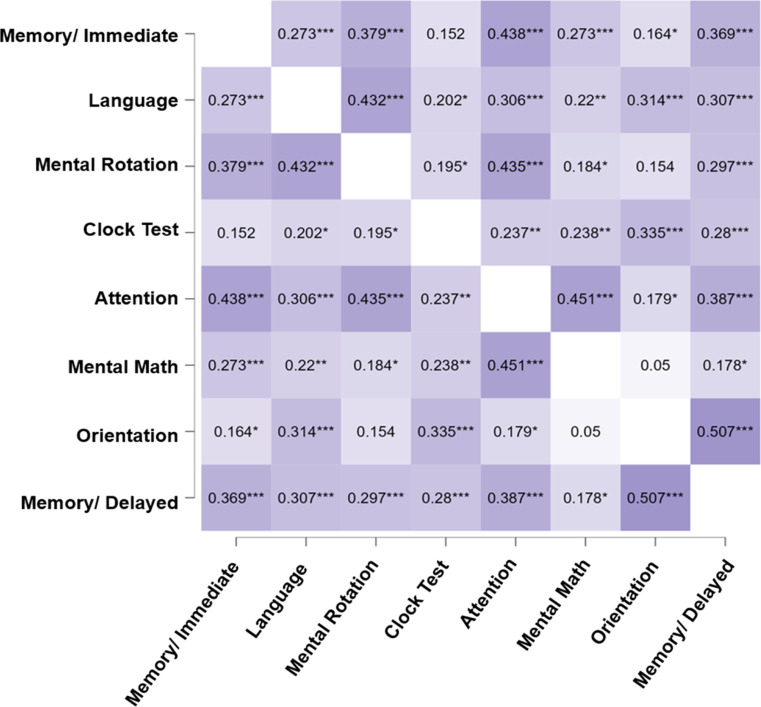
BOCA was administered to 150 participants, including cognitively healthy controls (HC, n = 50), patients with mild cognitive impairment (MCI, n = 50), and dementia (DEM, n = 50). The BOCA reliability was assessed using (i) Spearman's correlation analysis between subscales; (ii) Cronbach's alpha calculation, and (iii) Principal Component Analysis. Repeated-measures ANOVA was employed to assess the impact of the sequence of test administrations between the groups. BOCA performance between HS, MCI and DEM and within different severity subgroups were compared using Kruskall Wallis test. Furthermore, a comparison was conducted between MCI patients who tested positive for amyloid and those who tested negative, utilizing Mann Whitney's U-test.
Test scores were significantly different between patients and controls (p < 0.001) suggesting good discriminative ability. The Cronbach's alpha was 0.82 indicating a good internal consistency of the BOCA subscales and strong-to-moderate Spearman's correlation coefficients between them. BOCA total and subscores differ across different MoCA severity subgroups and demonstrated strong correlation with MoCA scores (rho = 0.790, p < 0.001).
The Italian version of the BOCA test exhibited validity, feasibility, and accurate discrimination closely performing as MoCA.
波士顿认知评估(BOCA)是一种用于老年人群认知筛查和脑健康纵向监测的自施式在线测试。本研究旨在验证BOCA在意大利人群中的有效性,并调查其在健康老年人群和阿尔茨海默病谱系患者中与蒙特利尔认知评估(MOCA)的收敛效度。
对150名参与者进行了BOCA测试,包括认知健康对照组(HC,n = 50)、轻度认知障碍患者(MCI,n = 50)和痴呆患者(DEM,n = 50)。使用(i)分量表之间的斯皮尔曼相关性分析;(ii)克朗巴哈α系数计算;以及(iii)主成分分析来评估BOCA的可靠性。采用重复测量方差分析来评估测试施测顺序对各组的影响。使用克鲁斯卡尔 - 沃利斯检验比较HS、MCI和DEM组之间以及不同严重程度亚组内的BOCA表现。此外,利用曼 - 惠特尼U检验对淀粉样蛋白检测呈阳性和阴性的MCI患者进行比较。
患者与对照组之间的测试分数存在显著差异(p < 0.001),表明具有良好的区分能力。克朗巴哈α系数为0.82,表明BOCA分量表具有良好的内部一致性,且它们之间的斯皮尔曼相关系数为强到中度。BOCA总分和分项得分在不同的MoCA严重程度亚组中存在差异,并与MoCA分数显示出强相关性(rho = 0.790,p < 0.001)。
意大利版的BOCA测试表现出有效性、可行性和准确的区分能力,与MoCA表现相近。