German Jakob, Cordioli Mattia, Tozzo Veronica, Urbut Sarah, Arumäe Kadri, Smit Roelof A J, Lee Jiwoo, Li Josephine H, Janucik Adrian, Ding Yi, Akinkuolie Akintunde, Heyne Henrike, Eoli Andrea, Saad Chadi, Al-Sarraj Yasser, Abdel-Latif Rania, Mohammed Shaban, Hail Moza Al, Barry Alexandra, Wang Zhe, Cajuso Tatiana, Corbetta Andrea, Natarajan Pradeep, Ripatti Samuli, Philippakis Anthony, Szczerbinski Lukasz, Pasaniuc Bogdan, Kutalik Zoltan, Mbarek Hamdi, Loos Ruth J F, Vainik Uku, Ganna Andrea
Institute for Molecular Medicine Finland (FIMM), University of Helsinki, Helsinki, Finland.
Eric and Wendy Schmidt Center, Broad Institute of MIT and Harvard, Cambridge, MA, USA, 02142.
medRxiv. 2025 Jan 8:2024.09.11.24313458. doi: 10.1101/2024.09.11.24313458.
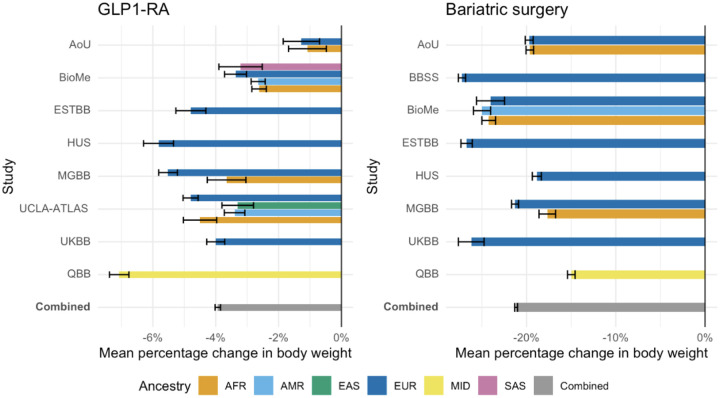
Obesity is a significant public health concern. GLP-1 receptor agonists (GLP1-RA), predominantly in use as a type 2 diabetes treatment, are a promising pharmacological approach for weight loss, while bariatric surgery (BS) remains a durable, but invasive, intervention. Despite observed heterogeneity in weight loss effects, the genetic effects on weight loss from GLP1-RA and BS have not been extensively explored in large sample sizes, and most studies have focused on differences in race and ethnicity, rather than genetic ancestry. We studied whether genetic factors, previously shown to affect body weight, impact weight loss due to GLP1-RA therapy or BS in 10,960 individuals from 9 multi-ancestry biobank studies in 6 countries. The average weight change between 6 and 12 months from therapy initiation was -3.93% for GLP1-RA users, with marginal differences across genetic ancestries. For BS patients the weight change between 6 and 48 months from the operation was -21.17%. There were no significant associations between weight loss due to GLP1-RA and polygenic scores for BMI or type 2 diabetes or specific missense variants in the genes, after multiple-testing correction. A higher polygenic score for BMI was significantly linked to lower weight loss after BS (+0.7% for 1 standard deviation change in the polygenic score, P = 1.24×10), but the effect was modest and further reduced in sensitivity analyses. Our findings suggest that existing polygenic scores related to weight and type 2 diabetes and missense variants in the drug target gene do not have a large impact on GLP1-RA effectiveness. Our results also confirm the effectiveness of these treatments across all major continental ancestry groups considered.
肥胖是一个重大的公共卫生问题。胰高血糖素样肽-1受体激动剂(GLP-1 RA)主要用于治疗2型糖尿病,是一种有前景的减肥药物,而减肥手术(BS)仍然是一种持久但具有侵入性的干预措施。尽管观察到减肥效果存在异质性,但在大样本中尚未广泛探索GLP-1 RA和BS减肥的遗传效应,并且大多数研究集中在种族和民族差异上,而非遗传血统。我们在来自6个国家9项多血统生物样本库研究的10960名个体中,研究了先前显示会影响体重的遗传因素是否会影响GLP-1 RA治疗或BS导致的体重减轻。GLP-1 RA使用者从治疗开始6至12个月的平均体重变化为-3.93%,不同遗传血统之间存在微小差异。对于接受BS手术的患者,术后6至48个月的体重变化为-21.17%。经过多重检验校正后,GLP-1 RA导致的体重减轻与BMI或2型糖尿病的多基因评分或基因中的特定错义变体之间没有显著关联。较高的BMI多基因评分与BS术后较低的体重减轻显著相关(多基因评分每变化1个标准差,体重减轻增加0.7%,P = 1.24×10),但这种影响较小,在敏感性分析中进一步降低。我们的研究结果表明,现有的与体重和2型糖尿病相关的多基因评分以及药物靶基因中的错义变体对GLP-1 RA的有效性影响不大。我们的结果还证实了这些治疗方法在所有考虑的主要大陆血统群体中的有效性。