Frodi Diana My, Kolk Maarten Z H, Langford Joss, Knops Reinoud, Tan Hanno L, Andersen Tariq Osman, Jacobsen Peter Karl, Risum Niels, Svendsen Jesper Hastrup, Tjong Fleur V Y, Diederichsen Søren Zöga
Department of Cardiology, Copenhagen University Hospital-Rigshospitalet, Inge Lehmanns Vej 7, DK-2100 Copenhagen, Denmark.
Department of Clinical and Experimental Cardiology, Amsterdam UMC, University of Amsterdam, Meibergdreef 9, 1105 AZ Amsterdam, The Netherlands.
Eur Heart J Digit Health. 2024 Aug 1;5(5):622-632. doi: 10.1093/ehjdh/ztae055. eCollection 2024 Sep.
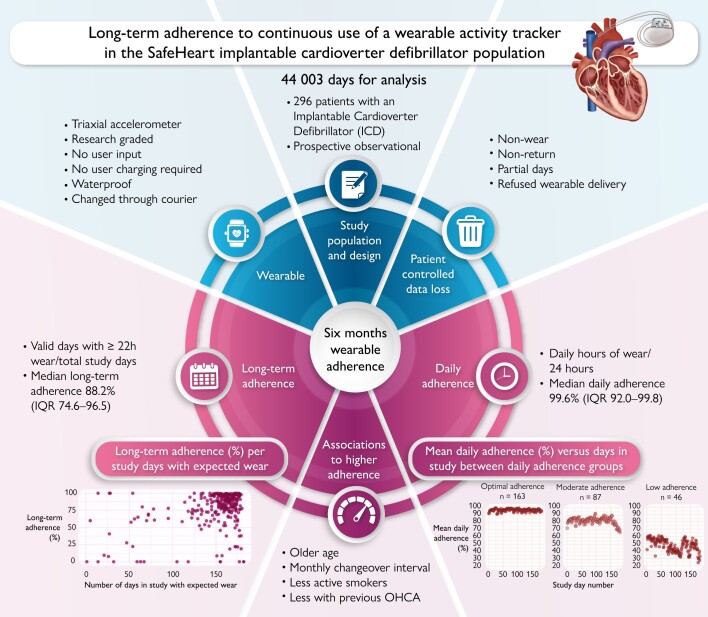
Wearable health technologies are increasingly popular. Yet, wearable monitoring only works when devices are worn as intended, and adherence reporting lacks standardization. In this study, we aimed to explore the long-term adherence to a wrist-worn activity tracker in the prospective SafeHeart study and identify patient characteristics associated with adherence.
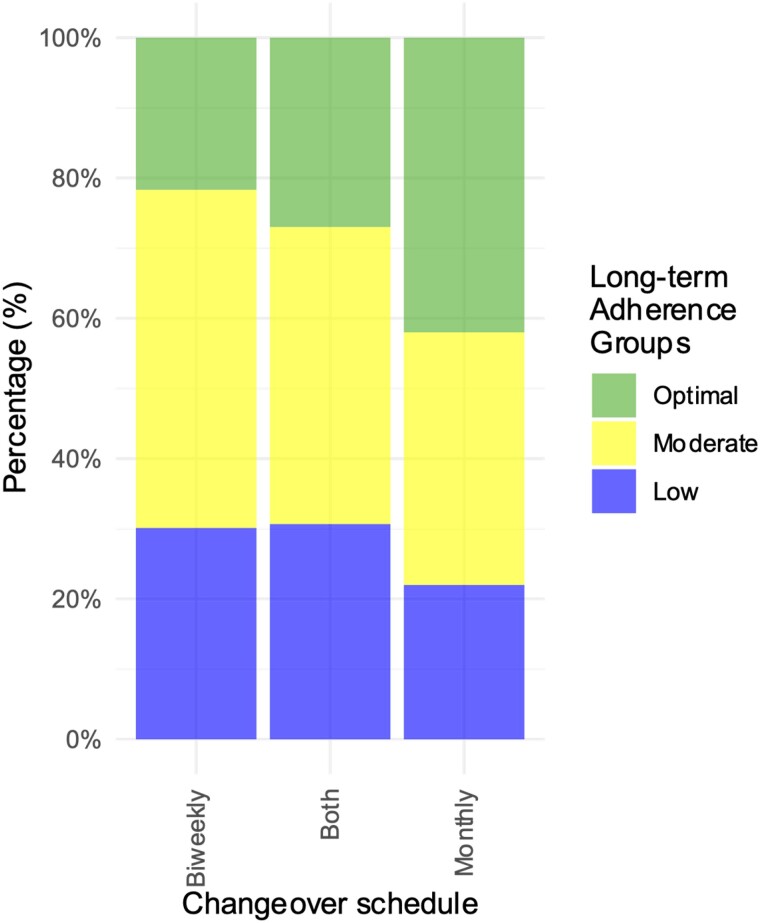
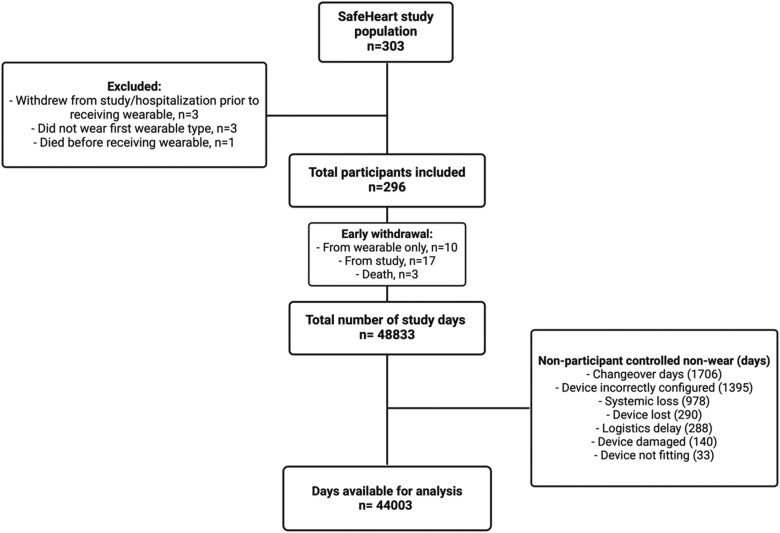
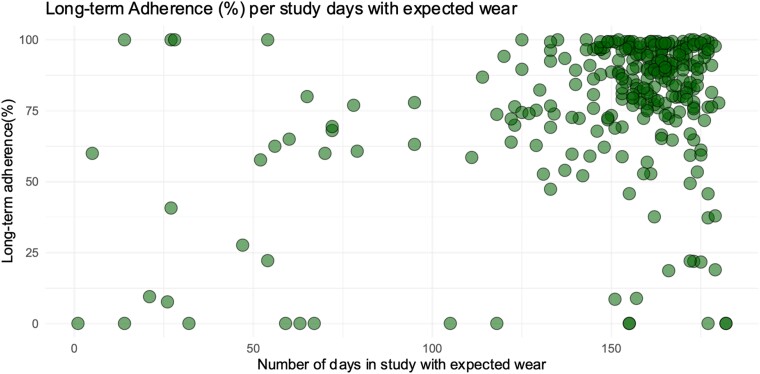
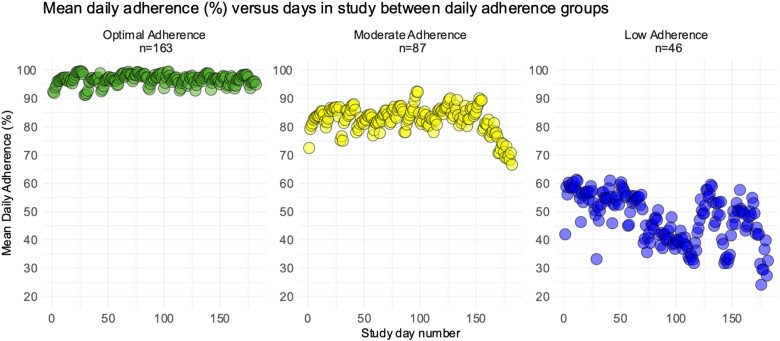
This study enrolled 303 participants, instructed to wear a wrist-worn accelerometer day and night for 6 months. Long-term adherence was defined as valid days (≥22 h of wear time) divided by expected days, and daily adherence as mean hours of wear time per 24 h period. Optimal, moderate, and low long-term and daily adherence groups were defined as long-term adherence above or below 95 and 75% and daily adherence above or below 90 and 75%. Regression models were used to identify patient characteristics associated with long-term adherence. In total, 296 participants [median age 64 years; interquartile range (IQR) 57-72; 19% female] were found eligible, yielding 44 003 days for analysis. The median long-term adherence was 88.2% (IQR 74.6-96.5%). A total of 83 (28%), 127 (42.9%), and 86 (29.1%) participants had optimal, moderate, and low long-term adherence, and 163 (55.1%), 87 (29.4%), and 46 (15.5%) had optimal, moderate, and low daily adherence, respectively. Age and smoking habits differed significantly between adherence levels, and increasing changeover intervals improved the degree of long-term adherence.
Long-term adherence to a wearable activity tracker was 88.2% over a 6-month period. Older age and longer changeover interval were positively associated with long-term adherence. This serves as a benchmark for future studies that rely on wearable devices.
The National Trial Registration number: NL9218 (https://onderzoekmetmensen.nl/).
可穿戴健康技术越来越受欢迎。然而,可穿戴监测只有在设备按预期佩戴时才有效,且依从性报告缺乏标准化。在本研究中,我们旨在探讨前瞻性SafeHeart研究中对腕戴式活动追踪器的长期依从性,并确定与依从性相关的患者特征。
本研究招募了303名参与者,指示他们日夜佩戴腕戴式加速度计6个月。长期依从性定义为有效天数(佩戴时间≥22小时)除以预期天数,每日依从性定义为每24小时期间的平均佩戴小时数。最佳、中度和低度长期及每日依从性组定义为长期依从性高于或低于95%和75%,以及每日依从性高于或低于90%和75%。使用回归模型确定与长期依从性相关的患者特征。总共发现296名参与者[中位年龄64岁;四分位间距(IQR)57 - 72;19%为女性]符合条件,产生44003天用于分析。长期依从性的中位数为88.2%(IQR 74.6 - 96.5%)。共有83名(28%)、127名(42.9%)和86名(29.1%)参与者具有最佳、中度和低度长期依从性,以及163名(55.1%)、87名(29.4%)和46名(15.5%)参与者分别具有最佳、中度和低度每日依从性。依从性水平之间的年龄和吸烟习惯差异显著,且更换间隔时间增加可提高长期依从性程度。
在6个月期间,对可穿戴活动追踪器的长期依从性为88.2%。年龄较大和更换间隔时间较长与长期依从性呈正相关。这为未来依赖可穿戴设备的研究提供了一个基准。
国家试验注册号:NL9218(https://onderzoekmetmensen.nl/)