• 文献检索
  • 文档翻译
  • 深度研究
  • 学术资讯
  • Suppr Zotero 插件Zotero 插件
  • 邀请有礼
  • 套餐&价格
  • 历史记录
应用&插件
Suppr Zotero 插件Zotero 插件浏览器插件Mac 客户端Windows 客户端微信小程序
定价
高级版会员购买积分包购买API积分包
服务
文献检索文档翻译深度研究API 文档MCP 服务
关于我们
关于 Suppr公司介绍联系我们用户协议隐私条款
关注我们

Suppr 超能文献

核心技术专利:CN118964589B侵权必究
粤ICP备2023148730 号-1Suppr @ 2026

文献检索

告别复杂PubMed语法,用中文像聊天一样搜索,搜遍4000万医学文献。AI智能推荐,让科研检索更轻松。

立即免费搜索

文件翻译

保留排版,准确专业,支持PDF/Word/PPT等文件格式,支持 12+语言互译。

免费翻译文档

深度研究

AI帮你快速写综述,25分钟生成高质量综述,智能提取关键信息,辅助科研写作。

立即免费体验

2019 年至 2020 年美国心血管疾病患者或心血管疾病风险人群使用可穿戴设备的情况。

Use of Wearable Devices in Individuals With or at Risk for Cardiovascular Disease in the US, 2019 to 2020.

机构信息

Section of Cardiovascular Medicine, Department of Internal Medicine, Yale School of Medicine, New Haven, Connecticut.

Heart and Vascular Center, Brigham and Women's Hospital, Harvard Medical School, Boston, Massachusetts.

出版信息

JAMA Netw Open. 2023 Jun 1;6(6):e2316634. doi: 10.1001/jamanetworkopen.2023.16634.

DOI:10.1001/jamanetworkopen.2023.16634
PMID:37285157
原文链接:https://pmc.ncbi.nlm.nih.gov/articles/PMC10248745/
Abstract

IMPORTANCE

Wearable devices may be able to improve cardiovascular health, but the current adoption of these devices could be skewed in ways that could exacerbate disparities.

OBJECTIVE

To assess sociodemographic patterns of use of wearable devices among adults with or at risk for cardiovascular disease (CVD) in the US population in 2019 to 2020.

DESIGN, SETTING, AND PARTICIPANTS: This population-based cross-sectional study included a nationally representative sample of the US adults from the Health Information National Trends Survey (HINTS). Data were analyzed from June 1 to November 15, 2022.

EXPOSURES

Self-reported CVD (history of heart attack, angina, or congestive heart failure) and CVD risk factors (≥1 risk factor among hypertension, diabetes, obesity, or cigarette smoking).

MAIN OUTCOMES AND MEASURES

Self-reported access to wearable devices, frequency of use, and willingness to share health data with clinicians (referred to as health care providers in the survey).

RESULTS

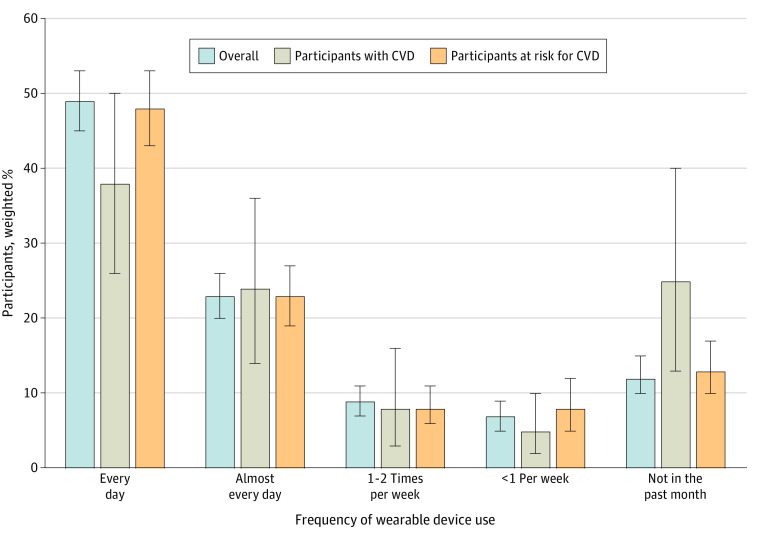
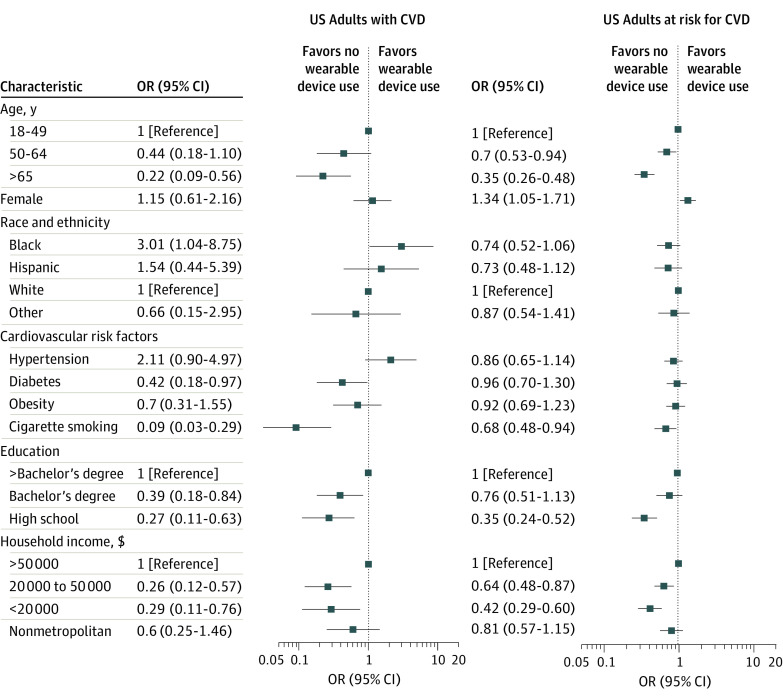
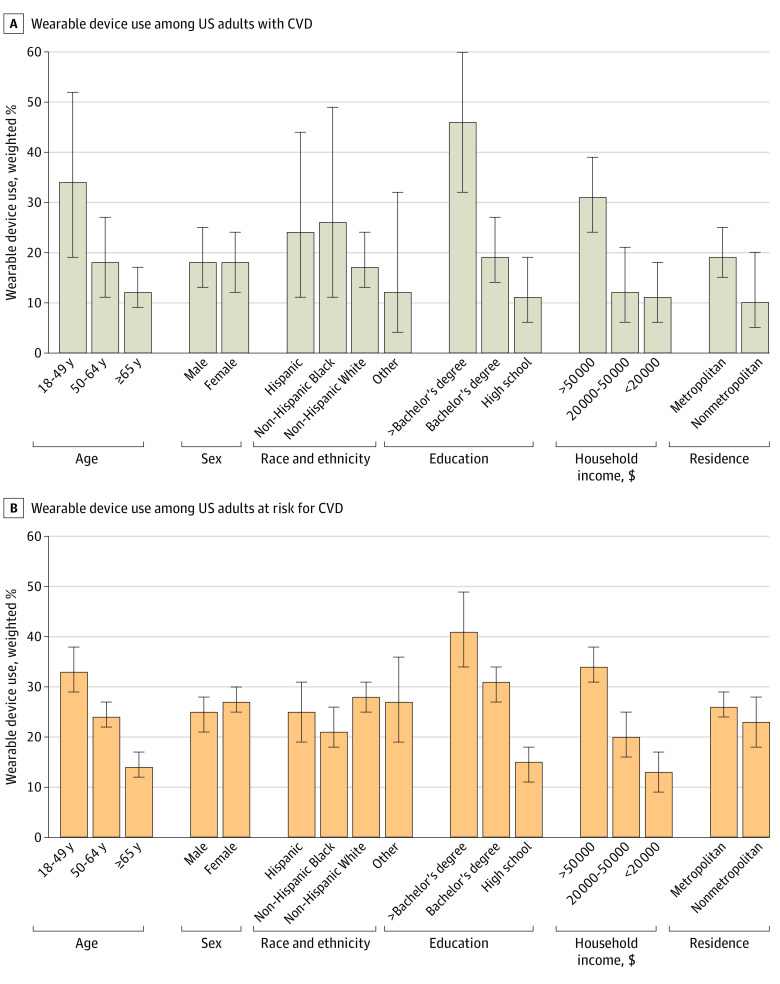
Of the overall 9303 HINTS participants representing 247.3 million US adults (mean [SD] age, 48.8 [17.9] years; 51% [95% CI, 49%-53%] women), 933 (10.0%) representing 20.3 million US adults had CVD (mean [SD] age, 62.2 [17.0] years; 43% [95% CI, 37%-49%] women), and 5185 (55.7%) representing 134.9 million US adults were at risk for CVD (mean [SD] age, 51.4 [16.9] years; 43% [95% CI, 37%-49%] women). In nationally weighted assessments, an estimated 3.6 million US adults with CVD (18% [95% CI, 14%-23%]) and 34.5 million at risk for CVD (26% [95% CI, 24%-28%]) used wearable devices compared with an estimated 29% (95% CI, 27%-30%) of the overall US adult population. After accounting for differences in demographic characteristics, cardiovascular risk factor profile, and socioeconomic features, older age (odds ratio [OR], 0.35 [95% CI, 0.26-0.48]), lower educational attainment (OR, 0.35 [95% CI, 0.24-0.52]), and lower household income (OR, 0.42 [95% CI, 0.29-0.60]) were independently associated with lower use of wearable devices in US adults at risk for CVD. Among wearable device users, a smaller proportion of adults with CVD reported using wearable devices every day (38% [95% CI, 26%-50%]) compared with overall (49% [95% CI, 45%-53%]) and at-risk (48% [95% CI, 43%-53%]) populations. Among wearable device users, an estimated 83% (95% CI, 70%-92%) of US adults with CVD and 81% (95% CI, 76%-85%) at risk for CVD favored sharing wearable device data with their clinicians to improve care.

CONCLUSIONS AND RELEVANCE

Among individuals with or at risk for CVD, fewer than 1 in 4 use wearable devices, with only half of those reporting consistent daily use. As wearable devices emerge as tools that can improve cardiovascular health, the current use patterns could exacerbate disparities unless there are strategies to ensure equitable adoption.

摘要

重要性

可穿戴设备或许能够改善心血管健康,但目前这些设备的采用情况可能存在偏差,从而加剧不平等现象。

目的

评估美国成年人中患有或有心血管疾病(CVD)风险人群在 2019 年至 2020 年期间使用可穿戴设备的社会人口统计学模式。

设计、地点和参与者:这项基于人群的横断面研究纳入了来自健康信息国家趋势调查(HINTS)的美国成年人的全国代表性样本。数据分析于 2022 年 6 月 1 日至 11 月 15 日进行。

暴露因素

自我报告的 CVD(心脏病发作、心绞痛或充血性心力衰竭病史)和 CVD 风险因素(高血压、糖尿病、肥胖或吸烟中的≥1 个风险因素)。

主要结果和测量指标

自我报告可获得可穿戴设备、使用频率以及愿意与临床医生(调查中称为医疗保健提供者)共享健康数据。

结果

在代表 2.473 亿美国成年人的 9303 名 HINTS 参与者中(平均[标准差]年龄为 48.8[17.9]岁;51%[95%CI,49%-53%]为女性),933 名(10.0%)代表 2030 万美国成年人患有 CVD(平均[标准差]年龄为 62.2[17.0]岁;43%[95%CI,37%-49%]为女性),5185 名(55.7%)代表 1.349 亿美国成年人有 CVD 风险(平均[标准差]年龄为 51.4[16.9]岁;43%[95%CI,37%-49%]为女性)。在全国加权评估中,估计有 360 万患有 CVD 的美国成年人(18%[95%CI,14%-23%])和 3450 万有 CVD 风险的成年人(26%[95%CI,24%-28%])使用可穿戴设备,而估计有 29%(95%CI,27%-30%)的美国成年人总体使用可穿戴设备。在考虑了人口统计学特征、心血管风险因素特征和社会经济特征的差异后,年龄较大(比值比[OR],0.35[95%CI,0.26-0.48])、教育程度较低(OR,0.35[95%CI,0.24-0.52])和家庭收入较低(OR,0.42[95%CI,0.29-0.60])与 CVD 风险人群中可穿戴设备使用率较低独立相关。在可穿戴设备使用者中,患有 CVD 的成年人中报告每天使用可穿戴设备的比例较小(38%[95%CI,26%-50%]),而总体(49%[95%CI,45%-53%])和有风险(48%[95%CI,43%-53%])人群中报告每天使用可穿戴设备的比例更大。在可穿戴设备使用者中,估计有 83%(95%CI,70%-92%)的患有 CVD 的美国成年人和 81%(95%CI,76%-85%)的有 CVD 风险的成年人支持与他们的临床医生共享可穿戴设备数据以改善护理。

结论和相关性

在患有或有 CVD 风险的人群中,不到 1/4 的人使用可穿戴设备,其中只有一半人报告每天都在使用。随着可穿戴设备成为改善心血管健康的工具,目前的使用模式可能会加剧不平等现象,除非有确保公平采用的策略。
https://cdn.ncbi.nlm.nih.gov/pmc/blobs/54d5/10248745/507aadfda7e2/jamanetwopen-e2316634-g003.jpg
https://cdn.ncbi.nlm.nih.gov/pmc/blobs/54d5/10248745/ed4370d1b79f/jamanetwopen-e2316634-g001.jpg
https://cdn.ncbi.nlm.nih.gov/pmc/blobs/54d5/10248745/d517c9bae415/jamanetwopen-e2316634-g002.jpg
https://cdn.ncbi.nlm.nih.gov/pmc/blobs/54d5/10248745/507aadfda7e2/jamanetwopen-e2316634-g003.jpg
https://cdn.ncbi.nlm.nih.gov/pmc/blobs/54d5/10248745/ed4370d1b79f/jamanetwopen-e2316634-g001.jpg
https://cdn.ncbi.nlm.nih.gov/pmc/blobs/54d5/10248745/d517c9bae415/jamanetwopen-e2316634-g002.jpg
https://cdn.ncbi.nlm.nih.gov/pmc/blobs/54d5/10248745/507aadfda7e2/jamanetwopen-e2316634-g003.jpg

相似文献

1
Use of Wearable Devices in Individuals With or at Risk for Cardiovascular Disease in the US, 2019 to 2020.2019 年至 2020 年美国心血管疾病患者或心血管疾病风险人群使用可穿戴设备的情况。
JAMA Netw Open. 2023 Jun 1;6(6):e2316634. doi: 10.1001/jamanetworkopen.2023.16634.
2
Patterns of Use and Key Predictors for the Use of Wearable Health Care Devices by US Adults: Insights from a National Survey.美国成年人使用可穿戴医疗设备的模式及关键预测因素:一项全国性调查的见解
J Med Internet Res. 2020 Oct 16;22(10):e22443. doi: 10.2196/22443.
3
Trends in Cardiovascular Disease Prevalence by Income Level in the United States.美国不同收入水平人群中心血管疾病的患病趋势。
JAMA Netw Open. 2020 Sep 1;3(9):e2018150. doi: 10.1001/jamanetworkopen.2020.18150.
4
Exploring Disparities in Healthcare Wearable Use among Cardiovascular Patients: Findings from a National Survey.探索心血管疾病患者使用医疗可穿戴设备的差异:一项全国性调查的结果
Rev Cardiovasc Med. 2023 Nov 9;24(11):307. doi: 10.31083/j.rcm2411307. eCollection 2023 Nov.
5
Mobile Health Access and Use Among Individuals With or At Risk for Cardiovascular Disease: 2018 Health Information National Trends Survey (HINTS).移动医疗在心血管疾病患者或高危人群中的可及性和使用情况:2018 年健康信息全国趋势调查(HINTS)。
J Am Heart Assoc. 2019 Dec 17;8(24):e014390. doi: 10.1161/JAHA.119.014390. Epub 2019 Dec 10.
6
Trends and Costs Associated With Suboptimal Physical Activity Among US Women With Cardiovascular Disease.美国心血管疾病女性中体力活动不足的趋势和成本。
JAMA Netw Open. 2019 Apr 5;2(4):e191977. doi: 10.1001/jamanetworkopen.2019.1977.
7
Willingness to Share Data From Wearable Health and Activity Trackers: Analysis of the 2019 Health Information National Trends Survey Data.可穿戴健康和活动追踪器数据共享意愿:2019 年健康信息国家趋势调查数据的分析。
JMIR Mhealth Uhealth. 2021 Dec 13;9(12):e29190. doi: 10.2196/29190.
8
Association Between the Composite Cardiovascular Risk and mHealth Use Among Adults in the 2017-2020 Health Information National Trends Survey: Cross-Sectional Study.2017-2020 年健康信息国家趋势调查中成年人复合心血管风险与移动医疗使用之间的关联:横断面研究。
J Med Internet Res. 2024 Jan 4;26:e46277. doi: 10.2196/46277.
9
Prevalence of major cardiovascular risk factors and cardiovascular diseases among Hispanic/Latino individuals of diverse backgrounds in the United States.美国不同族裔背景的西班牙裔/拉丁裔个体中心血管主要危险因素和心血管疾病的流行情况。
JAMA. 2012 Nov 7;308(17):1775-84. doi: 10.1001/jama.2012.14517.
10
Dyslipidemia and its associated factors among community adults located in Shangcheng district, Zhejiang province.浙江省尚城区社区成年人血脂异常及其相关因素。
Sci Rep. 2024 Feb 21;14(1):4268. doi: 10.1038/s41598-024-54953-6.

引用本文的文献

1
A guide to consumer-grade wearables in cardiovascular clinical care and population health for non-experts.非专业人士的心血管临床护理和人群健康领域消费级可穿戴设备指南。
NPJ Cardiovasc Health. 2025;2(1):44. doi: 10.1038/s44325-025-00082-6. Epub 2025 Sep 2.
2
Adherence to digital pregnancy care - lessons learned from the SMART start feasibility study.坚持数字孕期护理——从SMART start可行性研究中汲取的经验教训。
NPJ Digit Med. 2025 Aug 30;8(1):561. doi: 10.1038/s41746-025-01966-8.
3
Continuous Movement Monitoring at Home Through Wearable Devices: A Systematic Review.

本文引用的文献

1
Cost-effectiveness of Screening for Atrial Fibrillation Using Wearable Devices.使用可穿戴设备筛查心房颤动的成本效益。
JAMA Health Forum. 2022 Aug 5;3(8):e222419. doi: 10.1001/jamahealthforum.2022.2419. eCollection 2022 Aug.
2
The Use of Wearable ECG Devices in the Clinical Setting: a Review.可穿戴式心电图设备在临床环境中的应用:综述
Curr Emerg Hosp Med Rep. 2022;10(3):67-72. doi: 10.1007/s40138-022-00248-x. Epub 2022 Jun 25.
3
Trends in Consumer Wearable Devices With Cardiac Sensors in a Primary Care Cohort.基层医疗队列中配备心脏传感器的消费级可穿戴设备的趋势
通过可穿戴设备进行家庭连续运动监测:一项系统综述。
Sensors (Basel). 2025 Aug 8;25(16):4889. doi: 10.3390/s25164889.
4
Wearable device-based interventions in heat-exposed outdoor workers - a scoping review and an explanatory intervention model.针对户外高温作业工人的基于可穿戴设备的干预措施——一项范围综述及解释性干预模型
BMC Public Health. 2025 Aug 22;25(1):2893. doi: 10.1186/s12889-025-24262-2.
5
Predictors of physical activity in daily life among women of reproductive age: a scoping review.育龄女性日常生活中身体活动的预测因素:一项范围综述
Mhealth. 2025 Jun 15;11:37. doi: 10.21037/mhealth-24-70. eCollection 2025.
6
Development and multinational validation of an ensemble deep learning algorithm for detecting and predicting structural heart disease using noisy single-lead electrocardiograms.一种用于使用噪声单导联心电图检测和预测结构性心脏病的集成深度学习算法的开发与多中心验证。
Eur Heart J Digit Health. 2025 Apr 10;6(4):554-566. doi: 10.1093/ehjdh/ztaf034. eCollection 2025 Jul.
7
A Smartphone Application to Measure Walking Cadence before Major Abdominal Surgery in Older Adults.一款用于测量老年人大腹部手术前步行节奏的智能手机应用程序。
Digit Biomark. 2025 Jun 12;9(1):113-123. doi: 10.1159/000545982. eCollection 2025 Jan-Dec.
8
Cardiovascular autonomic dysfunction precedes cardiovascular disease and all-cause mortality: 11-year follow-up in the ADDITION-PRO study.心血管自主神经功能障碍先于心血管疾病和全因死亡率出现:ADDITION-PRO研究的11年随访
Diabetes Obes Metab. 2025 Sep;27(9):5147-5159. doi: 10.1111/dom.16566. Epub 2025 Jul 9.
9
Leveraging AI-enhanced digital health with consumer devices for scalable cardiovascular screening, prediction, and monitoring.利用人工智能增强的数字健康技术与消费设备,实现可扩展的心血管筛查、预测和监测。
NPJ Cardiovasc Health. 2025;2(1):34. doi: 10.1038/s44325-025-00071-9. Epub 2025 Jul 2.
10
Smart Wearable Technologies for Balance Rehabilitation in Older Adults at Risk of Falls: Scoping Review and Comparative Analysis.用于有跌倒风险的老年人平衡康复的智能可穿戴技术:范围综述与比较分析
JMIR Rehabil Assist Technol. 2025 May 28;12:e69589. doi: 10.2196/69589.
Circ Cardiovasc Qual Outcomes. 2022 Jul;15(7):e008833. doi: 10.1161/CIRCOUTCOMES.121.008833. Epub 2022 Jun 27.
4
How to use digital devices to detect and manage arrhythmias: an EHRA practical guide.如何使用数字设备检测和管理心律失常:欧洲心律协会实用指南
Europace. 2022 Jul 15;24(6):979-1005. doi: 10.1093/europace/euac038.
5
Willingness to Share Data From Wearable Health and Activity Trackers: Analysis of the 2019 Health Information National Trends Survey Data.可穿戴健康和活动追踪器数据共享意愿:2019 年健康信息国家趋势调查数据的分析。
JMIR Mhealth Uhealth. 2021 Dec 13;9(12):e29190. doi: 10.2196/29190.
6
Income disparity and utilization of cardiovascular preventive care services among U.S. adults.美国成年人的收入差距与心血管预防保健服务的利用情况
Am J Prev Cardiol. 2021 Nov 6;8:100286. doi: 10.1016/j.ajpc.2021.100286. eCollection 2021 Dec.
7
The Rise of Wearable Devices during the COVID-19 Pandemic: A Systematic Review.新冠疫情期间可穿戴设备的兴起:一项系统综述。
Sensors (Basel). 2021 Aug 28;21(17):5787. doi: 10.3390/s21175787.
8
Smart Wearables for Cardiac Monitoring-Real-World Use beyond Atrial Fibrillation.可穿戴式智能设备在心脏监测中的应用——除心房颤动外的实际应用。
Sensors (Basel). 2021 Apr 5;21(7):2539. doi: 10.3390/s21072539.
9
Smart wearable devices in cardiovascular care: where we are and how to move forward.智能可穿戴设备在心血管护理中的应用:现状与展望。
Nat Rev Cardiol. 2021 Aug;18(8):581-599. doi: 10.1038/s41569-021-00522-7. Epub 2021 Mar 4.
10
Wearable Health Devices in Health Care: Narrative Systematic Review.可穿戴健康设备在医疗保健中的应用:叙事系统性综述。
JMIR Mhealth Uhealth. 2020 Nov 9;8(11):e18907. doi: 10.2196/18907.