From the VIB Center for Molecular Neurology (M.V., R.R., V.B., S.W.); Department of Biomedical Sciences (M.V., M.V.B., S.W., R.R.), University of Antwerp, Belgium; Department of Neurology (E.M.R., M.F.M.), David Geffen School of Medicine, University of California, Los Angeles; Department of Neurology (N.C.-L., V.K.R., T.K., K.K., B.F.B.); Department of Psychiatry and Psychology (N.C.-L., J.A.F., D.S.K., L.K.F.), Mayo Clinic, Rochester, MN; Department of Epidemiology and Biostatistics (J.K.), University of California, San Francisco; Department of Quantitative Health Sciences (C.M., D.E.B.), Mayo Clinic, Rochester, MN; Department of Neurology (A.M.S., A.A.W.), Memory and Aging Center, University of California, San Francisco; Weill Institute for Neurosciences, San Francisco, California; Institute for Precision Health (D.H.G.), Departments of Neurology, Psychiatry and Human Genetics at David Geffen School of Medicine, UCLA; Department of Neuroscience (T.G., L.P., M.B., N.R.G.-R.), Mayo Clinic, Jacksonville, FL; Alzheimer's Disease and Other Cognitive Disorders Unit (S.B.-É.), Neurology Service, Hospital Clínic de Barcelona, Institut d'Investigacions Biomèdiques August Pi i Sunyer (IDIBAPS), Fundació Clínic per a la Recerca Biomèdica, Uni; Department of Neurology (B.A., B.C.D.), Case Western Reserve University, Cleveland, OH; Department of Neurology (S.B.), University of Michigan, Ann Arbor; Department of Neurology (A.C.B.), University of North Carolina, Chapel Hill; Department of Neurology (D.C.), Indiana University, Indianapolis; Department of Neurology (R.R.D.), Vanderbilt University, Nashville, TN; Department of Neurology (K.D.-R.), University of Washington, Seattle, WA; Department of Neurosciences (D.G., G.C.L., I.L.), University of California, San Diego, La Jolla; Departments of Neurology and Psychiatry (N.G.), Washington University School of Medicine, Washington University, St. Louis, MO; Department of Psychiatry and Behavioral Sciences (I.M.G.), Northwestern Feinberg School of Medicine, Chicago, IL; Taub Institute for Research on Alzheimer's Disease and the Aging Brain (L.S.H.), College of Physicians and Surgeons; Department of Neurology (L.S.H.), Columbia University, New York; Division of Neurology (G.-Y.R.H.), University of British Columbia, Vancouver, Canada; Department of Psychiatry and Human Behavior (E.D.H.), Alpert Medical School of Brown University, Providence, RI; Department of Neurology and Penn Frontotemporal Degeneration Center (D.J.I.), Perelman School of Medicine, University of Pennsylvania, Philadelphia; National Institute of Neurological Disorders and Stroke (J.Y.K., A.S.), National Institutes of Health, Bethesda, MD; Department of Neurology (J.C.M., B.P.), Houston Methodist, TX; Department of Psychiatry and Behavioral Sciences (C.U.O.), Johns Hopkins University, Baltimore, MD; Department of Neurology (P.S.P.), University of Colorado, Aurora; Cleveland Clinic Lou Ruvo Center for Brain Health (A.R., D.W.), Las Vegas, NV; Department of Neurology (E.D.R.), University of Alabama at Birmingham; Glenn Biggs Institute for Alzheimer's & Neurodegenerative Diseases (A.C.S.), UT Health San Antonio; Tanz Centre for Research in Neurodegenerative Diseases (M.C.T.), Division of Neurology, University of Toronto, Ontario, Canada; Department of Neurology (H.W.H., A.L.B., H.J.R.), Memory and Aging Center, University of California, San Francisco; Weill Institute for Neurosciences, San Francisco, CA; and Department of Neuroscience (R.R.), Mayo Clinic, Jacksonville, FL.
Neurology. 2024 Oct 22;103(8):e209832. doi: 10.1212/WNL.0000000000209832. Epub 2024 Sep 25.
has been proposed as a modifier of disease risk in FTLD-TDP, particularly in pathogenic variant carriers. Furthermore, has been investigated as a disease modifier in the context of healthy aging and across multiple neurodegenerative diseases. The objective of this study was to evaluate and compare the effect of on gray matter volume and cognition in each of the common genetic FTD groups and in patients with sporadic FTD.
Participants were enrolled through the ARTFL/LEFFTDS Longitudinal Frontotemporal Lobar Degeneration (ALLFTD) study, which includes symptomatic and presymptomatic individuals with a pathogenic variant in symptomatic nonpathogenic variant carriers, and noncarrier family controls. All participants were genotyped for the rs1990622 SNP. Cross-sectionally, linear mixed-effects models were fitted to assess an association between and genetic group interaction with each outcome measure (gray matter volume and UDS3-EF for cognition), adjusting for education, age, sex, and CDR+NACC-FTLD sum of boxes. Subsequently, associations between and each outcome measure were investigated within the genetic group. For longitudinal modeling, linear mixed-effects models with time by predictor interactions were fitted.
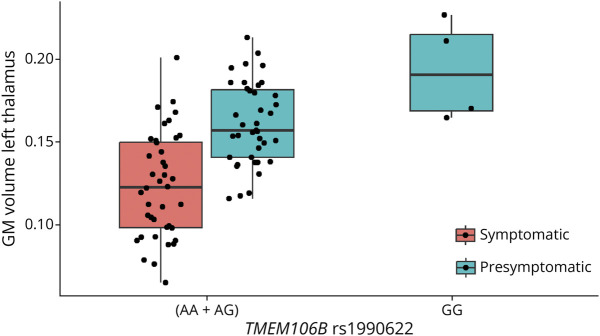
The minor allele of rs1990622, linked to a decreased risk of FTD, associated with greater gray matter volume in pathogenic variant carriers under the recessive dosage model (N = 82, beta = 3.25, 95% CI [0.37-6.19], = 0.034). This was most pronounced in the thalamus in the left hemisphere (beta = 0.03, 95% CI [0.01-0.06], = 0.006), with a retained association when considering presymptomatic pathogenic variant carriers only (N = 42, beta = 0.03, 95% CI [0.01-0.05], = 0.003). The minor allele of rs1990622 also associated with greater cognitive scores among all pathogenic variant carriers (N = 229, beta = 0.36, 95% CI [0.05-0.066], = 0.021) and in presymptomatic pathogenic variant carriers (N = 106, beta = 0.33, 95% CI [0.03-0.63], = 0.036), under the recessive dosage model.
We identified associations of with gray matter volume and cognition in the presence of and pathogenic variants. The association of with outcomes of interest in presymptomatic and pathogenic variant carriers could additionally reflect TMEM106B's effect on divergent pathophysiologic changes before the appearance of clinical symptoms.
已被提议作为 FTLD-TDP 疾病风险的修饰因子,特别是在致病性变异携带者中。此外, 在健康老龄化和多种神经退行性疾病的背景下, 也被研究为疾病修饰因子。本研究的目的是评估和比较 在每种常见的遗传 FTD 组和散发性 FTD 患者中的灰质体积和认知方面的作用。
通过 ARTFL/LEFFTDS 纵向额颞叶变性 (ALLFTD) 研究招募参与者,该研究包括有致病性变异的症状性和前症状性个体、无症状性非致病性变异携带者和非携带者家族对照。所有参与者均进行了 rs1990622 SNP 的基因分型。横截面线性混合效应模型拟合评估 与每个结局测量(灰质体积和 UDS3-EF 认知)之间的关联,调整了教育、年龄、性别和 CDR+NACC-FTLD 总框。随后,在遗传组内研究了 与每个结局测量的关联。对于纵向建模,拟合了具有时间与 预测因子相互作用的线性混合效应模型。
rs1990622 的次要等位基因与 FTD 风险降低相关,在隐性剂量模型下,与致病性变异携带者的灰质体积更大相关(N=82,β=3.25,95%CI[0.37-6.19], =0.034)。在左侧丘脑最为明显(β=0.03,95%CI[0.01-0.06], =0.006),当仅考虑前症状性 致病性变异携带者时,仍保留关联(N=42,β=0.03,95%CI[0.01-0.05], =0.003)。rs1990622 的次要等位基因也与所有 致病性变异携带者的认知评分更高相关(N=229,β=0.36,95%CI[0.05-0.066], =0.021)和前症状性 致病性变异携带者(N=106,β=0.33,95%CI[0.03-0.63], =0.036),在隐性剂量模型下。
我们在 存在和 致病性变异的情况下鉴定了 与灰质体积和认知的关联。 在无症状性和 致病性变异携带者出现临床症状之前, 与感兴趣结局的关联可能还反映了 TMEM106B 对不同病理生理变化的影响。