Department of Neurology, Memory and Aging Center, Weill Institute for Neurosciences, University of California, San Francisco.
Department of Neurology, College of Medicine, Mayo Clinic, Rochester, Minnesota.
JAMA Netw Open. 2020 Oct 1;3(10):e2022847. doi: 10.1001/jamanetworkopen.2020.22847.
Several clinical trials are planned for familial forms of frontotemporal lobar degeneration (f-FTLD). Precise modeling of brain atrophy in f-FTLD could improve the power to detect a treatment effect.
To characterize regions and rates of atrophy in the 3 primary f-FTLD genetic groups (MAPT, GRN, and C9orf72) across all disease stages from asymptomatic to dementia.
DESIGN, SETTING, AND PARTICIPANTS: This investigation was a case-control study of participants enrolled in the Advancing Research and Treatment for Frontotemporal Lobar Degeneration or Longitudinal Evaluation of Familial Frontotemporal Dementia studies. The study took place at 18 North American academic medical centers between January 2009 and September 2018. Participants with f-FTLD (n = 100) with a known pathogenic variant (MAPT [n = 28], GRN [n = 33], or C9orf72 [n = 39]) were grouped according to disease stage (ie, Clinical Dementia Rating [CDR] plus National Alzheimer's Coordinating Center [NACC] FTLD module). Included were participants with at least 2 structural magnetic resonance images at presymptomatic (CDR + NACC FTLD = 0 [n = 57]), mild or questionable (CDR + NACC FTLD = 0.5 [n = 15]), or symptomatic (CDR + NACC FTLD = ≥1 [n = 28]) disease stages. The control group included family members of known pathogenic variant carriers who did not carry the pathogenic variant (n = 60).
This study fitted bayesian linear mixed-effects models in each voxel of the brain to quantify the rate of atrophy in each of the 3 genes, at each of the 3 disease stages, compared with controls. The study also analyzed rates of clinical decline in each of these groups, as measured by the CDR + NACC FTLD box score.
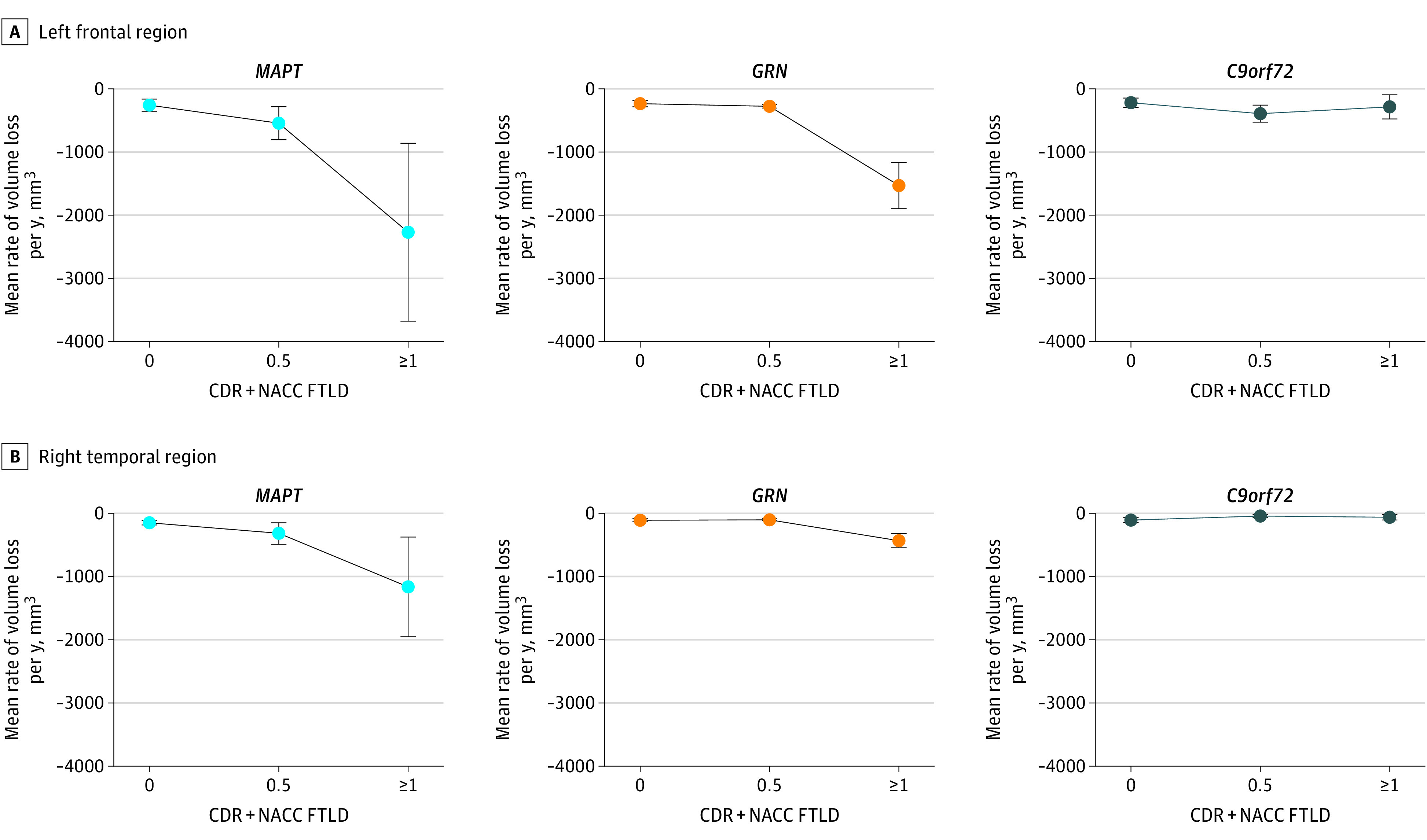
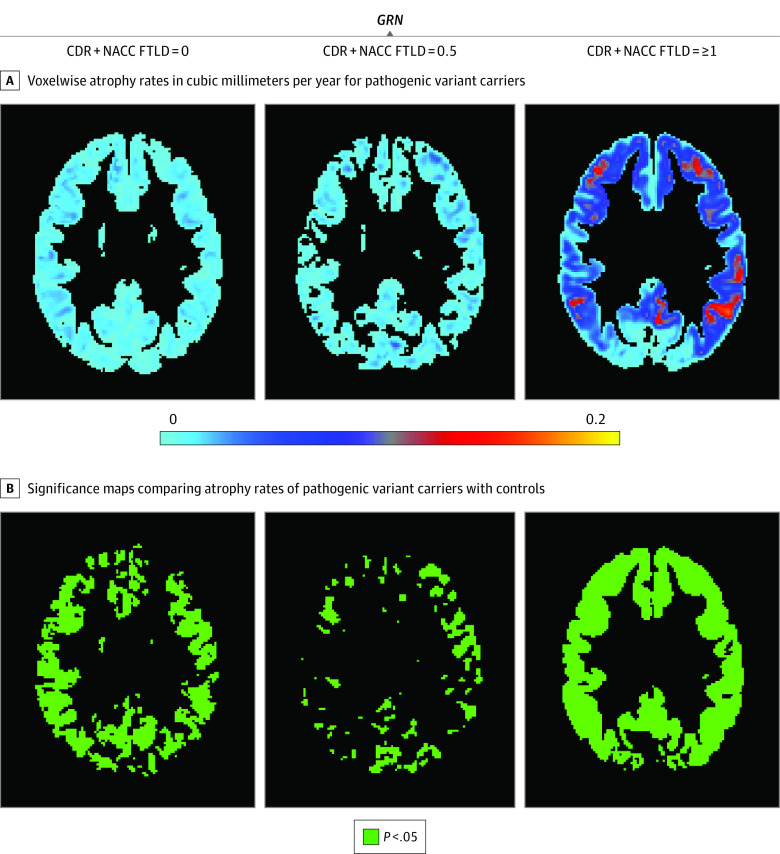
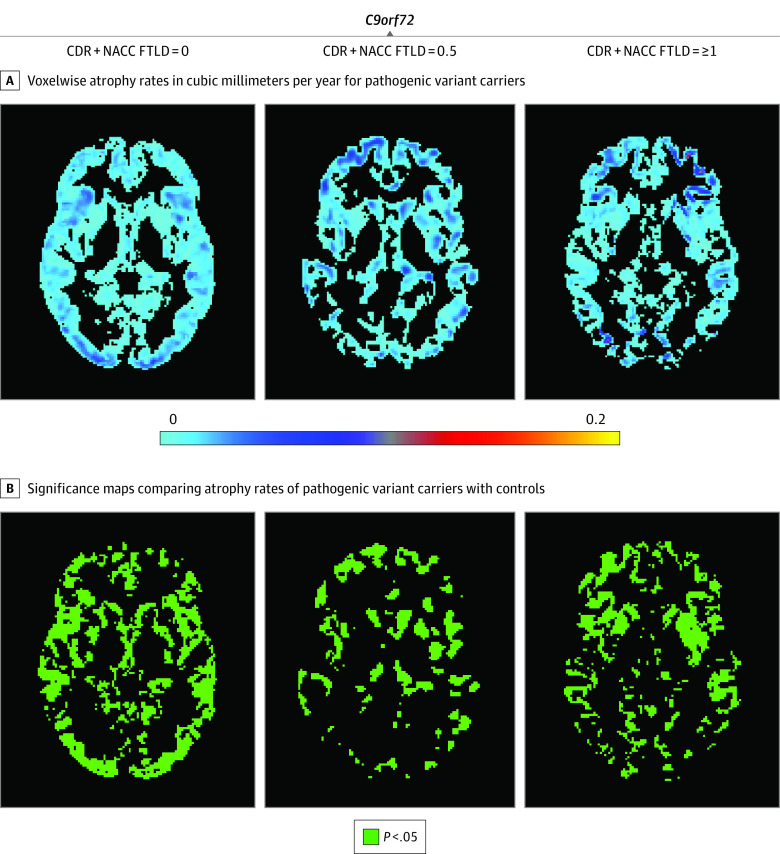
The sample included 100 participants with f-FTLD with a known pathogenic variant (mean [SD] age, 50.48 [13.78] years; 53 [53%] female) and 60 family members of known pathogenic variant carriers who did not carry the pathogenic variant (mean [SD] age, 47.51 [12.43] years; 36 [60%] female). MAPT and GRN pathogenic variants were associated with increased rates of volume loss compared with controls at all stages of disease. In MAPT pathogenic variant carriers, statistically significant regions of accelerated volume loss compared with controls were identified in temporal regions bilaterally in the presymptomatic stage, with global spread in the symptomatic stage. For example, mean [SD] rates of atrophy in the left temporal were -231 [47] mm3 per year during the presymptomatic stage, -381 [208] mm3 per year during the mild stage, and -1485 [1025] mm3 per year during the symptomatic stage (P < .05). GRN pathogenic variant carriers generally had minimal increases in atrophy rates between the presymptomatic and mild stages, with rapid increases in atrophy rates in the symptomatic stages. For example, in the right frontal lobes, annualized volume loss was -267 [81] mm3 per year in the presymptomatic stage and -182 [90] mm3 per year in the mild stage, but -1169 [555] mm3 per year in the symptomatic stage. Compared with the other groups, C9orf72 expansion carriers showed minimal increases in rate of volume loss with disease progression. For example, the mean (SD) annualized rates of atrophy in the right frontal lobe in C9orf72 expansion carriers was -272 (118) mm3 per year in presymptomatic stages, -310 (189) mm3 per year in mildly symptomatic stages, and -251 (145) mm3 per year in symptomatic stages.
These findings are relevant to clinical trial planning and suggest that the mechanism by which C9orf72 pathogenic variants lead to symptoms may be fundamentally different from the mechanisms associated with other pathogenic variants.
有几项临床试验计划针对家族性额颞叶变性(f-FTLD)的形式。在 f-FTLD 中精确建模脑萎缩可以提高检测治疗效果的能力。
在无症状到痴呆的所有疾病阶段,描述 3 种主要的 f-FTLD 遗传组(MAPT、GRN 和 C9orf72)的脑萎缩区域和速度。
设计、地点和参与者:这是一项病例对照研究,参与者来自 Advancing Research and Treatment for Frontotemporal Lobar Degeneration 或 Longitudinal Evaluation of Familial Frontotemporal Dementia 研究。该研究于 2009 年 1 月至 2018 年 9 月在 18 个北美学术医疗中心进行。有已知致病性变异(MAPT [n=28]、GRN [n=33]或 C9orf72 [n=39])的 f-FTLD 患者(n=100)根据疾病阶段(即临床痴呆评定量表[CDR]+国家阿尔茨海默病协调中心[NACC]FTLD 模块)分组。包括至少有 2 个结构磁共振成像的无症状(CDR+NACC FTLD=0[n=57])、轻度或可疑(CDR+NACC FTLD=0.5[n=15])或有症状(CDR+NACC FTLD≥1[n=28])疾病阶段的参与者。对照组包括已知致病性变异携带者的家庭成员,他们不携带致病性变异(n=60)。
该研究在每个脑区的每个体素中拟合贝叶斯线性混合效应模型,以量化每个基因在每个疾病阶段的萎缩率,并与对照组进行比较。该研究还分析了这些组中每个组的临床下降率,以 CDR+NACC FTLD 框评分来衡量。
该样本包括 100 名有已知致病性变异的 f-FTLD 患者(平均[标准差]年龄 50.48[13.78]岁;53[53%]为女性)和 60 名已知致病性变异携带者的家庭成员,他们不携带致病性变异(平均[标准差]年龄 47.51[12.43]岁;36[60%]为女性)。MAPT 和 GRN 致病性变异与所有疾病阶段的对照相比,与体积丢失率增加相关。在 MAPT 致病性变异携带者中,与对照相比,在无症状阶段双侧颞区、症状阶段全局扩散均有统计学意义的加速体积丢失区域。例如,左侧颞叶的平均[标准差]年萎缩率在无症状阶段为-231[47]mm3,轻度阶段为-381[208]mm3,症状阶段为-1485[1025]mm3(P<0.05)。GRN 致病性变异携带者在无症状和轻度阶段之间的萎缩率增加通常较少,在症状阶段迅速增加。例如,在右侧额叶,每年体积损失为无症状阶段-267[81]mm3,轻度阶段-182[90]mm3,但症状阶段-1169[555]mm3。与其他组相比,C9orf72 扩展携带者随着疾病的进展,体积损失率的增加最小。例如,在右侧额叶,C9orf72 扩展携带者的平均(标准差)每年萎缩率在无症状阶段为-272(118)mm3,轻度症状阶段为-310(189)mm3,症状阶段为-251(145)mm3。
这些发现与临床试验计划有关,表明 C9orf72 致病性变异导致症状的机制可能与其他致病性变异相关的机制有根本的不同。