Abdel-Razeq Hikmat, Tamimi Faris, Sharaf Baha, Nielsen Sarah M, Heald Brandie, Hatchell Kathryn E, Esplin Edward D, Bani Hani Hira, Al-Azzam Khansa, Alkyam Mais, Mustafa Rawan, Al-Atary Areej
Department of Internal Medicine, King Hussein Cancer Center, Amman, Jordan.
School of Medicine, the University of Jordan, Amman, Jordan.
World J Oncol. 2024 Oct;15(5):777-783. doi: 10.14740/wjon1919. Epub 2024 Sep 16.
The availability and affordability of germline genetic testing (GGT) has resulted in a broader utilization in daily clinical practice. However, adherence to testing guidelines is low, especially among older patients, where testing is often not offered.
In this study, consecutive, newly diagnosed patients with breast cancer (BC) aged ≥ 65 years and eligible for GGT, as per the National Comprehensive Cancer Network (NCCN) guidelines (version 1, 2021), were invited to participate, from March 2021 to December 2022. Patients were offered a restricted (two- or 20-gene panel), or an expanded 84-gene panel.
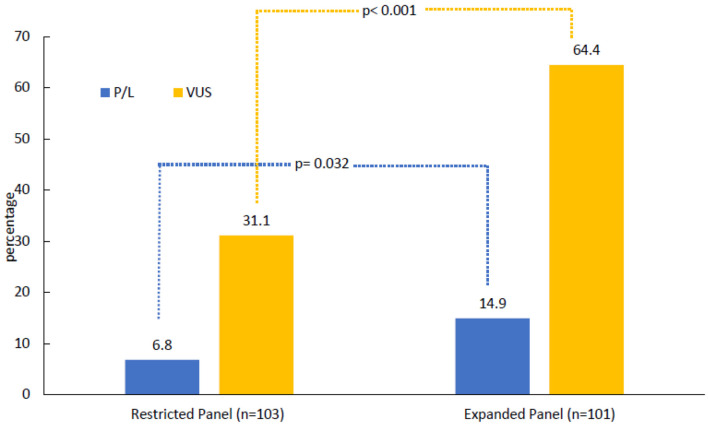
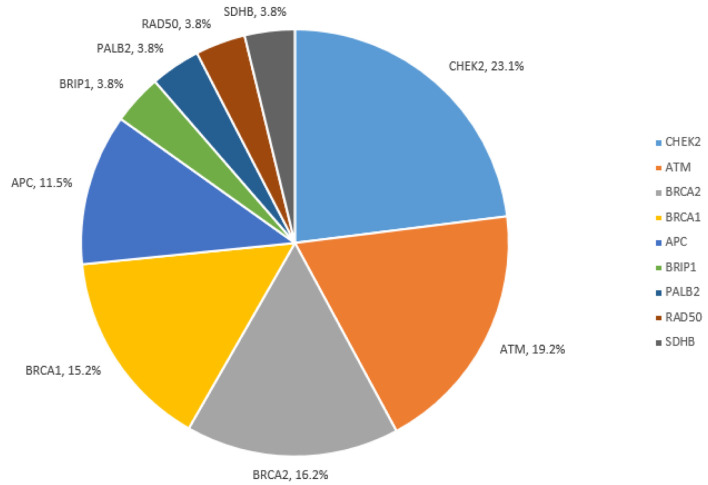
During the study period, 204 patients were enrolled. The mean (standard deviation (SD)) age at BC diagnosis was 70.5 (5.13) years, ranging 65 - 81 years. All patients were Arab and the majority were Jordanian. The majority (n = 188, 92.2%) had early-stage (stages I and II) disease. One hundred three (50.5%) patients were tested with a restricted two-gene (n = 13) or 20-gene (n = 90) panel, while the remaining 101 (49.5%) patients had an expanded 84-gene panel. Family history of close blood relative(s) with BC was the most common indication for testing (n = 110, 53.9%). Among the entire study cohort, 22 (10.8%) had pathogenic/likely pathogenic germline variants (PGVs) and another 97 (47.5%) had ≥ 1 variants of uncertain significance (VUS). PGV rates were significantly higher with the expanded panel (14.9%) compared to restricted testing (6.8%) (P = 0.032). Similarly, VUS rates were significantly higher with the expanded panel (64.4%) compared to the restricted panel (31.1%) (P < 0.001). The most prevalent genes with PGVs were (31.3% of all PGV-positive patients), (23.1%) and (19.2%).
GGT should not be overlooked in older BC patients, as this study demonstrates that > 10% of patients have PGVs, largely in potentially actionable genes.
种系基因检测(GGT)的可及性和可负担性使其在日常临床实践中的应用更为广泛。然而,对检测指南的遵循率较低,尤其是在老年患者中,这类患者往往未接受检测。
在本研究中,2021年3月至2022年12月期间,连续纳入了年龄≥65岁、符合美国国立综合癌症网络(NCCN)指南(2021年第1版)标准且新诊断为乳腺癌(BC)的患者,并邀请其参与研究。为患者提供了受限(两基因或20基因检测板)或扩展的84基因检测板。
在研究期间,共纳入204例患者。BC诊断时的平均(标准差(SD))年龄为70.5(5.13)岁,年龄范围为65 - 81岁。所有患者均为阿拉伯人,大多数为约旦人。大多数(n = 188,92.2%)患者处于疾病早期(I期和II期)。103例(50.5%)患者接受了受限的两基因(n = 13)或20基因(n = 90)检测板检测,其余101例(49.5%)患者接受了扩展的84基因检测板检测。有BC近亲家族史是最常见的检测指征(n = 110,53.9%)。在整个研究队列中,22例(10.8%)有致病性/可能致病性种系变异(PGV),另外97例(47.5%)有≥1个意义未明的变异(VUS)。与受限检测(6.8%)相比,扩展检测板的PGV率显著更高(14.9%)(P = 0.032)。同样,与受限检测板(31.1%)相比,扩展检测板的VUS率显著更高(64.4%)(P < 0.001)。携带PGV的最常见基因是 (占所有PGV阳性患者的31.3%)、 (23.1%)和 (19.2%)。
老年BC患者的GGT不应被忽视,因为本研究表明超过10%的患者有PGV,且大多存在于潜在可操作的基因中。