Department of Endocrinology, Shenzhen People's Hospital, Second Clinical Medical College of Jinan University, First Affiliated Hospital of Southern University of Science and Technology, Shenzhen, Guangdong, China.
Department of Microbiology, Post-Graduate Institute of Medical Education, Chandigarh, India.
Front Cell Infect Microbiol. 2024 Sep 12;14:1454549. doi: 10.3389/fcimb.2024.1454549. eCollection 2024.
Accurate identification of infectious diseases using molecular techniques, such as PCR and NGS, is well-established. This study aims to assess the utility of Bactfast and Fungifast in diagnosing bloodstream infections in ICU settings, comparing them against traditional culture methods. The objectives include evaluating sensitivity and specificity and identifying a wide range of pathogens, including non-culturable species.
We collected 500 non-duplicate blood samples from ICU patients between January 2023 and December 2023. Specimens underwent traditional culture, MALDI-TOF, VITEK2 compact system, and NGS-based Bactfast and Fungifast analyses.
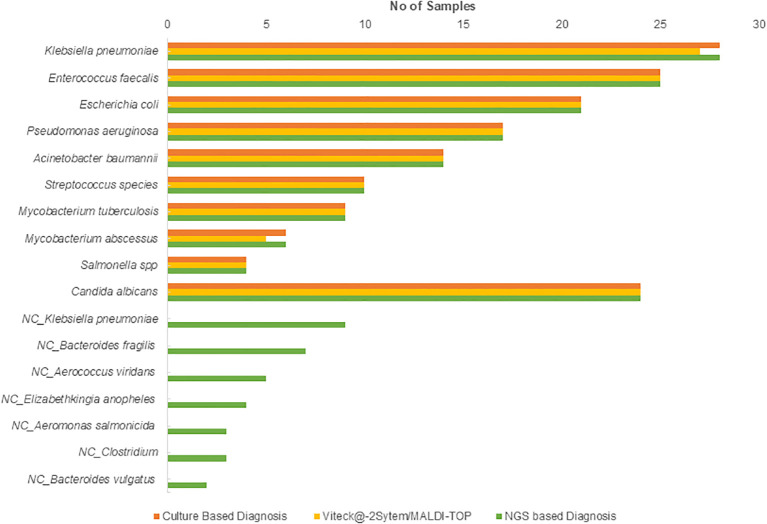
Out of the 500 samples, 26.8% (n=134) showed bacterial growth via traditional culture methods, while 4.8% (n=24) were positive for fungal growth. MALDI-TOF and VITEK2 compact system yielded comparable results, identifying 26.4% (n=132) of specimens with bacterial growth. NGS-based Bactfast detected bacterial presence in 38.2% (n=191) of samples, including non-culturable bacteria missed by traditional methods. However, NGS-based Fungifast showed concordant fungal detection rates with culture methods. Among identified pathogens by culture method included 20.89% (n=28), 18.65% (n=25), 15.67% (n=21), 12.68% (n=17), 10.44% (n=14), various species 7.46% (n=10), 6.71% (n=9), 4.47% (n=6), and 2.98% (n=4). Non-culture-based NGS identified additional (n=33) pathogens, including 27.27% (n=9), 21.21% (n=7), 15.15% (n=5), 12.12% (n=4), 9% (n=3), 9% (n=3), and 6% (n=2). was reported in 5% (n=24) of samples by both methods.
NGS-based Bactfast and Fungifast demonstrate high sensitivity in identifying a wide array of bacterial and fungal pathogens in ICU patients, outperforming traditional culture methods in detecting non-culturable organisms. These molecular assays offer rapid and comprehensive diagnostic capabilities, potentially improving clinical outcomes through timely and accurate pathogen identification.
使用分子技术(如 PCR 和 NGS)准确识别传染病已得到广泛认可。本研究旨在评估 Bactfast 和 Fungifast 在 ICU 环境中诊断血流感染的效用,并将其与传统培养方法进行比较。目标包括评估敏感性和特异性,并鉴定广泛的病原体,包括不可培养的物种。
我们收集了 2023 年 1 月至 12 月间 ICU 患者的 500 份非重复血液样本。标本进行了传统培养、MALDI-TOF、VITEK2 紧凑型系统以及基于 NGS 的 Bactfast 和 Fungifast 分析。
500 份样本中,26.8%(n=134)通过传统培养方法显示细菌生长,4.8%(n=24)真菌生长阳性。MALDI-TOF 和 VITEK2 紧凑型系统产生了相似的结果,鉴定出 26.4%(n=132)有细菌生长的标本。基于 NGS 的 Bactfast 在 38.2%(n=191)的样本中检测到细菌存在,包括传统方法漏检的不可培养细菌。然而,基于 NGS 的 Fungifast 与培养方法的真菌检测率一致。培养方法鉴定的病原体包括 20.89%(n=28)、18.65%(n=25)、15.67%(n=21)、12.68%(n=17)、10.44%(n=14)、各种 7.46%(n=10)、6.71%(n=9)、4.47%(n=6)和 2.98%(n=4)。非培养基于 NGS 鉴定了额外的(n=33)病原体,包括 27.27%(n=9)、21.21%(n=7)、15.15%(n=5)、12.12%(n=4)、9%(n=3)、9%(n=3)和 6%(n=2)。两种方法均报告 5%(n=24)的样本中存在 。
基于 NGS 的 Bactfast 和 Fungifast 在 ICU 患者中鉴定广泛的细菌和真菌病原体具有很高的敏感性,在检测不可培养的生物方面优于传统培养方法。这些分子检测方法提供了快速全面的诊断能力,通过及时准确的病原体鉴定,有可能改善临床结局。