Simó-Cabrera Lorena, García-Chumillas Salvador, Benitez-Benitez Sergio J, Cánovas Verónica, Monzó Fuensanta, Pire Carmen, Martínez-Espinosa Rosa María
Biochemistry, Molecular Biology, Edaphology and Agricultural Chemistry Department, Faculty of Science, University of Alicante, Carretera San Vicente del Raspeig s/n-03690 San Vicente del Raspeig, E-03690 Alicante, Spain.
Multidisciplinary Institute for Environmental Studies "Ramón Margalef", University of Alicante, Ap. 99, E-03080 Alicante, Spain.
Bioengineering (Basel). 2024 Aug 27;11(9):870. doi: 10.3390/bioengineering11090870.
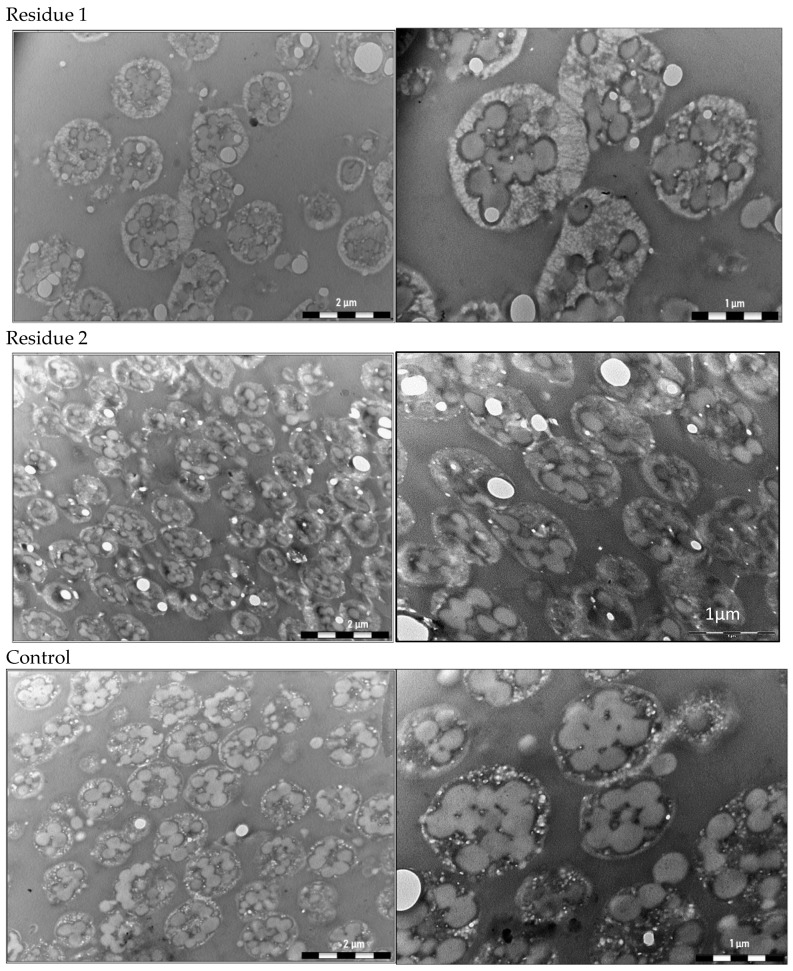
The haloarchaeon synthesizes poly(3-hydroxybutyrate--3-hydroxyvalerate) (PHBV) under unfavorable nutritional conditions without the addition of any precursor to the culture, which is an advantage compared to other microbial counterparts able to synthesize polyhydroxyalkanoates (PHA). PHBV is a biodegradable polymer showing physiochemical properties of biotechnological and biomedical interest and can be used as an alternative to plastics made from chemical synthesis (which are not environmentally friendly). The versatile metabolism of makes the use of waste as a carbon source for cellular growth and PHA synthesis possible. In this work, cellular growth and the production and characterization of PHBV using two different types of confectionery waste were analyzed and compared with cellular growth and PHBV synthesis in a standard culture media with glucose of analytical grade as a carbon source. The PHBV granules produced were analyzed by TEM and the biopolymer was isolated and characterized by GC-MS, FTIR NMR, and DSC. The results reveal that can use these two residues (R1 and R2) for pure PHBV production, achieving 0.256 and 0.983 g PHBV/L, respectively, which are among the highest yields so far described using for the first-time waste from the candy industry. Thus, a circular economy-based process has been designed to optimize the upscaling of PHBV production by using haloarchaea as cell factories and valorizing confectionery waste.
嗜盐古菌在不利的营养条件下,无需向培养物中添加任何前体就能合成聚(3-羟基丁酸酯-3-羟基戊酸酯)(PHBV),与其他能够合成聚羟基脂肪酸酯(PHA)的微生物相比,这是一个优势。PHBV是一种可生物降解的聚合物,具有生物技术和生物医学方面感兴趣的物理化学性质,可作为化学合成塑料(不环保)的替代品。[嗜盐古菌]的多功能代谢使得利用废物作为细胞生长和PHA合成的碳源成为可能。在这项工作中,分析了使用两种不同类型的糖果废料进行细胞生长以及PHBV的生产和表征,并与以分析纯葡萄糖作为碳源的标准培养基中的细胞生长和PHBV合成进行了比较。通过透射电子显微镜(TEM)分析所产生的PHBV颗粒,并通过气相色谱-质谱联用仪(GC-MS)、傅里叶变换红外光谱仪(FTIR)、核磁共振仪(NMR)和差示扫描量热仪(DSC)对该生物聚合物进行分离和表征。结果表明,[嗜盐古菌]可以利用这两种废料(R1和R2)生产纯PHBV,产量分别达到0.256和0.983 g PHBV/L,这是迄今为止首次使用糖果工业废料所报道的最高产量之一。因此,设计了一种基于循环经济的工艺,以优化利用嗜盐古菌作为细胞工厂生产PHBV的规模扩大,并使糖果废料增值。