Giri Sumon, Chakraborty Anhic, Mandal Chiranjit, Rajwar Tushar Kanti, Halder Jitu, Irfan Zainab, Gouda Mostafa M
Department of Pharmaceutical Technology, Brainware University, Barasat, Kolkata 700125, India.
Department of Pharmaceutics, School of Pharmaceutical Sciences, Siksha 'O' Anusandhan (Deemed to be University), Bhubaneswar 751030, India.
Gels. 2024 Sep 5;10(9):578. doi: 10.3390/gels10090578.
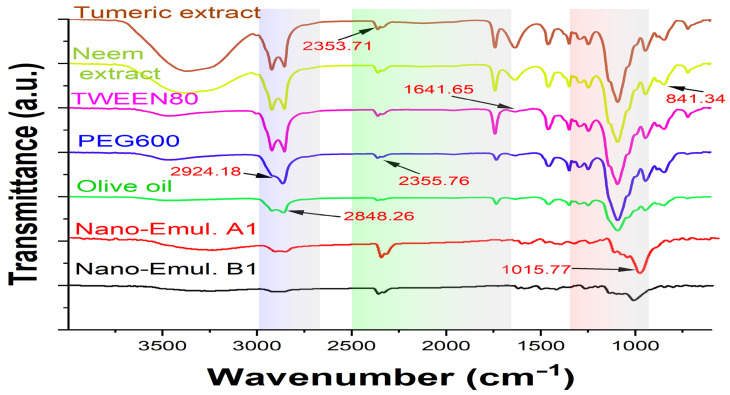
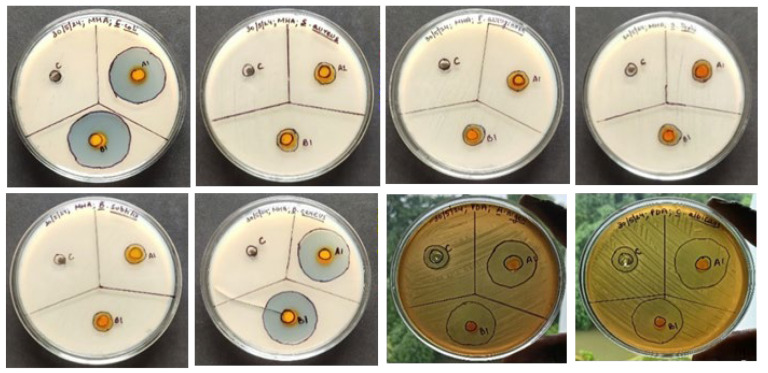
The combination of nanoemulgel and phytochemistry has resulted in several recent discoveries in the field of topical delivery systems. The present study aimed to prepare nanoemulgel based on turmeric () and neem () against microbial infection as topical drug delivery. Olive oil (oil phase), Tween 80 (surfactant), and PEG600 (co-surfactant) were used for the preparation of nanoemulsion. Carbopol 934 was used as a gelling agent to convert the nanoemulsion to nanoemulgel and promote the control of the release of biological properties of turmeric and neem. The nanoemulsion was characterized based on particle size distribution, PDI values, and compatibility using FTIR analysis. In contrast, the nanoemulgel was evaluated based on pH, viscosity, spreadability, plant extract and excipient compatibility or physical state, in vitro study, ex vivo mucoadhesive study, antimicrobial properties, and stability. The resulting nanoemulsion was homogeneous and stable during the centrifugation process, with the smallest droplets and low PDI values. FTIR analysis also confirmed good compatibility and absence of phase separation between the oil substance, surfactant, and co-surfactant with both plant extracts. The improved nanoemulgel also demonstrated a smooth texture, good consistency, good pH, desired viscosity, ex vivo mucoadhesive strength with the highest spreadability, and 18 h in vitro drug release. Additionally, it exhibited better antimicrobial properties against different microbial strains. Stability studies also revealed that the product had good rheological properties and physicochemical state for a period of over 3 months. The present study affirmed that turmeric- and neem-based nanoemulgel is a promising alternative for microbial infection particularly associated with microorganisms via topical application.
纳米乳凝胶与植物化学的结合在局部给药系统领域带来了一些最新发现。本研究旨在制备基于姜黄()和印楝()的纳米乳凝胶,用于对抗微生物感染,作为局部药物递送载体。使用橄榄油(油相)、吐温80(表面活性剂)和聚乙二醇600(助表面活性剂)制备纳米乳液。使用卡波姆934作为胶凝剂将纳米乳液转化为纳米乳凝胶,并促进对姜黄和印楝生物特性释放的控制。基于粒径分布、多分散指数(PDI)值以及使用傅里叶变换红外光谱(FTIR)分析的相容性对纳米乳液进行表征。相比之下,基于pH值、粘度、铺展性、植物提取物与辅料的相容性或物理状态、体外研究、离体粘膜粘附研究、抗菌性能和稳定性对纳米乳凝胶进行评估。所得纳米乳液在离心过程中均匀且稳定,液滴最小且PDI值低。FTIR分析还证实了油质、表面活性剂和助表面活性剂与两种植物提取物之间具有良好的相容性且无相分离。改进后的纳米乳凝胶还表现出质地光滑、稠度良好、pH值适宜、粘度符合要求、具有最高铺展性的离体粘膜粘附强度以及18小时的体外药物释放。此外,它对不同微生物菌株表现出更好的抗菌性能。稳定性研究还表明,该产品在超过3个月的时间内具有良好的流变学性质和物理化学状态。本研究证实,基于姜黄和印楝的纳米乳凝胶是通过局部应用对抗微生物感染,特别是与微生物相关感染的一种有前景的替代物。