Krissansen-Totton Joshua, Wogan Nicholas, Thompson Maggie, Fortney Jonathan J
Department of Earth and Space Sciences/Astrobiology Program, University of Washington, Seattle, WA, 98195, USA.
NASA NExSS Virtual Planetary Laboratory, University of Washington, Seattle, WA, 98195, USA.
Nat Commun. 2024 Sep 27;15(1):8374. doi: 10.1038/s41467-024-52642-6.
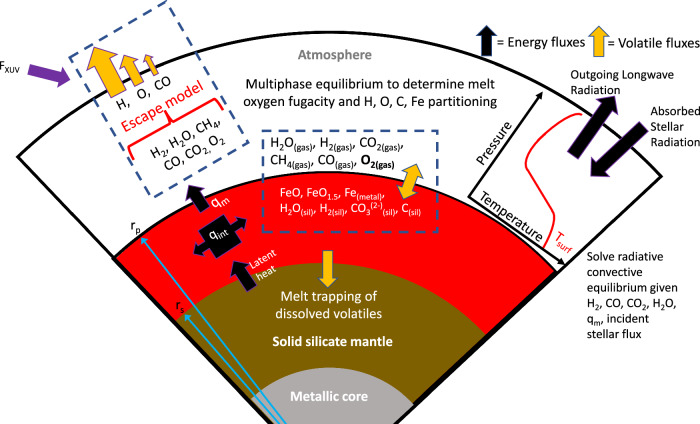
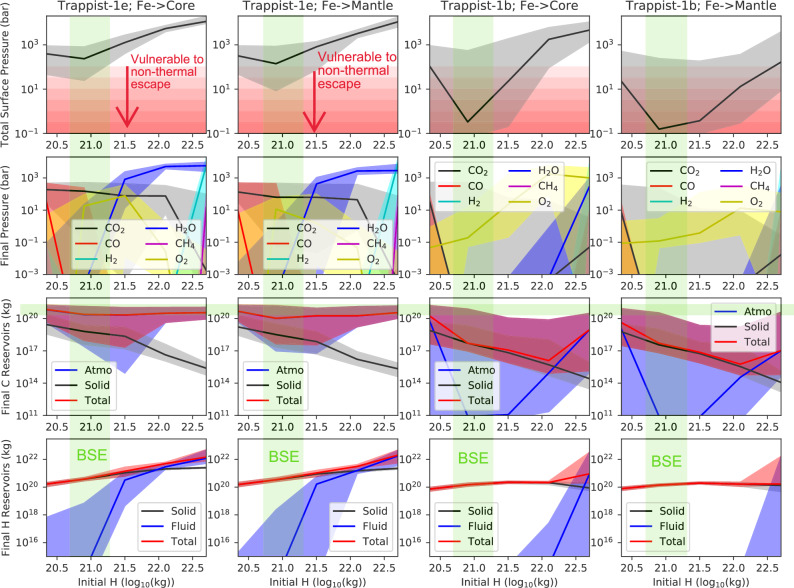
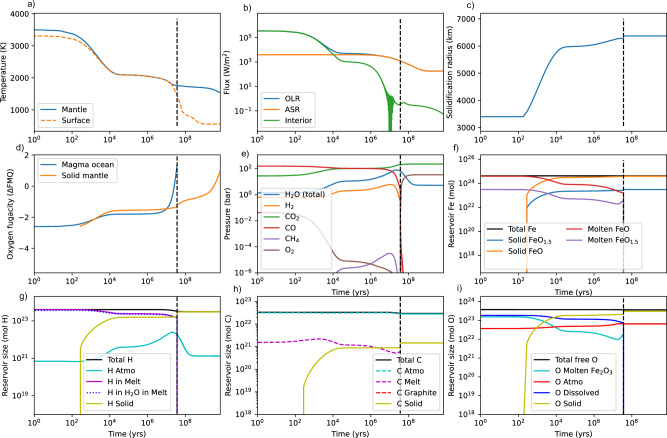
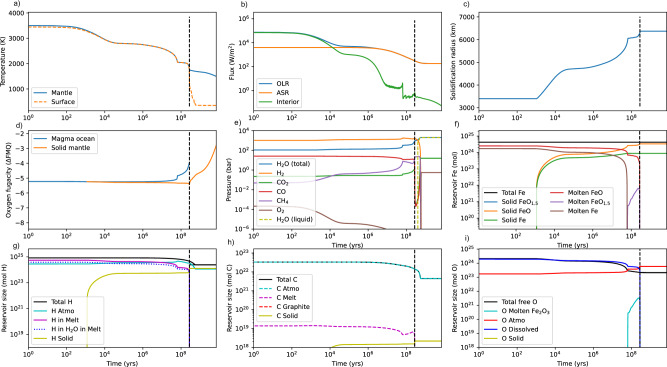
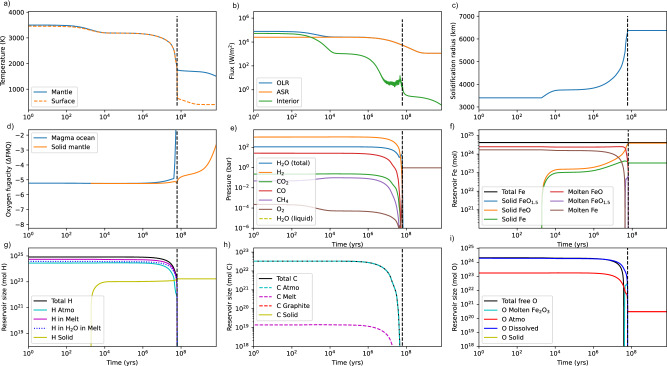
Exoplanet exploration has revealed that many-perhaps most-terrestrial exoplanets formed with substantial H-rich envelopes, seemingly in contrast to solar system terrestrials, for which there is scant evidence of long-lived primary atmospheres. It is not known how a long-lived primary atmosphere might affect the subsequent habitability prospects of terrestrial exoplanets. Here, we present a new, self-consistent evolutionary model of the transition from primary to secondary atmospheres. The model incorporates all Fe-C-O-H-bearing species and simulates magma ocean solidification, radiative-convective climate, thermal escape, and mantle redox evolution. For our illustrative example TRAPPIST-1, our model strongly favors atmosphere retention for the habitable zone planet TRAPPIST-1e. In contrast, the same model predicts a comparatively thin atmosphere for the Venus-analog TRAPPIST-1b, which would be vulnerable to complete erosion via non-thermal escape and is consistent with JWST observations. More broadly, we conclude that the erosion of primary atmospheres typically does not preclude surface habitability, and frequently results in large surface water inventories due to the reduction of FeO by H.
系外行星探索表明,许多(也许是大多数)类地系外行星形成时带有大量富含氢的包层,这似乎与太阳系类地行星形成对比,因为几乎没有证据表明太阳系类地行星存在长期的原始大气。目前尚不清楚长期存在的原始大气会如何影响类地系外行星随后的宜居前景。在此,我们提出了一个从原始大气到次生大气转变的全新、自洽的演化模型。该模型纳入了所有含Fe-C-O-H的物种,并模拟了岩浆海洋固化、辐射对流气候、热逃逸以及地幔氧化还原演化。对于我们的示例TRAPPIST-1,我们的模型强烈支持宜居带行星TRAPPIST-1e保留大气。相比之下,同一模型预测类似金星的TRAPPIST-1b的大气相对较薄,它可能会因非热逃逸而完全被侵蚀,这与詹姆斯·韦布空间望远镜(JWST)的观测结果一致。更广泛地说,我们得出结论,原始大气的侵蚀通常并不排除表面宜居性,而且由于氢对FeO的还原作用,常常会导致大量的地表水存量。