• 文献检索
  • 文档翻译
  • 深度研究
  • 学术资讯
  • Suppr Zotero 插件Zotero 插件
  • 邀请有礼
  • 套餐&价格
  • 历史记录
应用&插件
Suppr Zotero 插件Zotero 插件浏览器插件Mac 客户端Windows 客户端微信小程序
定价
高级版会员购买积分包购买API积分包
服务
文献检索文档翻译深度研究API 文档MCP 服务
关于我们
关于 Suppr公司介绍联系我们用户协议隐私条款
关注我们

Suppr 超能文献

核心技术专利:CN118964589B侵权必究
粤ICP备2023148730 号-1Suppr @ 2026

文献检索

告别复杂PubMed语法,用中文像聊天一样搜索,搜遍4000万医学文献。AI智能推荐,让科研检索更轻松。

立即免费搜索

文件翻译

保留排版,准确专业,支持PDF/Word/PPT等文件格式,支持 12+语言互译。

免费翻译文档

深度研究

AI帮你快速写综述,25分钟生成高质量综述,智能提取关键信息,辅助科研写作。

立即免费体验

岩石系外行星 TRAPPIST-1c 上没有浓厚的二氧化碳大气层。

No thick carbon dioxide atmosphere on the rocky exoplanet TRAPPIST-1 c.

机构信息

Max-Planck-Institut für Astronomie, Heidelberg, Germany.

Leiden Observatory, Leiden University, Leiden, The Netherlands.

出版信息

Nature. 2023 Aug;620(7975):746-749. doi: 10.1038/s41586-023-06232-z. Epub 2023 Jun 19.

DOI:10.1038/s41586-023-06232-z
PMID:37337068
原文链接:https://pmc.ncbi.nlm.nih.gov/articles/PMC10447244/
Abstract

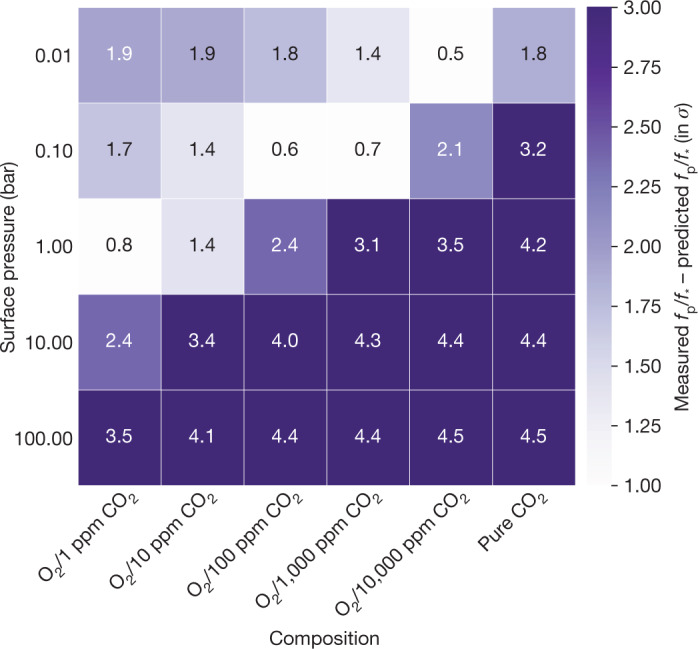
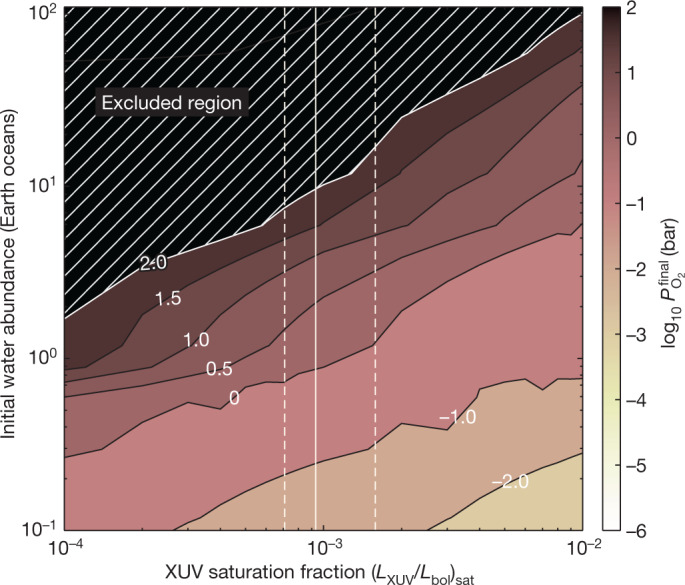
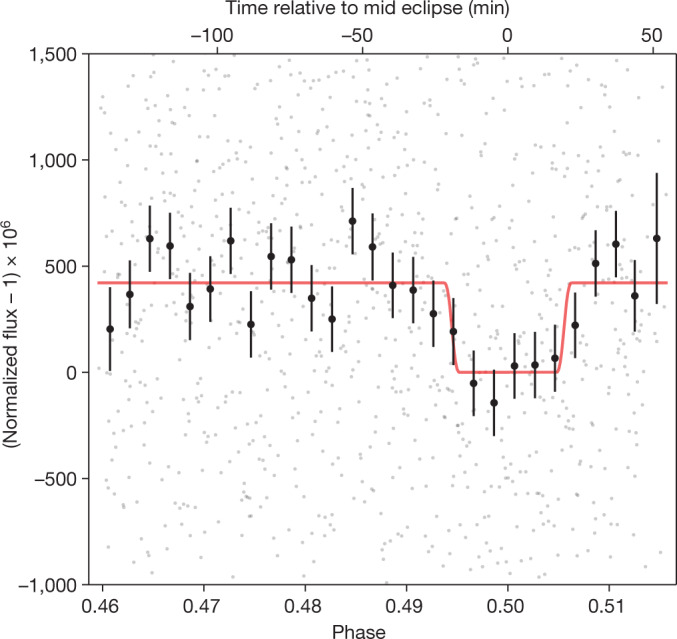
Seven rocky planets orbit the nearby dwarf star TRAPPIST-1, providing a unique opportunity to search for atmospheres on small planets outside the Solar System. Thanks to the recent launch of the James Webb Space Telescope (JWST), possible atmospheric constituents such as carbon dioxide (CO) are now detectable. Recent JWST observations of the innermost planet TRAPPIST-1 b showed that it is most probably a bare rock without any CO in its atmosphere. Here we report the detection of thermal emission from the dayside of TRAPPIST-1 c with the Mid-Infrared Instrument (MIRI) on JWST at 15 µm. We measure a planet-to-star flux ratio of f/f = 421 ± 94 parts per million (ppm), which corresponds to an inferred dayside brightness temperature of 380 ± 31 K. This high dayside temperature disfavours a thick, CO-rich atmosphere on the planet. The data rule out cloud-free O/CO mixtures with surface pressures ranging from 10 bar (with 10 ppm CO) to 0.1 bar (pure CO). A Venus-analogue atmosphere with sulfuric acid clouds is also disfavoured at 2.6σ confidence. Thinner atmospheres or bare-rock surfaces are consistent with our measured planet-to-star flux ratio. The absence of a thick, CO-rich atmosphere on TRAPPIST-1 c suggests a relatively volatile-poor formation history, with less than [Formula: see text] Earth oceans of water. If all planets in the system formed in the same way, this would indicate a limited reservoir of volatiles for the potentially habitable planets in the system.

摘要

七颗类地行星围绕着附近的矮星 TRAPPIST-1 运行,这为在太阳系外的小行 星上寻找大气层提供了独特的机会。由于最近詹姆斯·韦伯太空望远镜(JWST)的发 射,现在可以探测到二氧化碳(CO)等可能的大气成分。最近 JWST 对最内层行星 TRAPPIST-1b 的观测表明,它很可能是一颗没有任何 CO 大气层的裸露岩石行星。在这里,我们报告了在 JWST 的中红外仪器(MIRI)在 15μm 处探测到 TRAPPIST-1c 的昼面热辐射。我们测量到行星-恒星通量比 f/f=421±94ppm,这对应于推断出的昼面亮度温度为 380±31K。这个高昼面温度不利于行星上存在厚的、富含 CO 的大气层。数据排除了无云的 O/CO 混合物,其表面压力范围从 10 巴(含 10ppm CO)到 0.1 巴(纯 CO)。在 2.6σ置信度下,也排除了具有硫酸云的类金星大气。较薄的大气层或裸露的岩石表面与我们测量的行星-恒星通量比一致。TRAPPIST-1c 上没有厚的、富含 CO 的大气层表明其形成历史相对缺乏挥发物,水的含量不到[Formula: see text]个地球海洋。如果系统中的所有行星都是以同样的方式形成的,这将表明该系统中潜在宜居行星的挥发物储量有限。
https://cdn.ncbi.nlm.nih.gov/pmc/blobs/4c66/10447244/9307ba422d2c/41586_2023_6232_Fig10_ESM.jpg
https://cdn.ncbi.nlm.nih.gov/pmc/blobs/4c66/10447244/18a9ff6d9f2e/41586_2023_6232_Fig1_HTML.jpg
https://cdn.ncbi.nlm.nih.gov/pmc/blobs/4c66/10447244/cb5fcdcbff44/41586_2023_6232_Fig2_HTML.jpg
https://cdn.ncbi.nlm.nih.gov/pmc/blobs/4c66/10447244/7e8406042499/41586_2023_6232_Fig3_HTML.jpg
https://cdn.ncbi.nlm.nih.gov/pmc/blobs/4c66/10447244/ced4eba3b29d/41586_2023_6232_Fig4_HTML.jpg
https://cdn.ncbi.nlm.nih.gov/pmc/blobs/4c66/10447244/9aed45d345f9/41586_2023_6232_Fig5_ESM.jpg
https://cdn.ncbi.nlm.nih.gov/pmc/blobs/4c66/10447244/c783cebef1f7/41586_2023_6232_Fig6_ESM.jpg
https://cdn.ncbi.nlm.nih.gov/pmc/blobs/4c66/10447244/e2fec4f83848/41586_2023_6232_Fig7_ESM.jpg
https://cdn.ncbi.nlm.nih.gov/pmc/blobs/4c66/10447244/35274047e87f/41586_2023_6232_Fig8_ESM.jpg
https://cdn.ncbi.nlm.nih.gov/pmc/blobs/4c66/10447244/fb5394e5f8ee/41586_2023_6232_Fig9_ESM.jpg
https://cdn.ncbi.nlm.nih.gov/pmc/blobs/4c66/10447244/9307ba422d2c/41586_2023_6232_Fig10_ESM.jpg
https://cdn.ncbi.nlm.nih.gov/pmc/blobs/4c66/10447244/18a9ff6d9f2e/41586_2023_6232_Fig1_HTML.jpg
https://cdn.ncbi.nlm.nih.gov/pmc/blobs/4c66/10447244/cb5fcdcbff44/41586_2023_6232_Fig2_HTML.jpg
https://cdn.ncbi.nlm.nih.gov/pmc/blobs/4c66/10447244/7e8406042499/41586_2023_6232_Fig3_HTML.jpg
https://cdn.ncbi.nlm.nih.gov/pmc/blobs/4c66/10447244/ced4eba3b29d/41586_2023_6232_Fig4_HTML.jpg
https://cdn.ncbi.nlm.nih.gov/pmc/blobs/4c66/10447244/9aed45d345f9/41586_2023_6232_Fig5_ESM.jpg
https://cdn.ncbi.nlm.nih.gov/pmc/blobs/4c66/10447244/c783cebef1f7/41586_2023_6232_Fig6_ESM.jpg
https://cdn.ncbi.nlm.nih.gov/pmc/blobs/4c66/10447244/e2fec4f83848/41586_2023_6232_Fig7_ESM.jpg
https://cdn.ncbi.nlm.nih.gov/pmc/blobs/4c66/10447244/35274047e87f/41586_2023_6232_Fig8_ESM.jpg
https://cdn.ncbi.nlm.nih.gov/pmc/blobs/4c66/10447244/fb5394e5f8ee/41586_2023_6232_Fig9_ESM.jpg
https://cdn.ncbi.nlm.nih.gov/pmc/blobs/4c66/10447244/9307ba422d2c/41586_2023_6232_Fig10_ESM.jpg

相似文献

1
No thick carbon dioxide atmosphere on the rocky exoplanet TRAPPIST-1 c.岩石系外行星 TRAPPIST-1c 上没有浓厚的二氧化碳大气层。
Nature. 2023 Aug;620(7975):746-749. doi: 10.1038/s41586-023-06232-z. Epub 2023 Jun 19.
2
Thermal emission from the Earth-sized exoplanet TRAPPIST-1 b using JWST.利用 JWST 观测地球大小系外行星 TRAPPIST-1b 的热辐射。
Nature. 2023 Jun;618(7963):39-42. doi: 10.1038/s41586-023-05951-7. Epub 2023 Mar 27.
3
The Habitability of Proxima Centauri b: Environmental States and Observational Discriminants.比邻星 b 的可居住性:环境状态和观测判别。
Astrobiology. 2018 Feb;18(2):133-189. doi: 10.1089/ast.2016.1589. Epub 2018 Feb 12.
4
A temperate rocky super-Earth transiting a nearby cool star.一颗温暖的岩石超级地球凌日一颗附近的冷恒星。
Nature. 2017 Apr 19;544(7650):333-336. doi: 10.1038/nature22055.
5
Magma Ocean Evolution of the TRAPPIST-1 Planets.TRAPPIST-1行星的岩浆海洋演化
Astrobiology. 2021 Nov;21(11):1325-1349. doi: 10.1089/ast.2020.2277. Epub 2021 Jul 26.
6
Surface and Oceanic Habitability of Trappist-1 Planets under the Impact of Flares.《耀斑影响下的“TRAPPIST-1 行星”的表面和海洋宜居性》
Astrobiology. 2020 Dec;20(12):1465-1475. doi: 10.1089/ast.2019.2126.
7
M stars as targets for terrestrial exoplanet searches and biosignature detection.M型恒星作为类地系外行星搜索和生物特征探测的目标。
Astrobiology. 2007 Feb;7(1):85-166. doi: 10.1089/ast.2006.0125.
8
Habitable zones around main sequence stars.主序星周围的宜居带。
Icarus. 1993 Jan;101(1):108-28. doi: 10.1006/icar.1993.1010.
9
Assessment of Isoprene as a Possible Biosignature Gas in Exoplanets with Anoxic Atmospheres.评估缺氧行星大气中的异戊二烯是否可能成为生物特征气体。
Astrobiology. 2021 Jul;21(7):765-792. doi: 10.1089/ast.2019.2146. Epub 2021 Apr 1.
10
Phosphine as a Biosignature Gas in Exoplanet Atmospheres.磷化氢作为系外行星大气中的生物特征气体。
Astrobiology. 2020 Feb;20(2):235-268. doi: 10.1089/ast.2018.1954. Epub 2019 Nov 22.

引用本文的文献

1
Tracing the inner edge of the habitable zone with sulfur chemistry.利用硫化学追踪宜居带的内边缘。
Sci Adv. 2025 Jan 31;11(5):eadp8105. doi: 10.1126/sciadv.adp8105. Epub 2025 Jan 29.
2
The Role of Atmospheric Composition in Defining the Habitable Zone Limits and Supporting Growth.大气成分在界定宜居带范围及支持生命生长方面的作用。
Life (Basel). 2025 Jan 10;15(1):79. doi: 10.3390/life15010079.
3
Magma Ocean Evolution at Arbitrary Redox State.任意氧化还原状态下的岩浆海洋演化

本文引用的文献

1
Thermal emission from the Earth-sized exoplanet TRAPPIST-1 b using JWST.利用 JWST 观测地球大小系外行星 TRAPPIST-1b 的热辐射。
Nature. 2023 Jun;618(7963):39-42. doi: 10.1038/s41586-023-05951-7. Epub 2023 Mar 27.
2
Early Release Science of the exoplanet WASP-39b with JWST NIRCam.用 JWST NIRCam 观测系外行星 WASP-39b 的早期科学释放。
Nature. 2023 Feb;614(7949):653-658. doi: 10.1038/s41586-022-05590-4. Epub 2023 Jan 9.
3
Early Release Science of the exoplanet WASP-39b with JWST NIRSpec G395H.系外行星 WASP-39b 的 JWST NIRSpec G395H 早期释放科学
J Geophys Res Planets. 2024 Dec;129(12):e2024JE008576. doi: 10.1029/2024JE008576. Epub 2024 Dec 23.
4
JWST sighting of decametre main-belt asteroids and view on meteorite sources.詹姆斯·韦布空间望远镜对分米级主带小行星的观测及陨石来源的观点。
Nature. 2025 Feb;638(8049):74-78. doi: 10.1038/s41586-024-08480-z. Epub 2024 Dec 9.
5
The erosion of large primary atmospheres typically leaves behind substantial secondary atmospheres on temperate rocky planets.大型原始大气层的侵蚀通常会在温带岩石行星上留下大量的次生大气层。
Nat Commun. 2024 Sep 27;15(1):8374. doi: 10.1038/s41467-024-52642-6.
6
A secondary atmosphere on the rocky exoplanet 55 Cancri e.岩石系外行星55 Cancri e上的次生大气。
Nature. 2024 Jun;630(8017):609-612. doi: 10.1038/s41586-024-07432-x. Epub 2024 May 8.
7
Patterns Lead the Way to Far-from-Equilibrium Materials.模式引领通往远离平衡态材料之路。
ACS Phys Chem Au. 2023 Nov 22;4(1):19-30. doi: 10.1021/acsphyschemau.3c00050. eCollection 2024 Jan 24.
8
Life in the cosmos: JWST hints at lower number of habitable planets.宇宙中的生命:詹姆斯·韦布空间望远镜暗示宜居行星数量较少。
Nature. 2023 Jun;618(7967):897-898. doi: 10.1038/d41586-023-01983-1.
Nature. 2023 Feb;614(7949):664-669. doi: 10.1038/s41586-022-05591-3. Epub 2023 Jan 9.
4
Early Release Science of the exoplanet WASP-39b with JWST NIRSpec PRISM.利用 JWST NIRSpec PRISM 观测系外行星 WASP-39b 的早期释放科学数据
Nature. 2023 Feb;614(7949):659-663. doi: 10.1038/s41586-022-05677-y. Epub 2023 Jan 9.
5
Array programming with NumPy.使用 NumPy 进行数组编程。
Nature. 2020 Sep;585(7825):357-362. doi: 10.1038/s41586-020-2649-2. Epub 2020 Sep 16.
6
Absence of a thick atmosphere on the terrestrial exoplanet LHS 3844b.在地球系外行星 LHS 3844b 上不存在浓厚的大气层。
Nature. 2019 Sep;573(7772):87-90. doi: 10.1038/s41586-019-1497-4. Epub 2019 Aug 19.
7
Atmospheric escape from the TRAPPIST-1 planets and implications for habitability.《TRAPPIST-1 行星的大气逃逸及其对可居住性的影响》
Proc Natl Acad Sci U S A. 2018 Jan 9;115(2):260-265. doi: 10.1073/pnas.1708010115. Epub 2017 Dec 28.
8
Seven temperate terrestrial planets around the nearby ultracool dwarf star TRAPPIST-1.在附近的超低温矮星TRAPPIST-1周围发现了七颗温带类地行星。
Nature. 2017 Feb 22;542(7642):456-460. doi: 10.1038/nature21360.
9
Extreme water loss and abiotic O2 buildup on planets throughout the habitable zones of M dwarfs.M矮星宜居带内各行星上的极端水分流失和非生物氧气积累。
Astrobiology. 2015 Feb;15(2):119-43. doi: 10.1089/ast.2014.1231. Epub 2015 Jan 28.
10
Earth as an extrasolar planet: Earth model validation using EPOXI earth observations.作为一颗系外行星的地球:利用 EPOXI 对地球的观测进行地球模型验证。
Astrobiology. 2011 Jun;11(5):393-408. doi: 10.1089/ast.2011.0642. Epub 2011 Jun 1.