Provita Żory Medical Center, Żory, Poland.
Department of Medical Sciences, The Wojciech Korfanty Upper Silesian Academy, Katowice, Poland.
Sci Rep. 2024 Sep 28;14(1):22410. doi: 10.1038/s41598-024-72412-0.
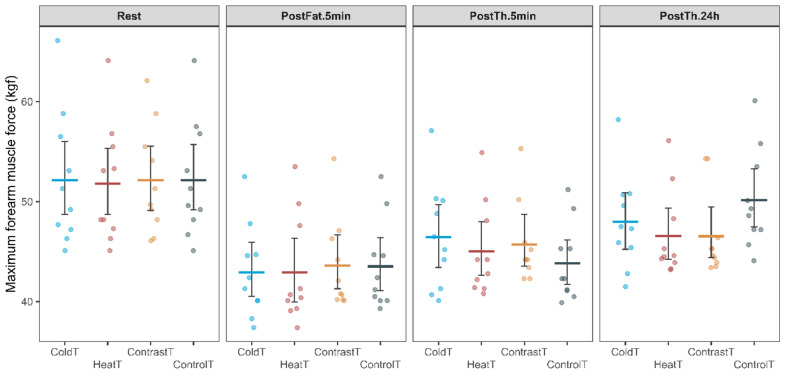
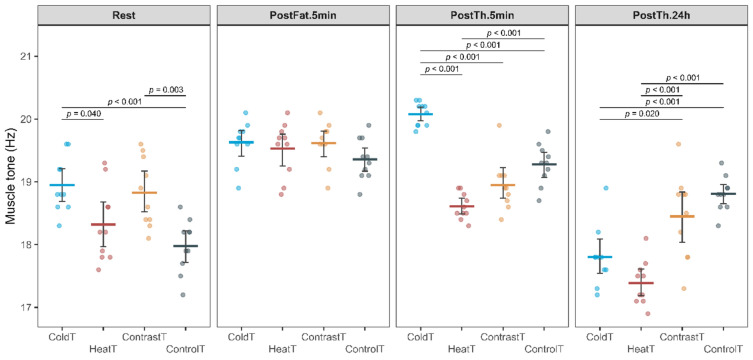
Due to the specific loads that occur in combat sports athletes' forearm muscles, we decided to compare the immediate effect of monotherapy with the use of compressive heat (HT), cold (CT), and alternating therapy (HCT) in terms of eliminating muscle tension, improving muscle elasticity and tissue perfusion and forearm muscle strength. This is a single-blind, randomized, experimental clinical trial. Group allocation was performed using simple 1:1 sequence randomization using the website randomizer.org. The study involved 40 40 combat sports athletes divided into four groups and four therapeutic sessions lasting 20 min. (1) Heat compression therapy session (HT, n = 10) (2) (CT, n = 10), (3) alternating (HCT, n = 10), and sham, control (ShT, n = 10). All participants had measurements of tissue perfusion (PU, [non-reference units]), muscle tension (T-[Hz]), elasticity (E-[arb- relative arbitrary unit]), and maximum isometric force (Fmax [kgf]) of the dominant hand at rest (Rest) after the muscle fatigue protocol (PostFat.5 min), after therapy (PostTh.5 min) and 24 h after therapy (PostTh.24 h). A two-way ANOVA with repeated measures: Group (ColdT, HeatT, ContrstT, ControlT) × Time (Rest, PostFat.5 min, PostTh.5 min, Post.24 h) was used to examine the changes in examined variables. Post-hoc tests with Bonferroni correction and ± 95% confidence intervals (CI) for absolute differences (△) were used to analyze the pairwise comparisons when a significant main effect or interaction was found. The ANOVA for PU, T, E, and Fmax revealed statistically significant interactions of Group by Time factors (p < 0.0001), as well as main effects for the Group factors (p < 0.0001; except for Fmax). In the PostTh.5 min. Period, significantly (p < 0.001) higher PU values were recorded in the HT (19.45 ± 0.91) and HCT (18.71 ± 0.67) groups compared to the ShT (9.79 ± 0.35) group (△ = 9.66 [8.75; 10.57 CI] > MDC, and △ = 8.92 [8.01; 9.83 CI] > MDC, respectively). Also, significantly (p < 0.001) lower values were recorded in the CT (3.69 ± 0.93) compared to the ShT (9.79 ± 0.35) group △ = 6.1 [5.19; 7.01 CI] > MDC. For muscle tone in the PostTh.5 m period significantly (p < 0.001) higher values were observed in the CT (20.08 ± 0.19 Hz) group compared to the HT (18.61 ± 0.21 Hz), HCT (18.95 ± 0.41 Hz) and ShT (19.28 ± 0.33 Hz) groups (respectively: △ = 1.47 [1.11; 1.83 CI] > MDC; △ = 1.13 [0.77; 1.49 CI] > MDC, and △ = 0.8 [0.44; 1.16 CI], < MDC). The highest elasticity value in the PostTh.5 m period were observed in the CT (1.14 ± 0.07) group, and it was significantly higher than the values observed in the HT (0.97 ± 0.03, △ = 0.18 [0.11; 0.24 CI] > MDC, p < 0.001), HCT (0.90 ± 0.04, △ = 0.24 [0.17; 0.31 CI] > MDC, p < 0.001) and ShT (1.05 ± 0.07, △ = 0.094 [0.03; 0.16 CI] = MDC, p = 0.003) groups. For Fmax, there were no statistically significant differences between groups at any level of measurement. The results of the influence of the forearm of all three therapy forms on the muscles' biomechanical parameters confirmed their effectiveness. However, the effect size of alternating contrast therapy cannot be confirmed, especially in the PostTh24h period. Statistically significant changes were observed in favor of this therapy in PU and E measurements immediately after therapy (PostTh.5 min). Further research on contrast therapy is necessary.
由于在格斗运动运动员的前臂肌肉中会出现特定的负荷,我们决定比较单一疗法的即时效果,即使用压缩热 (HT)、冷 (CT) 和交替疗法 (HCT) 来消除肌肉紧张、提高肌肉弹性和组织灌注以及前臂肌肉力量。这是一项单盲、随机、实验性临床试验。使用网站 randomizer.org 进行简单的 1:1 序列随机分组。该研究涉及 40 名 40 名格斗运动运动员,分为四组,每组进行四次治疗,每次持续 20 分钟。(1) 热压缩治疗组 (HT, n = 10) (2) (CT, n = 10), (3) 交替组 (HCT, n = 10) 和假治疗、对照组 (ShT, n = 10)。所有参与者在手疲劳协议后 (PostFat.5 min)、治疗后 (PostTh.5 min) 和治疗后 24 小时 (PostTh.24 h) 测量组织灌注 (PU, [非参考单位])、肌肉张力 (T-[Hz])、弹性 (E-[arb-相对任意单位]) 和最大等长力 (Fmax [kgf]) 休息时 (Rest)。使用重复测量的双因素方差分析:组 (ColdT、HeatT、ContrstT、ControlT) × 时间 (Rest、PostFat.5 min、PostTh.5 min、PostTh.24 h) 来检查检查变量的变化。当发现主效应或交互作用具有统计学意义时,使用具有 Bonferroni 校正的事后检验和绝对差异 (△) 的 95% 置信区间 (CI) 来分析成对比较。对于 PU、T、E 和 Fmax 的 ANOVA 显示,组间因素 (p < 0.0001) 和组因素 (p < 0.0001;除了 Fmax) 都具有统计学显著的交互作用。在 PostTh.5 min 期间,HT (19.45 ± 0.91) 和 HCT (18.71 ± 0.67) 组的 PU 值明显高于 ShT (9.79 ± 0.35) 组 (p < 0.001),△ = 9.66 [8.75;10.57 CI] > MDC,△ = 8.92 [8.01;9.83 CI] > MDC。此外,CT (3.69 ± 0.93) 组的 CT 值明显低于 ShT (9.79 ± 0.35) 组 (p < 0.001),△ = 6.1 [5.19;7.01 CI] > MDC。对于 PostTh.5 m 期间的肌肉张力,CT (20.08 ± 0.19 Hz) 组的 CT 值明显高于 HT (18.61 ± 0.21 Hz)、HCT (18.95 ± 0.41 Hz) 和 ShT (19.28 ± 0.33 Hz) 组 (分别:△ = 1.47 [1.11;1.83 CI] > MDC;△ = 1.13 [0.77;1.49 CI] > MDC,△ = 0.8 [0.44;1.16 CI],< MDC)。PostTh.5 m 期间的最高弹性值出现在 CT (1.14 ± 0.07) 组,明显高于 HT (0.97 ± 0.03,△ = 0.18 [0.11;0.24 CI] > MDC,p < 0.001)、HCT (0.90 ± 0.04,△ = 0.24 [0.17;0.31 CI] > MDC,p < 0.001) 和 ShT (1.05 ± 0.07,△ = 0.094 [0.03;0.16 CI] = MDC,p = 0.003) 组。在任何测量水平下,各组之间的 Fmax 均无统计学差异。三种治疗形式对手臂肌肉生物力学参数的影响结果证实了它们的有效性。然而,交替对比疗法的效果大小无法确认,特别是在 PostTh24h 期间。在治疗后即刻 (PostTh.5 min) 测量的 PU 和 E 方面,这种治疗方法具有统计学意义的变化有利于这种治疗方法。需要进一步研究对比疗法。