Miyamoto Keiko, Okamoto Reiko, Koide Keiko, Shimodawa Mirei
Osaka University Graduate School of Medicine, Division of Health Sciences, Yamadaoka 1-7, Suita-city, Osaka, 565-0871, Japan.
Former Osaka University Graduate School of Medicine, Division of Health Sciences, Suita, Japan.
BMC Nurs. 2024 Sep 27;23(1):678. doi: 10.1186/s12912-024-02287-z.
Health service development aims to close the gap between evidence and practice by adopting and appropriately utilizing the latest findings. To address this gap, dissemination and implementation research has been promoted and developed. Despite promoting evidence-based programs over the years, public health nurses have had few training opportunities in evidence-based public health. This study evaluated the effectiveness of a web-based training in building the basic program implementation capacity of public health nurses with two to five years of experience.
We developed a simulation-powered web-based training according to an Implementation Degree Assessment Sheet for health programs. This was a randomized, single-blind, parallel-group trial. The primary outcome, the result of implementation capacity for public health nurses, was assessed by the total score of the Implementation Degree Assessment Sheet, and scores for its five domains. The secondary outcome was evaluated by the level of understanding. The primary outcome was analyzed utilizing the t-test and analysis of covariance, whereas the secondary outcome was assessed utilizing the U-test and Quade's analysis of covariance. Data were collected directly before intervention (T1: baseline), immediately post-intervention (T2), and four weeks post-intervention (T3: endpoint).
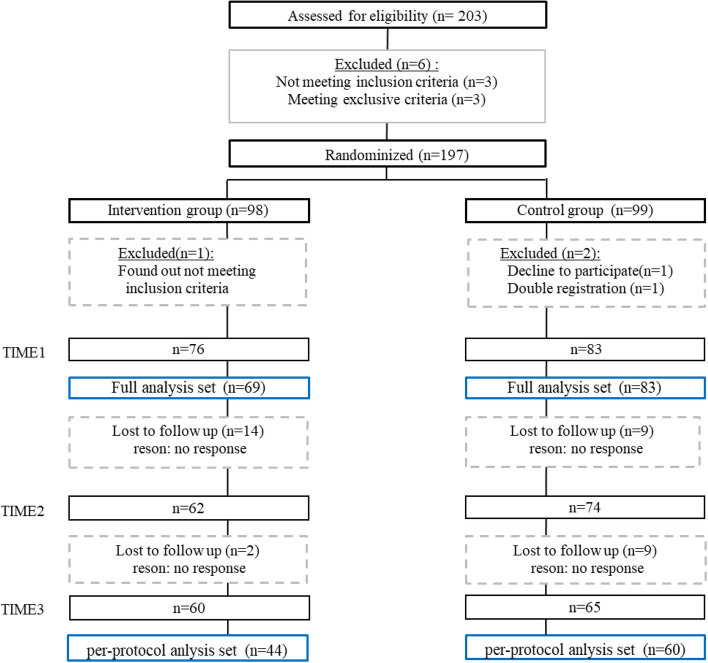
The 197 participants were randomly allocated to either the intervention group (n = 98) or the control group (n = 99). A full analysis set of 152 samples and a per-protocol set of 104 samples were analyzed. The intervention group exhibited a significantly higher total score and five domain-wise scores at the endpoint compared with the control group. The disparity between the endpoint and baseline scores was significantly larger for the intervention group for all scores. The level of understanding was significantly higher in the intervention group than in the control group at T2 and T3. The effect size of the total score was higher in the full analysis set (Cohen's d = 0.5) than in the per-protocol set (d = 0.48).
This web-based training was effective in building the program implementation capacity of participants four weeks post-intervention.
University Hospital Medical Information Network Center Clinical Trials Registry UMIN000048421.
卫生服务发展旨在通过采用并合理利用最新研究成果来缩小证据与实践之间的差距。为解决这一差距,传播与实施研究得到了推广和发展。尽管多年来一直在推广循证项目,但公共卫生护士接受循证公共卫生培训的机会却很少。本研究评估了基于网络的培训对培养有两到五年工作经验的公共卫生护士基本项目实施能力的有效性。
我们根据卫生项目实施程度评估表开发了一个基于模拟的网络培训。这是一项随机、单盲、平行组试验。主要结局,即公共卫生护士的实施能力结果,通过实施程度评估表的总分及其五个领域的得分来评估。次要结局通过理解水平来评估。主要结局采用t检验和协方差分析进行分析,而次要结局采用U检验和Quade协方差分析进行评估。数据在干预前(T1:基线)、干预后立即(T2)以及干预后四周(T3:终点)直接收集。
197名参与者被随机分配到干预组(n = 98)或对照组(n = 99)。对152个样本的完整分析集和104个样本的符合方案集进行了分析。与对照组相比,干预组在终点时的总分和五个领域得分均显著更高。干预组所有得分的终点与基线得分之间的差异显著更大。在T2和T3时,干预组的理解水平显著高于对照组。完整分析集中总分的效应量(Cohen's d = 0.5)高于符合方案集(d = 0.48)。
这项基于网络的培训在干预后四周有效地提高了参与者的项目实施能力。
大学医院医学信息网络中心临床试验注册库UMIN000048421。