Balada Ferran, Aluja Anton, García Óscar, Aymamí Neus, García Luis F
Lleida Institute for Biomedical Research, Dr. Pifarré Foundation, 25198 Lleida, Spain.
Departamento de Psicobiologia i Metodología CCSS, Facultad de Psicologia, Autonomous University of Barcelona, 08193 Barcelona, Spain.
Brain Sci. 2024 Aug 30;14(9):884. doi: 10.3390/brainsci14090884.
Road safety improvement is a governmental priority due to driver-caused accidents. Driving style variation affects safety, with emotional regulation being pivotal. However, functional near-infrared spectroscopy (fNIRS) studies show inconsistent prefrontal cortex activity during emotion processing. This study examines prefrontal cortex response to negative emotional stimuli, particularly traffic accident images, across drivers diverse in age and gender.
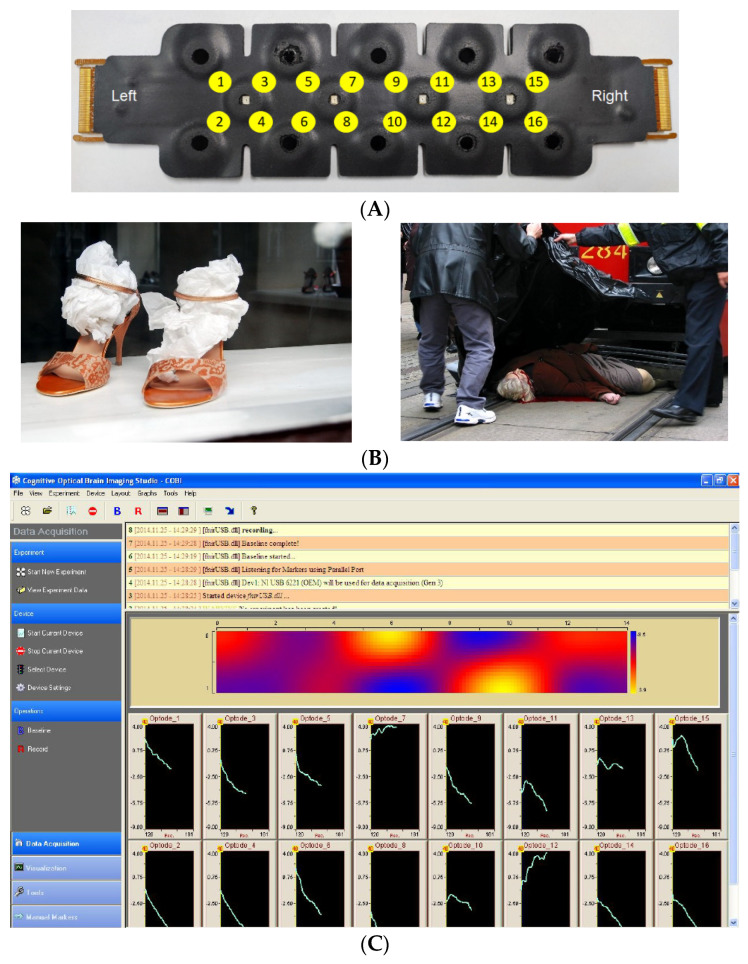
The study involved 118 healthy males (44.38 ± 12.98 years) and 84 females (38.89 ± 10.60 years). The Multidimensional Driving Style Inventory (MDSI) was used to assess driving behavior alongside fNIRS recordings. Participants viewed traffic accident and neutral images while prefrontal oxygenation was monitored.
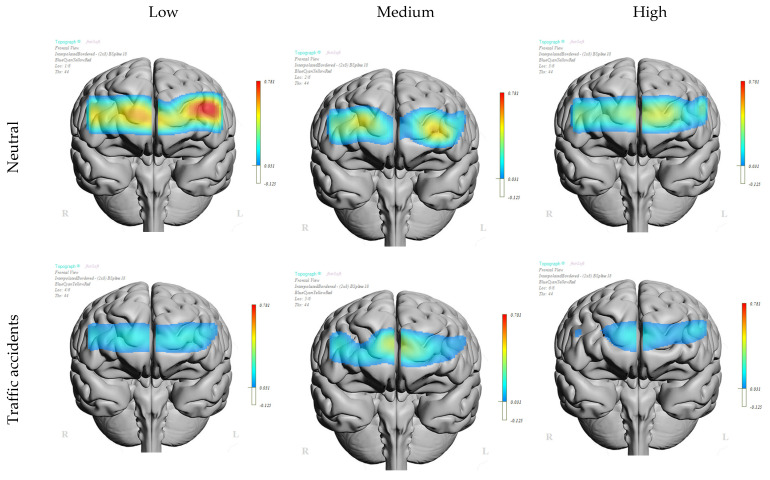
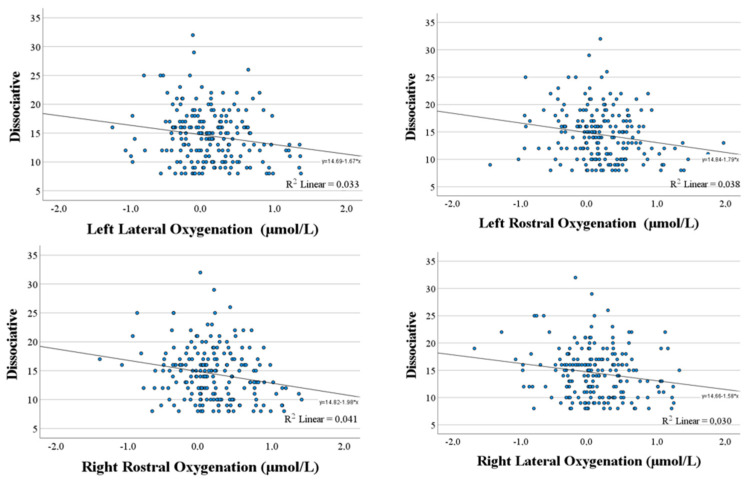
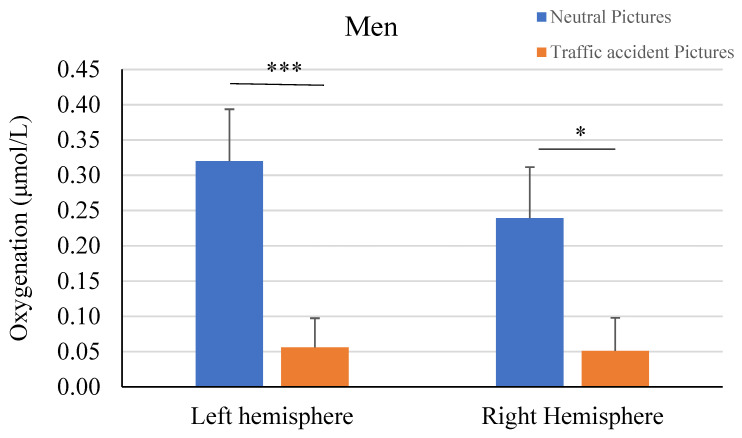
Women rated traffic accidents (-test = 2.43; < 0.016) and neutral images (-test = 2.19; < 0.030) lower in valence than men. Arousal differences were significant for traffic accident images (-test = -3.06; < 0.002). correlational analysis found an inverse relationship between Dissociative scale scores and oxygenation (all -values ≤ 0.013). Greater prefrontal oxygenation occurred with neutral images compared to traffic accidents. Left hemisphere differences (-test = 3.23; < 0.001) exceeded right hemisphere differences (-test = 2.46; < 0.015). Subgroup analysis showed male participants to be driving these disparities. Among adaptive drivers, significant oxygenation differences between neutral and accident images were evident in both hemispheres (left: -test = 2.72, < 0.009; right: -test = 2.22, < 0.030).
Male drivers with maladaptive driving styles, particularly dissociative ones, exhibit reduced prefrontal oxygenation when exposed to neutral and traffic accident images. This response was absent in female drivers, with no notable age-related differences.
由于驾驶员引发的事故,道路安全改善是政府的一项优先任务。驾驶风格的差异会影响安全性,其中情绪调节起着关键作用。然而,功能近红外光谱(fNIRS)研究表明,在情绪处理过程中前额叶皮层的活动并不一致。本研究考察了不同年龄和性别的驾驶员前额叶皮层对负面情绪刺激,特别是交通事故图像的反应。
该研究纳入了118名健康男性(44.38±12.98岁)和84名女性(38.89±10.60岁)。使用多维驾驶风格量表(MDSI)结合fNIRS记录来评估驾驶行为。参与者观看交通事故和中性图像时,监测前额叶的氧合情况。
女性对交通事故(t检验=2.43;P<0.016)和中性图像(t检验=2.19;P<0.030)的效价评分低于男性。交通事故图像的唤醒差异显著(t检验=-3.06;P<0.002)。相关分析发现解离量表得分与氧合之间存在负相关(所有P值≤0.013)。与交通事故图像相比,中性图像时前额叶氧合更高。左半球差异(t检验=3.23;P<0.001)超过右半球差异(t检验=2.46;P<0.015)。亚组分析显示男性参与者导致了这些差异。在适应性驾驶员中,中性图像和事故图像之间在两个半球均存在明显的氧合差异(左:t检验=2.72,P<0.009;右:t检验=2.22,P<0.030)。
具有适应不良驾驶风格,特别是解离型驾驶风格的男性驾驶员,在接触中性和交通事故图像时前额叶氧合降低。女性驾驶员没有这种反应,也没有明显的年龄相关差异。