Serretiello Enrica, Iervolino Domenico, Di Siervi Giuseppe, Gallo Luigi, Bernardi Francesca F, Pagliano Pasquale, Boccia Giovanni, Folliero Veronica, Franci Gianluigi, Rinaldi Luca
Clinical Pathology and Microbiology Unit, San Giovanni di Dio and Ruggi D'Aragona University Hospital, 84131 Salerno, Italy.
Department of Public Health and Infectious Diseases, Sapienza University of Rome, 00185 Rome, Italy.
J Clin Med. 2024 Sep 18;13(18):5534. doi: 10.3390/jcm13185534.
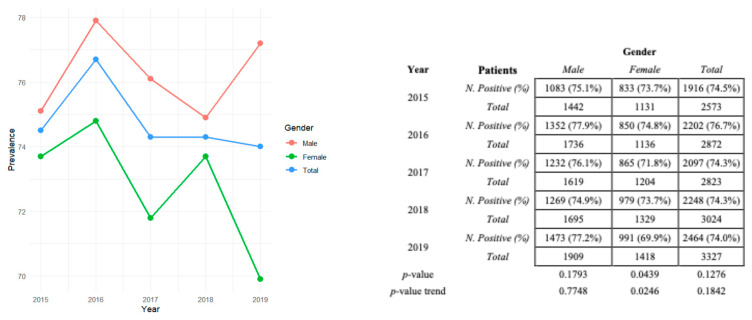
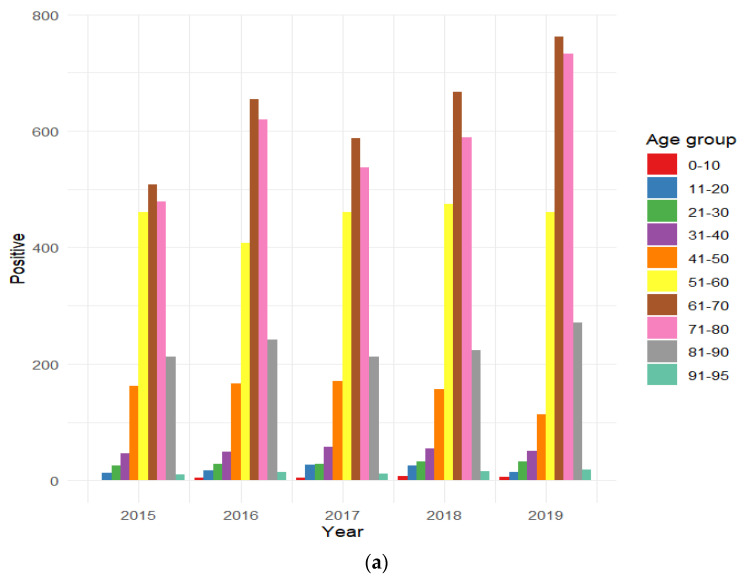
Hepatitis A virus (HAV) infection is a significant global cause of viral hepatitis. At present, the anti-HAV vaccine in Italy is proposed exclusively for specific high-risk groups, and a universal vaccination program is not implemented. This study aimed to assess the level of immunity against HAV in patients of both sexes across age groups ranging from 0 to 95 years admitted to the San Giovanni di Dio e Ruggi d'Aragona Hospital in Salerno, Italy, over a 9-year period (2015-2023). The total HAV seroprevalence by chemiluminescence Vitros system immunodiagnostics (ortho-diagnostics) was obtained by database analysis, stratifying patients for gender and age group in both the pre-pandemic (2015-2019) and pandemic (2020-2023) periods. Out of 28,104 samples collected in 2015-2023, 20,613 resulted positive by total HAV immune screening, with a significant reduction in the annualized proportion of events during the pandemic period compared to the pre-pandemic period. HAV was more abundant in males than females in both periods (exceeding the 70%), with a statistically significant decrease in HAV in females in 2015-2019. The 61-70-year-old age group is more susceptible for both genders, with a strong deviation from the 41-50-year-old age group compared to the 51-60-year-old group. The pandemic period affected the number of analyzed samples in 2020. The study revealed high HAV seroprevalence, especially in males and individuals aged 61-70 years. There was a notable decrease in seroprevalence during the pandemic compared to pre-pandemic years. These results emphasize the need for ongoing monitoring and suggest that a universal vaccination program could address regional immunity gaps and lower disease incidence.
甲型肝炎病毒(HAV)感染是全球病毒性肝炎的一个重要病因。目前,意大利的抗HAV疫苗仅针对特定的高危人群推荐使用,尚未实施全民疫苗接种计划。本研究旨在评估在9年期间(2015 - 2023年)入住意大利萨勒诺的圣乔瓦尼迪奥 - 鲁吉·德阿拉贡纳医院的0至95岁各年龄组男女患者的HAV免疫水平。通过数据库分析,采用化学发光Vitros系统免疫诊断法(奥多诊断法)获得HAV总血清阳性率,并在疫情前(2015 - 2019年)和疫情期间(2020 - 2023年)按性别和年龄组对患者进行分层。在2015 - 2023年收集的28,104份样本中,20,613份经HAV总免疫筛查呈阳性,与疫情前相比,疫情期间事件的年化比例显著降低。在两个时期,男性的HAV感染率均高于女性(超过70%),2015 - 2019年女性的HAV感染率有统计学意义的下降。61 - 70岁年龄组的男女对HAV更易感,与51 - 60岁年龄组相比,与41 - 50岁年龄组有较大偏差。疫情期间影响了2020年分析样本的数量。研究显示HAV血清阳性率较高,尤其是在男性和61 - 70岁的个体中。与疫情前相比,疫情期间血清阳性率显著下降。这些结果强调了持续监测的必要性,并表明全民疫苗接种计划可以弥补地区免疫差距并降低疾病发病率。