Piao JunJie, Shin Dongho, Moon MyeongKeon, Kim SaeWoong, Bae WoongJin
Department of Urology, College of Medicine, The Catholic University of Korea, Seoul 03083, Republic of Korea.
Catholic Integrative Medicine Research Institute, The Catholic University of Korea, Seoul 06591, Republic of Korea.
J Pers Med. 2024 Sep 3;14(9):938. doi: 10.3390/jpm14090938.
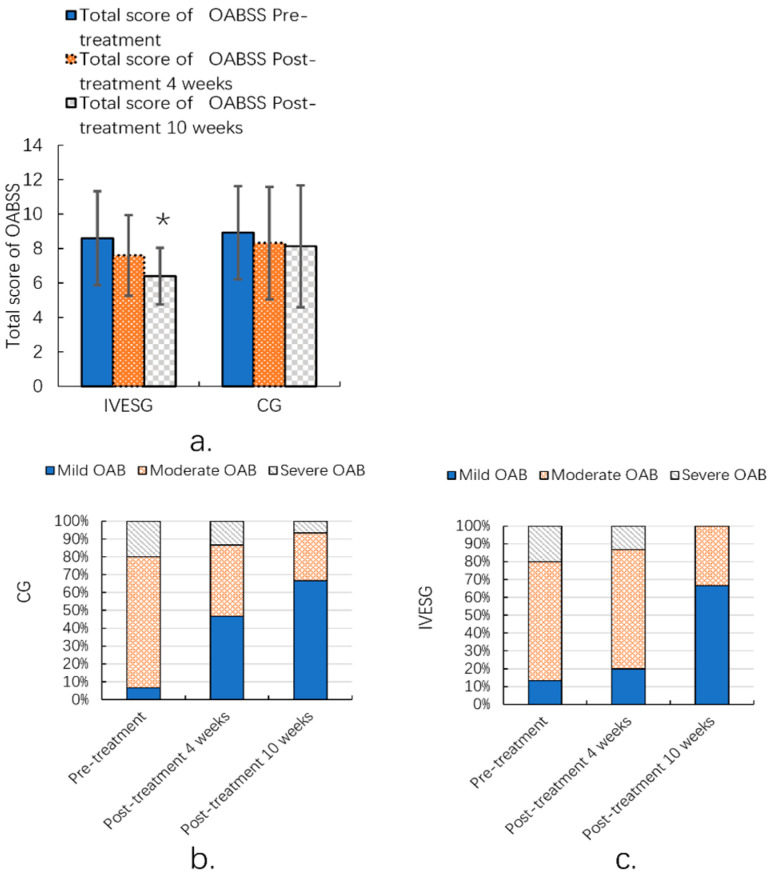
(1) Background: Female sexual dysfunction (FSD) and overactive bladder (OAB) are prevalent disorders that significantly impair women's quality of life. While pelvic floor muscle training (PFMT) is a well-established treatment for OAB, its effectiveness for FSD remains uncertain. Recent studies suggest that intravaginal electrical stimulation (IVES) may enhance the effects of PFMT. Therefore, this study aimed to evaluate the efficacy of combining IVES with PFMT to improve sexual function and bladder control in women with OAB and FSD. (2) Methods: A total of 40 women with FSD and OAB as determined by the Female Sexual Function Index (FSFI) and Overactive Bladder Symptom Score (OABSS) were randomized into two groups: group 1, the intravaginal electrical stimulation group (IVESG) ( = 20), and group 2, the placebo control group (CG) ( = 20). Patients in both groups received PFMT during the trial, and the IVESG underwent 10 weeks of electrical stimulation. The primary outcome was the change in the FSFI score from baseline to week 4 and week 10. The secondary outcome was a comparison of the OABSS values at week 4 and week 10 of the trial. (3) Results: After treatment, the IVESG scores for the total FSFI, sexual arousal and orgasm, increased significantly ( < 0.05). After 10 weeks of treatment, the OABSS values for IVESG were significantly lower ( < 0.01). After 10 weeks of treatment, the percentage of patients with mild OAB in the IVESG and CG increased by 53.33% and 60%, respectively, while the percentage of patients with both moderate and severe OAB decreased, especially in the IVESG, where patients with severe OAB were non-existent after 10 weeks of treatment. (4) Conclusions: IVES combined with PFMT improved objective and subjective measures of FSD and OAB. There was a significant improvement in FSD (including arousal and orgasmic domain scores). This study concludes that IVES is an effective conservative treatment.
(1)背景:女性性功能障碍(FSD)和膀胱过度活动症(OAB)是常见疾病,严重影响女性生活质量。虽然盆底肌训练(PFMT)是治疗OAB的成熟方法,但其对FSD的有效性仍不确定。近期研究表明,阴道内电刺激(IVES)可能增强PFMT的效果。因此,本研究旨在评估IVES联合PFMT对改善OAB和FSD女性性功能及膀胱控制能力的疗效。(2)方法:根据女性性功能指数(FSFI)和膀胱过度活动症症状评分(OABSS)确定的40例患有FSD和OAB的女性被随机分为两组:第1组为阴道内电刺激组(IVESG)(n = 20),第2组为安慰剂对照组(CG)(n = 20)。两组患者在试验期间均接受PFMT,IVESG组接受10周的电刺激。主要结局指标是从基线到第4周和第10周FSFI评分的变化。次要结局指标是试验第4周和第10周OABSS值的比较。(3)结果:治疗后,IVESG组的FSFI总分、性唤起和性高潮评分显著增加(P < 0.05)。治疗10周后,IVESG组的OABSS值显著降低(P < 0.01)。治疗10周后,IVESG组和CG组轻度OAB患者的百分比分别增加了53.33%和60%,而中度和重度OAB患者的百分比下降,尤其是IVESG组,治疗10周后重度OAB患者不存在。(4)结论:IVES联合PFMT改善了FSD和OAB的客观和主观指标。FSD有显著改善(包括性唤起和性高潮领域评分)。本研究得出结论,IVES是一种有效的保守治疗方法。