Mansoor Masab A, Ansari Kashif H
Louisiana Campus, Edward College of Osteopathic Medicine, Monroe, LA 71203, USA.
East Houston Medical Center, Houston, TX 77049, USA.
J Pers Med. 2024 Sep 9;14(9):958. doi: 10.3390/jpm14090958.
The early detection of mental health crises is crucial for timely interventions and improved outcomes. This study explores the potential of artificial intelligence (AI) in analyzing social media data to identify early signs of mental health crises.
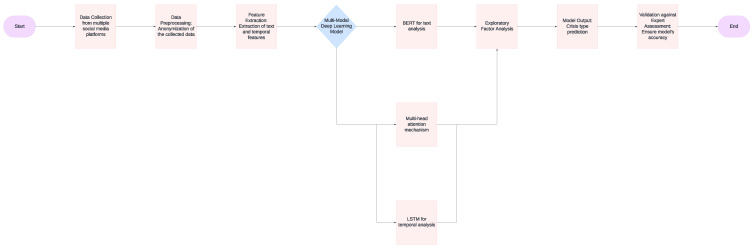
We developed a multimodal deep learning model integrating natural language processing and temporal analysis techniques. The model was trained on a diverse dataset of 996,452 social media posts in multiple languages (English, Spanish, Mandarin, and Arabic) collected from Twitter, Reddit, and Facebook over 12 months. Its performance was evaluated using standard metrics and validated against expert psychiatric assessments.
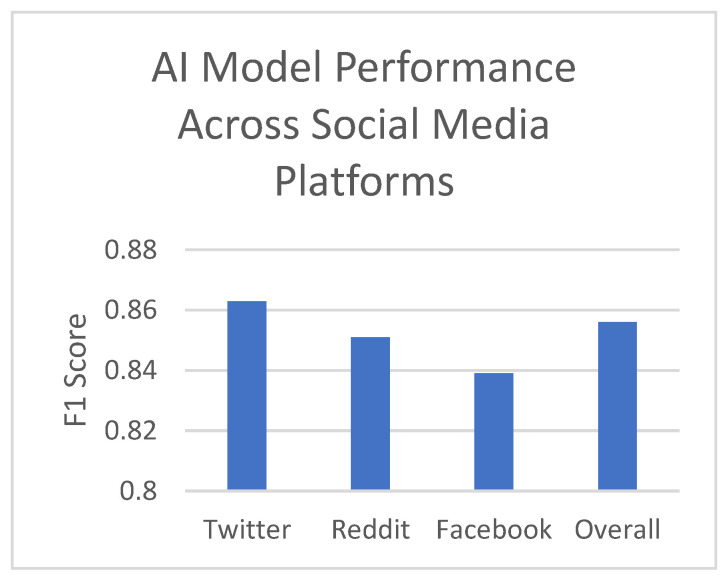
The AI model demonstrated a high level of accuracy (89.3%) in detecting early signs of mental health crises, with an average lead time of 7.2 days before human expert identification. Performance was consistent across languages (F1 scores: 0.827-0.872) and platforms (F1 scores: 0.839-0.863). Key digital markers included linguistic patterns, behavioral changes, and temporal trends. The model showed varying levels of accuracy for different crisis types: depressive episodes (91.2%), manic episodes (88.7%), suicidal ideation (93.5%), and anxiety crises (87.3%).
AI-powered analysis of social media data shows promise for the early detection of mental health crises across diverse linguistic and cultural contexts. However, ethical challenges, including privacy concerns, potential stigmatization, and cultural biases, need careful consideration. Future research should focus on longitudinal outcome studies, ethical integration of the method with existing mental health services, and developing personalized, culturally sensitive models.
心理健康危机的早期发现对于及时干预和改善预后至关重要。本研究探讨了人工智能(AI)在分析社交媒体数据以识别心理健康危机早期迹象方面的潜力。
我们开发了一种整合自然语言处理和时间分析技术的多模态深度学习模型。该模型在12个月内从推特、红迪网和脸书收集的996,452条多种语言(英语、西班牙语、普通话和阿拉伯语)的社交媒体帖子的多样化数据集上进行训练。使用标准指标评估其性能,并与专家精神病学评估进行验证。
人工智能模型在检测心理健康危机早期迹象方面表现出高度准确性(89.3%),在人类专家识别之前平均提前7.2天。跨语言(F1分数:0.827 - 0.872)和平台(F1分数:0.839 - 0.863)的性能一致。关键数字标记包括语言模式、行为变化和时间趋势。该模型对不同危机类型的准确性水平有所不同:抑郁发作(91.2%)、躁狂发作(88.7%)、自杀意念(93.5%)和焦虑危机(87.3%)。
基于人工智能的社交媒体数据分析显示出在不同语言和文化背景下早期检测心理健康危机的前景。然而,包括隐私问题、潜在污名化和文化偏见在内的伦理挑战需要仔细考虑。未来的研究应侧重于纵向结局研究、该方法与现有心理健康服务的伦理整合,以及开发个性化、文化敏感的模型。