Tanase Alina Doina, Fnu Oktrian, Cristescu Dan-Mihai, Barata Paula Irina, David Dana, Petrescu Emanuela-Lidia, Bojoga Daliana-Emanuela, Hoinoiu Teodora, Blidisel Alexandru
Department of Professional Legislation in Dental Medicine, Faculty of Dental Medicine, "Victor Babes" University of Medicine and Pharmacy, Eftimie Murgu Square 2, 300041 Timisoara, Romania.
Doctoral School, "Victor Babes" University of Medicine and Pharmacy, Eftimie Murgu Square 2, 300041 Timisoara, Romania.
J Pers Med. 2024 Sep 11;14(9):966. doi: 10.3390/jpm14090966.
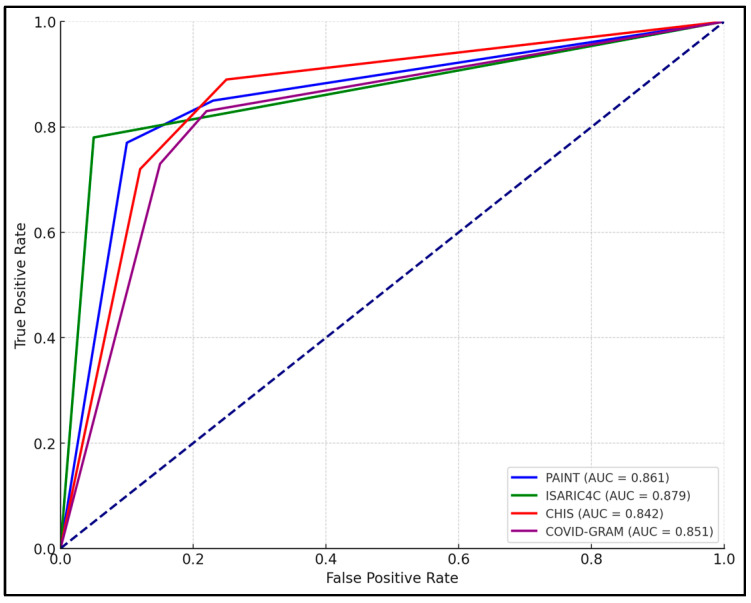
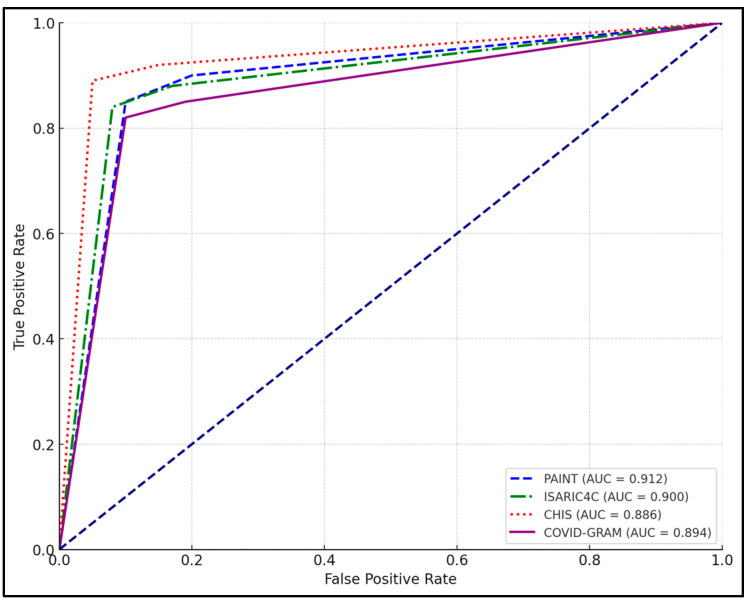
The COVID-19 pandemic underscores the need for accurate prognostic tools to predict patient outcomes. This study evaluates the effectiveness of four prominent COVID-19 prediction scores-PAINT, ISARIC4C, CHIS, and COVID-GRAM-at two critical time points: at admission and seven days post-symptom onset, to assess their utility in predicting mortality among hospitalized patients. Conducted at the Clinical Emergency Hospital Pius Brînzeu in Timișoara, this retrospective analysis included adult patients hospitalized with confirmed SARS-CoV-2 infection. Eligible patients had complete data for the scores at both time points. Statistical analysis involved ROC curves and logistic regression to assess the scores' predictive accuracy for mortality. The study included 215 patients, split into 139 survivors and 76 non-survivors. At admission, the PAINT, ISARIC4C, CHIS, and COVID-GRAM scores significantly differentiated between the survival outcomes ( < 0.0001). The best cutoff values at admission were 6.26 for PAINT, 7.95 for ISARIC4C, 5.58 for CHIS, and 0.63 for COVID-GRAM, corresponding to sensitivities of 85.47%, 80.56%, 88.89%, and 83.33% and specificities of 77.34%, 82.12%, 75.01%, and 78.45%, respectively. By day seven, the cutoff values increased, indicating deteriorating conditions in patients who eventually succumbed to the virus. The hazard ratios at admission for exceeding these cutoffs were significant: PAINT (HR = 3.45), ISARIC4C (HR = 2.89), CHIS (HR = 4.02), and COVID-GRAM (HR = 3.15), highlighting the scores' abilities to predict severe outcomes. One week post symptom onset, these scores' predictive values and corresponding hazard ratios increased, further validating their prognostic significance over time. The evaluated COVID-19 prediction scores robustly predict mortality at admission and become more predictive by the seventh day of symptom onset. These findings support the use of these scores in clinical settings to facilitate early identification and intervention for high-risk patients, potentially improving patient outcomes during the ongoing global health crisis.
新冠疫情凸显了准确预测患者预后的工具的必要性。本研究评估了四种著名的新冠预测评分——PAINT、ISARIC4C、CHIS和COVID - GRAM——在两个关键时间点(入院时和症状出现后七天)的有效性,以评估它们在预测住院患者死亡率方面的效用。这项回顾性分析在蒂米什瓦拉的皮乌斯·布林泽乌临床急诊医院进行,纳入了确诊感染SARS-CoV-2的成年住院患者。符合条件的患者在两个时间点都有完整的评分数据。统计分析采用ROC曲线和逻辑回归来评估评分对死亡率的预测准确性。该研究包括215名患者,分为139名幸存者和76名非幸存者。入院时,PAINT、ISARIC4C、CHIS和COVID - GRAM评分在生存结果之间有显著差异(<0.0001)。入院时的最佳临界值分别为:PAINT为6.26,ISARIC4C为7.95,CHIS为5.58,COVID - GRAM为0.63,相应的灵敏度分别为85.47%、80.56%、88.89%和83.33%,特异性分别为77.34%、82.12%、75.01%和78.45%。到第七天,临界值升高,表明最终死于病毒的患者病情恶化。入院时超过这些临界值的风险比具有显著性:PAINT(HR = 3.45)、ISARIC4C(HR = 2.89)、CHIS(HR = 4.02)和COVID - GRAM(HR = 3.15),突出了这些评分预测严重结果的能力。症状出现一周后,这些评分的预测价值和相应的风险比增加,进一步证实了它们随时间的预后意义。所评估的新冠预测评分能够有力地预测入院时的死亡率,并且在症状出现后第七天预测性更强。这些发现支持在临床环境中使用这些评分,以便于早期识别和干预高危患者,在当前全球健康危机期间可能改善患者预后。