Chaudhry Beenish Moalla, Siek Katie A, Connelly Kay
School of Computing and Informatics, University of Louisiana at Lafayette, Lafayette, LA 70504, USA.
Luddy School of Informatics, Computing and Engineering, Indiana University, Bloomington, IN 47408, USA.
J Pers Med. 2024 Sep 20;14(9):1001. doi: 10.3390/jpm14091001.
Our aim was to study how hemodialysis patients with varying levels of literacy would use a diet and fluid intake monitoring mobile application (DIMA-P) and what would be its impact on their dietary behaviors.
We developed a mobile application using user-centered methods and informed by the Integrated Theory of Health Behavior Change (ITHBC). Eight hemodialysis patients were recruited to use the application to record and monitor their diet and fluid intakes for a 6-week study. Overall, the participants had low literacy, numeracy, and technical skills. We collected the data on application usage and administered usability and context-of-use questionnaires to gain insights into the participants' interaction with the application. The participants' portion estimation skills and dietary self-regulation self-efficacy were assessed using various tests. In addition, interdialytic weight gain data were collected to assess the impact of app usage on the participants' health outcomes.
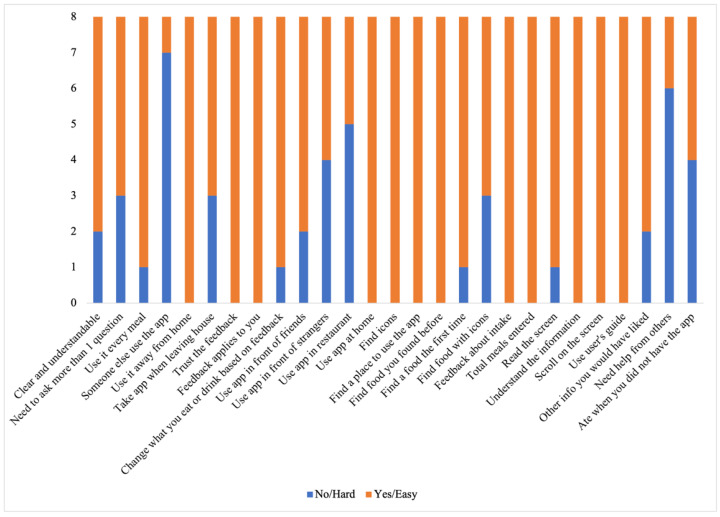
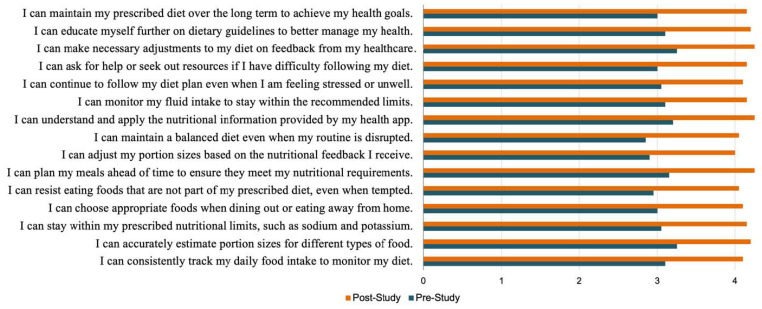
The application usage patterns varied, with a general trend towards frequent use ( = 5) correlating with engagement in self-monitoring. The participants gave high comprehensibility, user-friendliness, satisfaction, and usefulness ratings, suggesting that the app was well designed and the target users could easily navigate and interact with the features. While the participants improved in estimating portion sizes, the impact on measuring skills was variable. There was also an improvement in the participants' dietary self-regulation self-efficacy post-study. The interdialytic weight gain trends indicated a slight improvement in fluid and diet management.
People with different literacy skills can effectively use icon-based interfaces for portion size estimation and develop personalized usage patterns to self-regulate their fluid and dietary intakes. Moreover, they can experience an enhancement in their dietary self-efficacy skills by using a mobile application aimed at providing nutritional feedback. Furthermore, this research shows that the constructs of the ITHBC are effective in promoting dietary behavior change in a population with varying literacy skills. The target users can benefit from explicitly visualizing the relationship between their health outcomes and the factors influencing those outcomes. These user ambitions could be supported by developing machine learning models. Future research should also focus on enhancing the mechanisms by which technology can further enhance each component of the ITHBC framework.
我们的目的是研究不同读写能力水平的血液透析患者如何使用饮食和液体摄入监测移动应用程序(DIMA-P),以及它对患者饮食行为的影响。
我们采用以用户为中心的方法,并依据健康行为改变综合理论(ITHBC)开发了一款移动应用程序。招募了8名血液透析患者使用该应用程序记录和监测他们6周研究期间的饮食和液体摄入量。总体而言,参与者的读写能力、计算能力和技术技能较低。我们收集了应用程序使用数据,并发放了可用性和使用情境问卷,以深入了解参与者与应用程序的交互情况。使用各种测试评估参与者的份量估计技能和饮食自我调节自我效能。此外,收集透析间期体重增加数据,以评估应用程序使用对参与者健康结果的影响。
应用程序的使用模式各不相同,总体趋势是频繁使用(=5)与自我监测的参与度相关。参与者对可理解性、用户友好性、满意度和有用性给予了高度评价,表明该应用程序设计良好,目标用户能够轻松地浏览并与各项功能进行交互。虽然参与者在估计份量大小方面有所改进,但对测量技能的影响各不相同。研究后参与者的饮食自我调节自我效能也有所提高。透析间期体重增加趋势表明在液体和饮食管理方面略有改善。
具有不同读写技能的人可以有效地使用基于图标的界面来估计份量大小,并形成个性化的使用模式来自我调节液体和饮食摄入量。此外,通过使用旨在提供营养反馈的移动应用程序,他们可以体验到饮食自我效能技能的增强。此外,本研究表明,ITHBC的构建在促进不同读写技能人群的饮食行为改变方面是有效的。目标用户可以从明确可视化其健康结果与影响这些结果的因素之间的关系中受益。可以通过开发机器学习模型来支持这些用户目标。未来的研究还应侧重于加强技术进一步增强ITHBC框架各组成部分的机制。