Laboratory of Genetics and Biotechnology, Institute of Biotechnology, Universidade Federal de Uberlândia, Patos de Minas 38700-002, MG, Brazil.
Laboratory of Drug Candidate Synthesis, Institute of Chemistry, Universidade Federal de Uberlândia, Uberlândia 38400-902, MG, Brazil.
Molecules. 2024 Sep 20;29(18):4471. doi: 10.3390/molecules29184471.
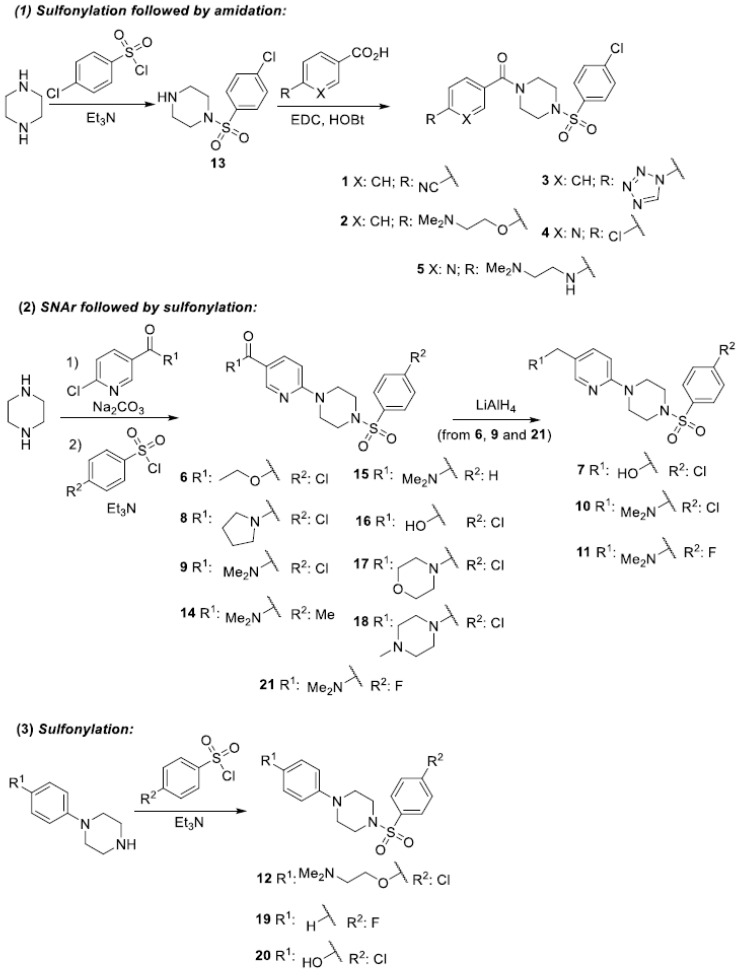
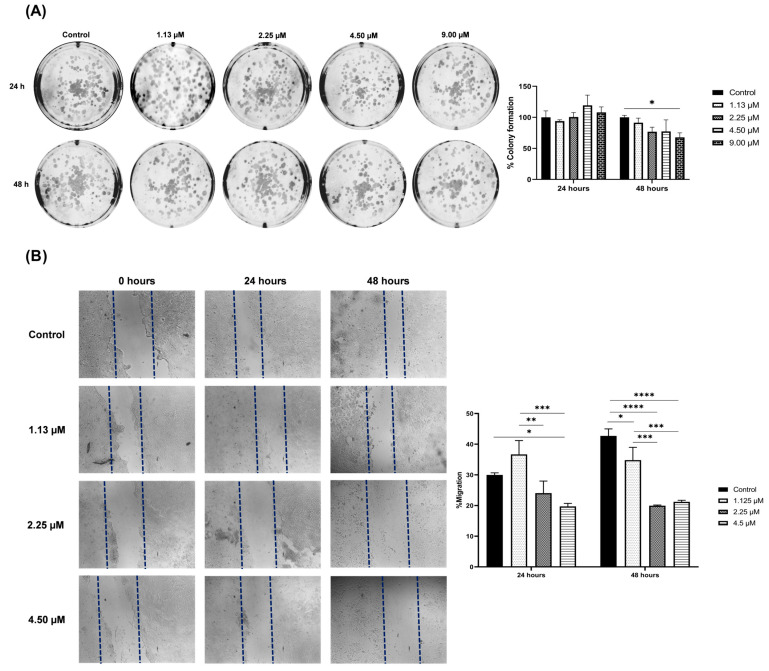
Breast cancer (BC) is the most common cancer in women, and is characterized by its histological and molecular heterogeneity. Luminal BC is an estrogen receptor-positive subtype, with varied clinical courses. Although BC patients are eligible for hormone therapy, both early and late relapses still occur, and thus there is a demand for new cytotoxic and selective treatment strategies for these patients. In the present study, inspired by the structure of phenylsulfonylpiperazine, a series of 20 derivatives were tested in bioassays against MCF7, MDA-MB-231 and MDA-MB-453 BC cells to discover new hit compounds. After 48 h of treatment, 12 derivatives impaired cell viability and presented significant IC values against at least one of the tumor lineages. Overall, the luminal BC cell line MCF7 was more sensitive to treatments. Compound , (4-(1H-tetrazol-1-yl)phenyl)(4-((4-chlorophenyl)sulfonyl)piperazin-1-yl)methanone, was the most promising, with IC = 4.48 μM and selective index (SI) = 35.6 in MCF7 cells. Compound also presented significant antimigratory and antiproliferative activities against luminal BC cells, possibly by affecting the expression of genes involved in the epithelial-mesenchymal transition mechanism, upregulating E-Cadherin transcripts (). Our findings suggest that phenylsulfonylpiperazine derivatives are potential candidates for the development of new therapies, especially those targeting luminal BC.
乳腺癌(BC)是女性最常见的癌症,其特征是组织学和分子异质性。腔 BC 是一种雌激素受体阳性亚型,具有不同的临床病程。尽管 BC 患者有资格接受激素治疗,但仍会出现早期和晚期复发,因此需要为这些患者提供新的细胞毒性和选择性治疗策略。在本研究中,受苯磺酰基哌嗪结构的启发,我们对 MCF7、MDA-MB-231 和 MDA-MB-453 BC 细胞进行了生物测定,测试了一系列 20 种衍生物,以发现新的有效化合物。经过 48 小时的治疗,有 12 种衍生物损害了细胞活力,并对至少一种肿瘤系表现出显著的 IC 值。总体而言,腔 BC 细胞系 MCF7 对治疗更为敏感。化合物 (4-(1H-四唑-1-基)苯基)(4-((4-氯苯基)磺酰基)哌嗪-1-基)甲酮,具有最大的潜力,在 MCF7 细胞中的 IC = 4.48 μM 和选择性指数(SI)= 35.6。化合物 对腔 BC 细胞也具有显著的抗迁移和抗增殖活性,可能通过影响参与上皮-间充质转化机制的基因表达,上调 E-钙粘蛋白转录本()。我们的研究结果表明,苯磺酰基哌嗪衍生物是开发新疗法的潜在候选物,特别是针对腔 BC 的疗法。