Orthopaedic Center for Musculoskeletal Research, University of Wuerzburg, 97074 Wuerzburg, Germany.
Frankfurt Centre for Bone Health and Endocrinology, 60313 Frankfurt, Germany.
Nutrients. 2024 Sep 11;16(18):3060. doi: 10.3390/nu16183060.
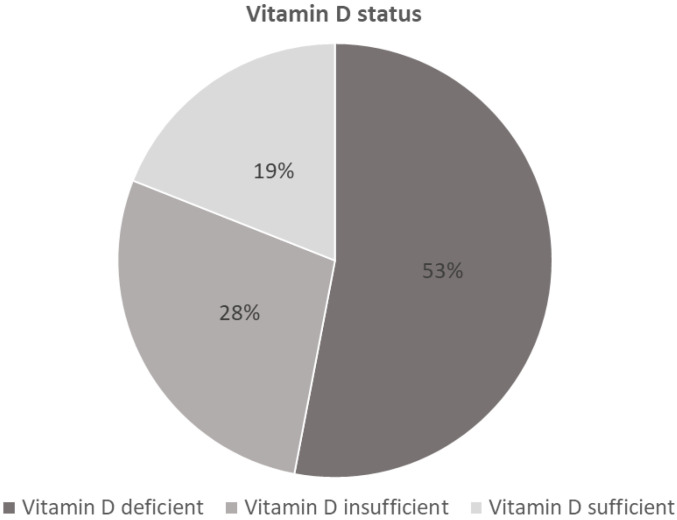
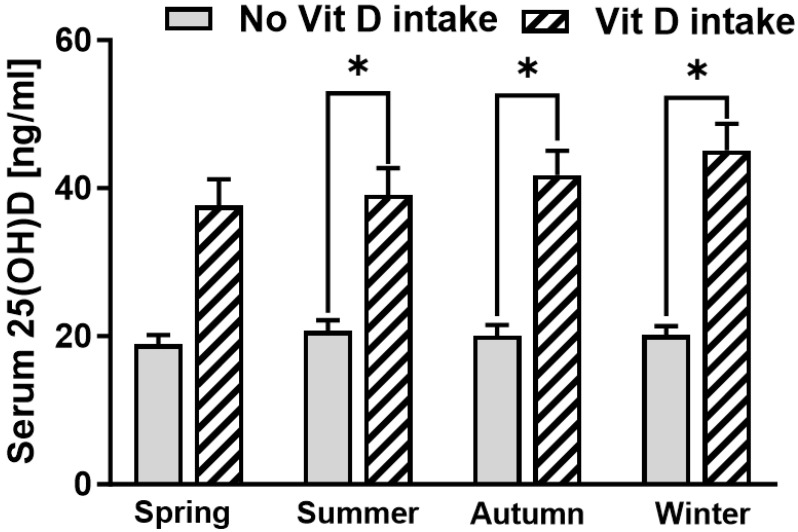
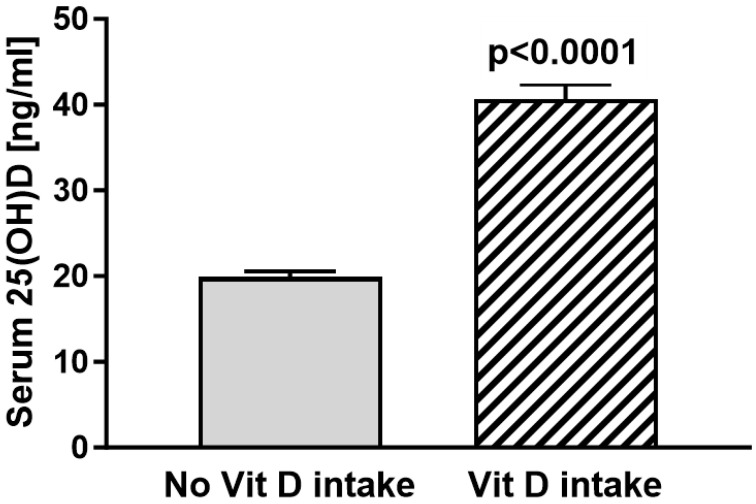
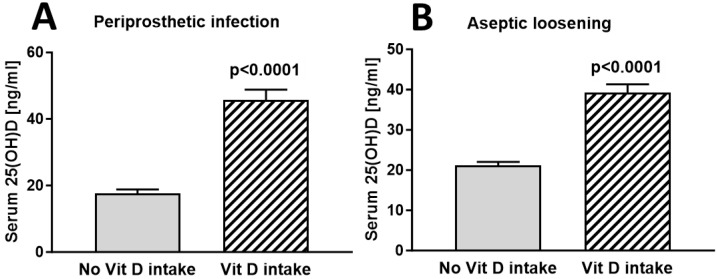
Vitamin D is crucial for ideal bone health and good muscle function, both essential requirements for successful joint arthroplasty. Hence, vitamin D deficiency has recently been identified as a predictor of poorer outcomes in patients scheduled to undergo total joint arthroplasty (TJA). Moreover, there is ample evidence today that vitamin D deficiency is associated with periprosthetic joint infection. Yet, vitamin D deficiency seems to be frequent in patients who are scheduled to undergo TJA. However, the prevalence of hypovitaminosis D in patients who require revision arthroplasty (rTJA) is largely unknown. Further, risk factors of vitamin D deficiency in these patients remain to be elucidated. For this reason, the primary objective of this study was to assess the vitamin D status of patients scheduled to undergo rTJA of the hip, knee and shoulder. The secondary objective was to identify potential risk factors for hypovitaminosis D in these patients. Serum vitamin D [25(OH)D] levels of 249 patients who were scheduled for rTJA were assessed over a period of twelve months at a high-volume TJA centre. Collectively, 23% of patients reported a routine intake of vitamin D supplements (58/249). Notably, 81% of patients (155/191) who did not report a routine vitamin D intake presented with insufficient vitamin D levels (below 30 ng/mL), while only 19% of patients (36/191) had sufficient vitamin D levels. Of those who reported a routine vitamin D intake, 75% (43/58) had sufficient vitamin D levels, while 25% (15/58) showed insufficient vitamin D status. Patients who did not routinely take any vitamin D supplements had significantly lower vitamin D levels compared to patients who reported regular vitamin D intake (19.91 ng/mL vs. 40.66 ng/mL). Further, BMI and nicotine abuse were identified as potential risk factors for hypovitaminosis D in patients without vitamin D supplementation. Moreover, the season of spring seems to be a risk factor in patients with vitamin D supplementation, while age itself did not appear to be a significant risk factor for low vitamin D levels. In conclusion, we found an alarmingly high rate of vitamin D deficiency in patients scheduled to undergo rTJA. Notably, reported routine vitamin D supplementation showed significantly increased serum vitamin D levels compared to patients with no reported supplementation. Due to the high prevalence of vitamin D deficiency, we believe that vitamin D status should routinely be assessed in patients who are scheduled to undergo rTJA.
维生素 D 对理想的骨骼健康和良好的肌肉功能至关重要,这是关节置换成功的基本要求。因此,维生素 D 缺乏最近被确定为计划接受全关节置换术 (TJA) 的患者预后较差的预测因子。此外,目前有大量证据表明,维生素 D 缺乏与假体周围关节感染有关。然而,计划接受 TJA 的患者中维生素 D 缺乏似乎很常见。然而,需要接受翻修关节置换术 (rTJA) 的患者中维生素 D 缺乏的患病率尚不清楚。此外,这些患者维生素 D 缺乏的危险因素仍有待阐明。出于这个原因,本研究的主要目的是评估计划接受髋关节、膝关节和肩关节 rTJA 的患者的维生素 D 状况。次要目标是确定这些患者发生维生素 D 缺乏症的潜在危险因素。在一家大容量 TJA 中心,对 249 名计划接受 rTJA 的患者进行了为期 12 个月的血清维生素 D [25(OH)D] 水平评估。共有 23%的患者报告常规服用维生素 D 补充剂(249/58)。值得注意的是,81%(155/191)未报告常规维生素 D 摄入的患者维生素 D 水平不足(低于 30ng/mL),而仅 19%的患者(191/36)维生素 D 水平充足。在报告常规维生素 D 摄入的患者中,75%(43/58)维生素 D 水平充足,而 25%(15/58)维生素 D 状态不足。与报告常规服用维生素 D 的患者相比,未常规服用任何维生素 D 补充剂的患者维生素 D 水平明显更低(19.91ng/mL 与 40.66ng/mL)。此外,BMI 和尼古丁滥用被确定为无维生素 D 补充患者维生素 D 缺乏的潜在危险因素。此外,春季似乎是维生素 D 补充患者的一个危险因素,而年龄本身似乎不是维生素 D 水平低的重要危险因素。总之,我们发现计划接受 rTJA 的患者中维生素 D 缺乏的发生率惊人地高。值得注意的是,与未报告补充的患者相比,报告常规补充维生素 D 的患者血清维生素 D 水平明显升高。由于维生素 D 缺乏的高患病率,我们认为应常规评估计划接受 rTJA 的患者的维生素 D 状态。