Laboratorio de Genómica, Pontificia Universidad Católica del Perú (PUCP), Lima, Peru.
EpiCenter for Emerging Infectious Disease Intelligence, Centers for Research in Emerging Infectious Diseases, Lima, Peru.
Nat Commun. 2023 Sep 7;14(1):5489. doi: 10.1038/s41467-023-41182-0.
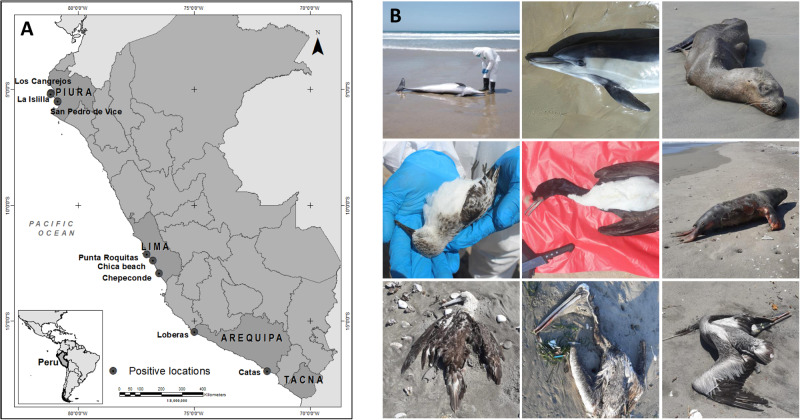
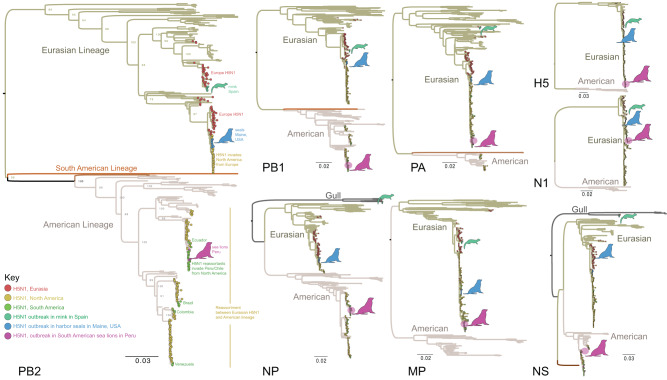
Highly pathogenic avian influenza (HPAI) A/H5N1 viruses (lineage 2.3.4.4b) are rapidly invading the Americas, threatening wildlife, poultry, and potentially evolving into the next global pandemic. In November 2022 HPAI arrived in Peru, triggering massive pelican and sea lion die-offs. We report genomic characterization of HPAI/H5N1 in five species of marine mammals and seabirds (dolphins, sea lions, sanderlings, pelicans and cormorants). Peruvian viruses belong to lineage 2.3.4.4b, but they are 4:4 reassortants where 4 genomic segments (PA, HA, NA and MP) position within the Eurasian lineage that initially entered North America from Eurasia, while the other 4 genomic segments (PB2, PB1, NP and NS) position within the American lineage (clade C) that circulated in North America. These viruses are rapidly accruing mutations, including mutations of concern, that warrant further examination and highlight an urgent need for active local surveillance to manage outbreaks and limit spillover into other species, including humans.
高致病性禽流感(HPAI)A/H5N1 病毒(谱系 2.3.4.4b)正在迅速侵袭美洲,威胁野生动物、家禽,并有可能演变成下一次全球大流行。2022 年 11 月,HPAI 抵达秘鲁,引发大量鹈鹕和海狮死亡。我们报告了五种海洋哺乳动物和海鸟(海豚、海狮、滨鹬、鹈鹕和鸬鹚)中 HPAI/H5N1 的基因组特征。秘鲁病毒属于谱系 2.3.4.4b,但它们是 4:4 重配体,其中 4 个基因组片段(PA、HA、NA 和 MP)位于最初从欧亚大陆进入北美的欧亚大陆系内,而其他 4 个基因组片段(PB2、PB1、NP 和 NS)位于在北美的美洲谱系(C 谱系)内。这些病毒正在迅速积累突变,包括令人关注的突变,这需要进一步检查,并强调迫切需要进行积极的本地监测,以管理疫情爆发并限制溢出到其他物种,包括人类。