Health Care Division, Health and Counseling Center, Osaka University, Osaka, Japan.
Department of Internal Medicine, Self-Defense Forces Central Hospital, Tokyo, Japan.
Sci Rep. 2024 Sep 28;14(1):22534. doi: 10.1038/s41598-024-73985-6.
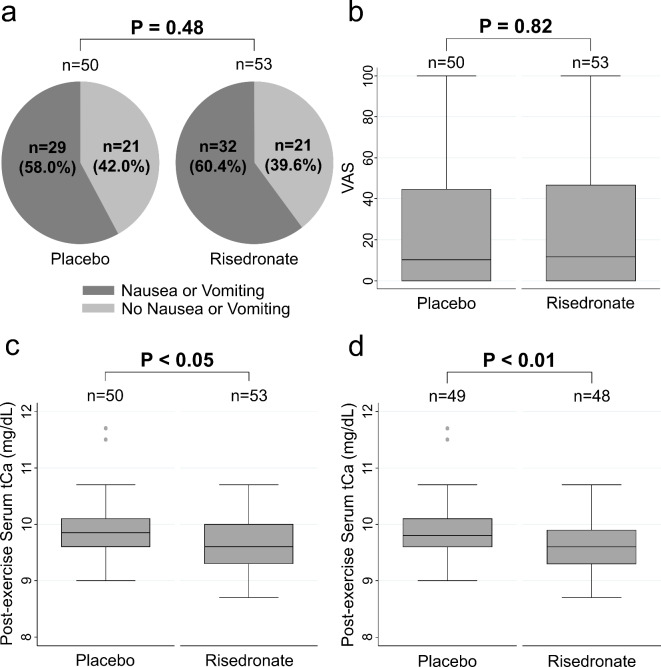
Reportedly, nausea or vomiting after heavy exercise was associated with post-exercise increased blood calcium (Ca) levels, which was correlated with enhanced bone resorption. We conducted a randomized, double-blind, placebo-controlled trial, enrolling 104 healthy trained male members of the Japan Ground Self-Defense Forces. Risedronate (17.5 mg) or placebo was prescribed 3 and 10 days before heavy exercise lasting approximately 5 h. The primary outcome was the severity of nausea or vomiting assessed by a visual analog scale during or post-exercise. The secondary outcomes included clinical symptoms associated with heat illness, post-exercise serum total Ca (tCa), whole blood ionized Ca (iCa), and serum tartrate-resistant acid phosphatase 5b (TRACP-5b) levels. The mean age was 26 years. The exercise resulted in a 4.5% weight loss. The two groups were comparable in terms of the symptoms, including primary outcome. However, post-exercise tCa and TRACP-5b were significantly lower with risedronate. A similar result was observed for iCa. The post-exercise urinary Ca/Magnesium ratio and the incidence of hypercalcemia (defined as tCa or iCa levels ≥ each median value of all subjects) were significantly lower with risedronate (78.0% vs. 58.5%). A stronger treatment effect of risedronate on blood Ca levels was observed in participants who lost substantial body weight. Post-exercise hypercalcemia is attributed to enhanced bone resorption but not the cause of nausea.
据报道,剧烈运动后出现恶心或呕吐与运动后血钙(Ca)水平升高有关,而血钙升高与增强的骨吸收相关。我们进行了一项随机、双盲、安慰剂对照试验,纳入了 104 名日本陆上自卫队的健康受训男性成员。利塞膦酸盐(17.5mg)或安慰剂在剧烈运动前 3 天和 10 天给予,剧烈运动持续约 5 小时。主要结局是通过视觉模拟量表评估运动期间或运动后恶心或呕吐的严重程度。次要结局包括与热应激相关的临床症状、运动后血清总钙(tCa)、全血离子钙(iCa)和血清对酒石酸抗性酸性磷酸酶 5b(TRACP-5b)水平。平均年龄为 26 岁。运动导致体重减轻 4.5%。两组在症状方面(包括主要结局)具有可比性。然而,利塞膦酸盐组运动后 tCa 和 TRACP-5b 显著降低。iCa 也观察到类似结果。运动后尿钙/镁比值和高钙血症(定义为 tCa 或 iCa 水平≥所有受试者的每个中位数)的发生率在利塞膦酸盐组显著降低(78.0%比 58.5%)。在体重明显减轻的参与者中,利塞膦酸盐对血钙水平的治疗效果更强。运动后高钙血症归因于增强的骨吸收,但不是恶心的原因。