VASCage - Centre on Clinical Stroke Research, Adamgasse 23, Innsbruck, Austria.
Department of Neurology, Medical University of Innsbruck, Anichstrasse 35, Innsbruck, Austria.
BMC Neurol. 2024 Sep 28;24(1):358. doi: 10.1186/s12883-024-03863-1.
Pre-existing comorbidities increase the likelihood of post-stroke dysphagia. This study investigates comorbidity prevalence in patients with dysphagia after ischemic stroke.
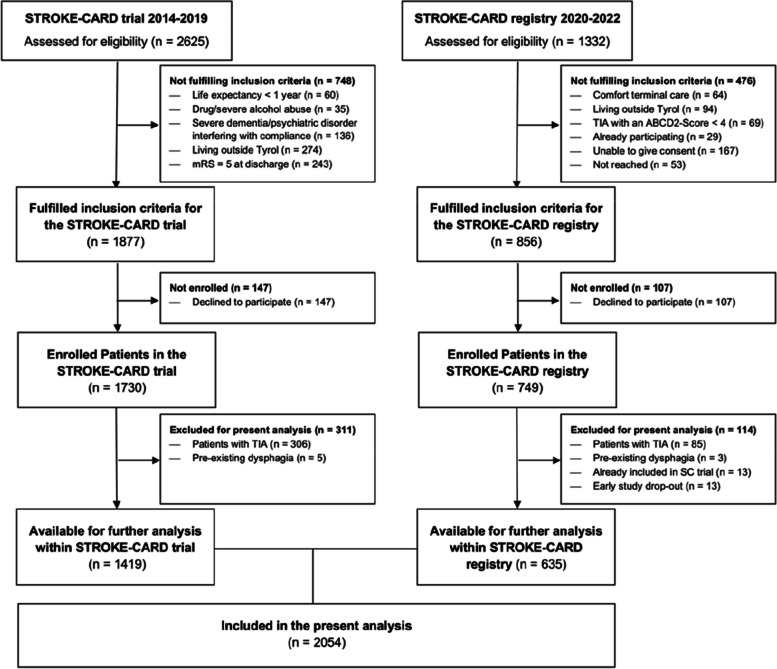
The data of patients with acute ischemic stroke from two large representative cohorts (STROKE-CARD trial 2014-2019 and STROKE-CARD registry 2020-2022 - both study center Innsbruck, Austria) were analyzed for the presence of dysphagia at hospital admission (clinical swallowing examination). Comorbidities were assessed using the Charlson Comorbidity Index (CCI).
Of 2054 patients with ischemic stroke, 17.2% showed dysphagia at hospital admission. Patients with dysphagia were older (77.8 ± 11.9 vs. 73.6 ± 14.3 years, p < 0.001), had more severe strokes (NIHSS 7(4-12) vs. 2(1-4), p < 0.001) and had higher CCI scores (4.7 ± 2.1 vs. 3.8 ± 2.0, p < 0.001) than those without swallowing impairment. Dysphagia correlated with hypertension (p = 0.034), atrial fibrillation (p < 0.001), diabetes (p = 0.002), non-smoking status (p = 0.014), myocardial infarction (p = 0.002), heart failure (p = 0.002), peripheral arterial disease (p < 0.001), severe chronic liver disease (p = 0.002) and kidney disease (p = 0.010). After adjusting for relevant factors, the associations with dysphagia remained significant for diabetes (p = 0.005), peripheral arterial disease (p = 0.007), kidney disease (p = 0.014), liver disease (p = 0.003) and overall CCI (p < 0.001).
Patients with multiple comorbidities have a higher risk of developing post-stroke dysphagia. Therefore, early and thorough screening for swallowing impairment after acute ischemic stroke is crucial especially in those with multiple concomitant diseases.
Stroke Card Registry (NCT04582825), Stroke Card Trial (NCT02156778).
既往合并症增加了卒中后吞咽困难的可能性。本研究旨在调查缺血性卒中后吞咽困难患者的合并症患病率。
分析来自两个大型代表性队列(2014 年至 2019 年的 STROKE-CARD 试验和 2020 年至 2022 年的 STROKE-CARD 注册研究[均为研究中心:奥地利因斯布鲁克])的急性缺血性卒中患者入院时(临床吞咽检查)存在吞咽困难的患者数据。使用 Charlson 合并症指数(CCI)评估合并症。
2054 例缺血性卒中患者中,17.2%的患者在入院时存在吞咽困难。吞咽困难患者年龄更大(77.8±11.9 vs. 73.6±14.3 岁,p<0.001)、卒中更严重(NIHSS 7(4-12) vs. 2(1-4),p<0.001)、CCI 评分更高(4.7±2.1 vs. 3.8±2.0,p<0.001)。与无吞咽障碍的患者相比,吞咽困难与高血压(p=0.034)、心房颤动(p<0.001)、糖尿病(p=0.002)、不吸烟(p=0.014)、心肌梗死(p=0.002)、心力衰竭(p=0.002)、外周动脉疾病(p<0.001)、严重慢性肝脏疾病(p=0.002)和肾脏疾病(p=0.010)相关。在调整相关因素后,糖尿病(p=0.005)、外周动脉疾病(p=0.007)、肾脏疾病(p=0.014)、肝脏疾病(p=0.003)和总体 CCI(p<0.001)与吞咽困难的关联仍具有统计学意义。
患有多种合并症的患者发生卒中后吞咽困难的风险更高。因此,急性缺血性卒中后早期、全面筛查吞咽障碍尤为重要,尤其是对伴有多种合并症的患者。
Stroke Card 注册表(NCT04582825)、Stroke Card 试验(NCT02156778)。