Research Institute for Farm Animal Biology (FBN), Wilhelm-Stahl-Allee 2, 18196, Dummerstorf, Germany.
Clinic for Poultry and Fish Medicine, University of Veterinary Medicine Vienna, Veterinärplatz 1, 1210, Vienna, Austria.
Vet Res. 2024 Sep 28;55(1):125. doi: 10.1186/s13567-024-01378-8.
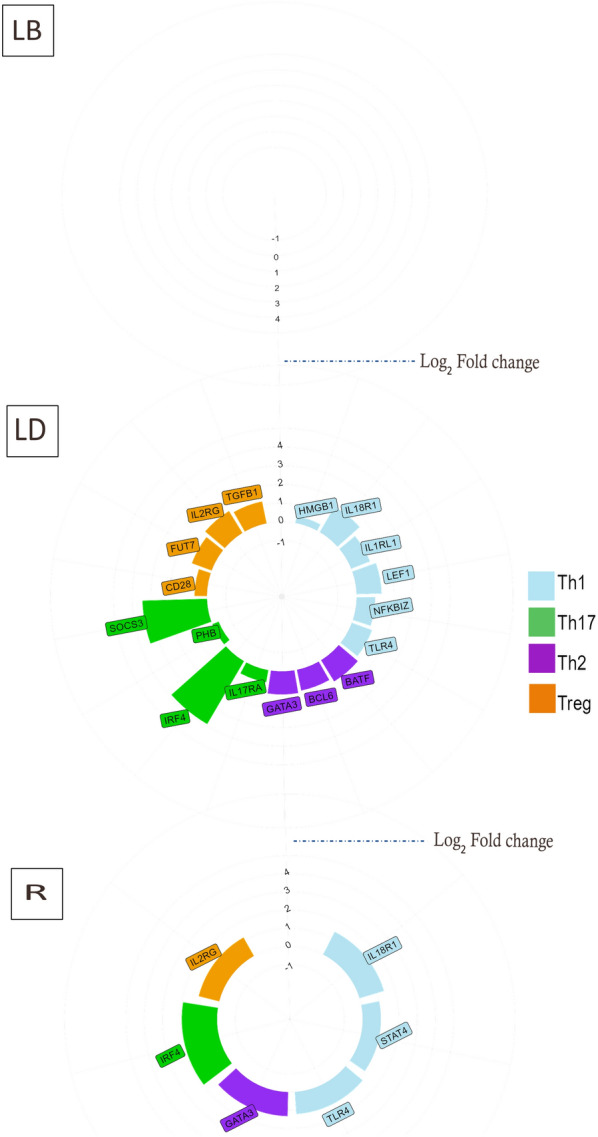
During parasite infections, the liver may prioritise immune-related pathways over its metabolic functions. Intestinal infections caused by Ascaridia galli and Heterakis gallinarum impair feed intake, nutrient absorption, and weight gain. Histomonas meleagridis, vectored by H. gallinarum, can also damage liver tissues, potentially impairing liver functions. This study examined the hepatic gene expression in three strains of chickens: Ross-308 (R), Lohmann Brown Plus (LB), and Lohmann Dual (LD), 2 weeks after an experimental infection (n = 18) with both A. galli and H. gallinarum or kept as uninfected control (n = 12). Furthermore, H. gallinarum infection led to a co-infection with H. meleagridis. The mixed infections reduced feed intake and the average daily weight gain (P < 0.001). The infections also increased the plasma concentrations of alpha (1)-acid glycoprotein and the antibody titre against H. meleagridis (P = 0.049), with no strain differences (P > 0.05). For host molecular response, 1887 genes were differentially expressed in LD, while 275 and 25 genes were differentially expressed in R and LB, respectively. The up-regulated genes in R and LD were mostly related to inflammatory and adaptive immune responses, while down-regulated genes in LD were involved in metabolic pathways, including gluconeogenesis. Despite performance differences among the strains, worm burdens were similar, but hepatic molecular responses differed significantly. Moreover, there was an indication of a shift in hepatic functions towards immune-related pathways. We, therefore, conclude that the liver shifts its functions from metabolic to immune-related activities in chickens when challenged with mixed parasite species.
在寄生虫感染期间,肝脏可能会优先考虑免疫相关途径,而不是代谢功能。由鸡蛔虫和鸡异刺线虫引起的肠道感染会降低采食量、营养吸收和体重增加。由鸡异刺线虫传播的火鸡组织滴虫也会损害肝组织,可能会损害肝功能。本研究检测了三种鸡(罗斯 308(R)、罗曼布罗(LB)和罗曼双系(LD))在感染鸡蛔虫和鸡异刺线虫 2 周后的肝脏基因表达情况(n=18),或作为未感染对照(n=12)。此外,鸡异刺线虫感染导致与火鸡组织滴虫的混合感染。混合感染降低了采食量和平均日增重(P<0.001)。感染还增加了血浆中α(1)-酸性糖蛋白和抗火鸡组织滴虫抗体的浓度(P=0.049),但与品系无关(P>0.05)。对于宿主分子反应,LD 中有 1887 个基因差异表达,而 R 和 LB 中分别有 275 个和 25 个基因差异表达。R 和 LD 中上调的基因主要与炎症和适应性免疫反应有关,而 LD 中下调的基因则与代谢途径有关,包括糖异生。尽管三个品系之间存在性能差异,但蠕虫负担相似,但肝脏分子反应明显不同。此外,有迹象表明肝脏功能向免疫相关途径转移。因此,我们得出结论,当鸡受到混合寄生虫物种的挑战时,肝脏会将其功能从代谢转向免疫相关活动。