Department of Laboratory Medicine, Asan Medical Center, University of Ulsan College of Medicine, Seoul, Korea.
Future Strategy Division, SD Biosensor, Seoul, Korea.
Ann Lab Med. 2025 Jan 1;45(1):1-11. doi: 10.3343/alm.2024.0258. Epub 2024 Sep 30.
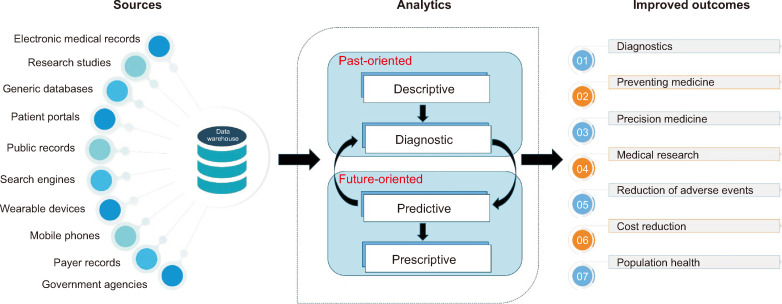
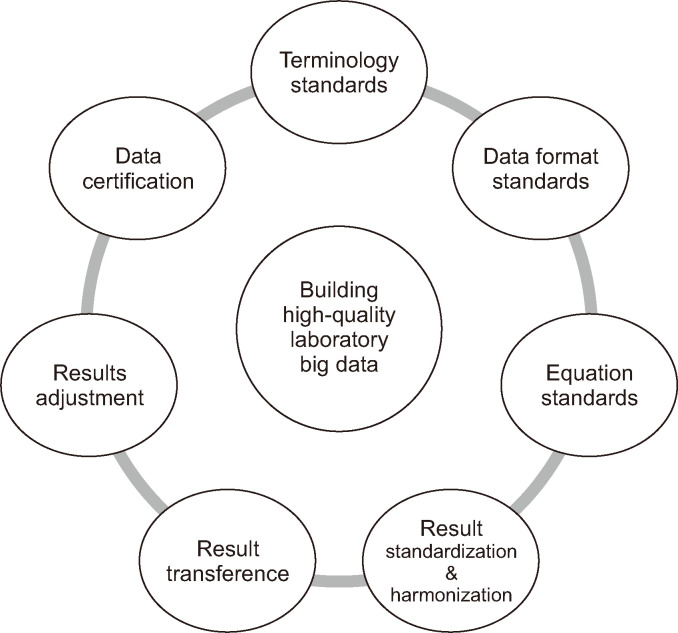
With Industry 4.0, big data and artificial intelligence have become paramount in the field of medicine. Electronic health records, the primary source of medical data, are not collected for research purposes but represent real-world data; therefore, they have various constraints. Although structured, laboratory data often contain unstandardized terminology or missing information. The major challenge lies in the lack of standardization of test results in terms of metrology, which complicates comparisons across laboratories. In this review, we delve into the essential components necessary for integrating real-world laboratory data into high-quality big data, including the standardization of terminology, data formats, equations, and the harmonization and standardization of results. Moreover, we address the transference and adjustment of laboratory results, along with the certification for quality of laboratory data. By discussing these critical aspects, we seek to shed light on the challenges and opportunities inherent to utilizing real-world laboratory data within the framework of healthcare big data and artificial intelligence.
随着工业 4.0、大数据和人工智能的发展,它们在医学领域变得至关重要。电子健康记录是医学数据的主要来源,这些数据不是为了研究目的而收集的,而是代表了真实世界的数据;因此,它们存在各种限制。虽然结构化的实验室数据通常包含非标准化的术语或缺失的信息。但主要的挑战在于计量学方面的测试结果缺乏标准化,这使得不同实验室之间的比较变得复杂。在这篇综述中,我们深入探讨了将真实世界的实验室数据整合到高质量大数据中所必需的基本组成部分,包括术语、数据格式、方程的标准化,以及结果的协调和标准化。此外,我们还讨论了实验室结果的转移和调整,以及实验室数据质量的认证。通过讨论这些关键方面,我们旨在揭示在医疗保健大数据和人工智能框架内利用真实世界实验室数据所固有的挑战和机遇。