College of Traditional Chinese Medicine, Shandong University of Traditional Chinese Medicine, Jinan, China.
Translational Pharmaceutical Laboratory, Jining NO.1 People's Hospital, Shandong First Medical University, Jining, China.
Pharm Biol. 2024 Dec;62(1):676-690. doi: 10.1080/13880209.2024.2406779. Epub 2024 Sep 30.
Epigallocatechin-3-gallate (EGCG), the predominant catechin in green tea, has shown the potential to combat various types of cancer cells through its ability to modulate multiple signaling pathways. However, its low bioavailability and rapid degradation hinder its clinical application.
This review explores the potential of nanoencapsulation to enhance the stability, bioavailability, and therapeutic efficacy of EGCG in cancer treatment.
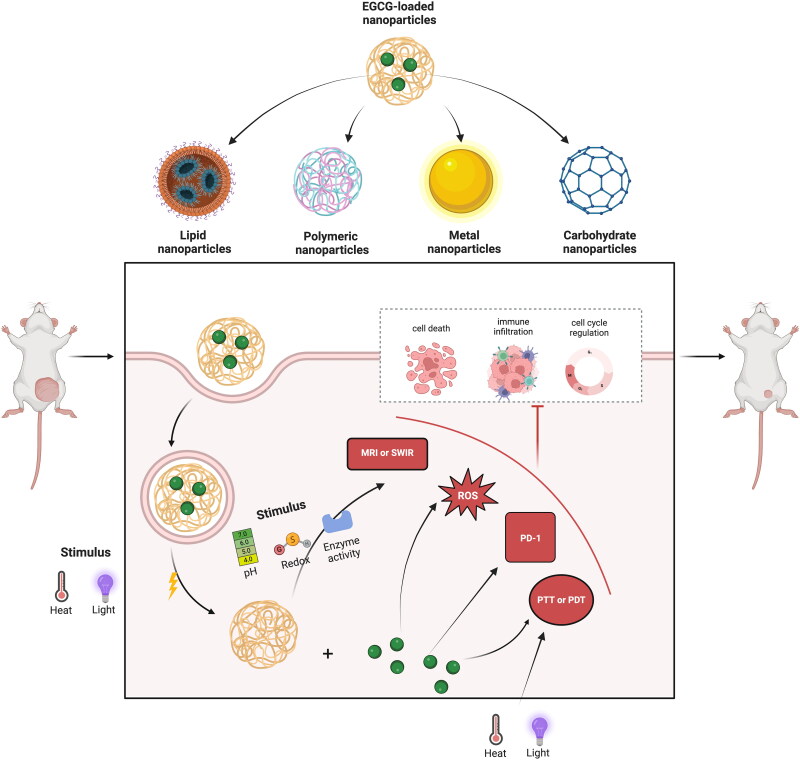
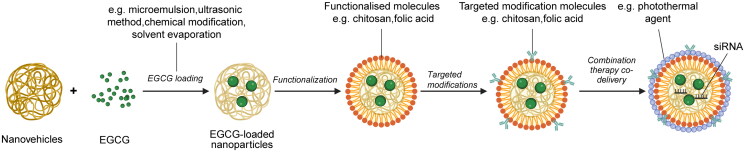
We searched the PubMed database from 2019 to the present, using 'epigallocatechin gallate', 'EGCG', and 'nanoparticles' as search terms to identify pertinent literature. This review examines recent nano-engineering technology advancements that encapsulate EGCG within various nanocarriers. The focus was on evaluating the types of nanoparticles used, their synthesis methods, and the technologies applied to optimize drug delivery, diagnostic capabilities, and therapeutic outcomes.
Nanoparticles improve the physicochemical stability and pharmacokinetics of EGCG, leading to enhanced therapeutic outcomes in cancer treatment. Nanoencapsulation allows for targeted drug delivery, controlled release, enhanced cellular uptake, and reduced premature degradation of EGCG. The studies highlighted include those where EGCG-loaded nanoparticles significantly inhibited tumor growth in various models, demonstrating enhanced penetration and efficacy through active targeting mechanisms.
Nanoencapsulation of EGCG represents a promising approach in oncology, offering multiple therapeutic benefits over its unencapsulated form. Although the results so far are promising, further research is necessary to fully optimize the design of these nanosystems to ensure their safety, efficacy, and clinical viability.
表没食子儿茶素没食子酸酯(EGCG)是绿茶中主要的儿茶素,具有通过调节多种信号通路来抵抗多种类型癌细胞的潜力。然而,其低生物利用度和快速降解阻碍了其临床应用。
本综述探讨了纳米封装技术提高 EGCG 在癌症治疗中的稳定性、生物利用度和治疗效果的潜力。
我们从 2019 年至今在 PubMed 数据库中进行了搜索,使用“表没食子儿茶素没食子酸酯”、“EGCG”和“纳米粒子”作为搜索词来识别相关文献。本综述考察了最近将 EGCG 封装在各种纳米载体中的纳米工程技术进展。重点评估了所使用的纳米粒子类型、它们的合成方法以及应用于优化药物传递、诊断能力和治疗效果的技术。
纳米粒子提高了 EGCG 的物理化学稳定性和药代动力学特性,导致癌症治疗的治疗效果得到增强。纳米封装允许靶向药物传递、控制释放、增强细胞摄取和减少 EGCG 的过早降解。所强调的研究包括那些载有 EGCG 的纳米粒子在各种模型中显著抑制肿瘤生长的研究,通过主动靶向机制证明了增强的穿透性和功效。
EGCG 的纳米封装代表了肿瘤学中的一种有前途的方法,与未封装的形式相比,提供了多种治疗益处。尽管到目前为止结果很有希望,但仍需要进一步研究来充分优化这些纳米系统的设计,以确保其安全性、功效和临床可行性。