
糖尿病对中度重症急性胰腺炎和重症急性胰腺炎的临床结局
Clinical Outcomes of Diabetes Mellitus on Moderately Severe Acute Pancreatitis and Severe Acute Pancreatitis.
作者信息
Xu Jiale, Xu Musen, Gao Xin, Liu Jiahang, Sun Jingchao, Ling Ruiqi, Zhao Xuchen, Fu Xifeng, Mo Shaojian, Tian Yanzhang
机构信息
Department of Biliary and Pancreatic Surgery, Third Hospital of Shanxi Medical University, Shanxi Bethune Hospital, Shanxi Academy of Medical Sciences, Tongji Shanxi Hospital, Taiyuan, People's Republic of China.
出版信息
J Inflamm Res. 2024 Sep 23;17:6673-6690. doi: 10.2147/JIR.S478983. eCollection 2024.
OBJECTIVE
To analyze the influence of diabetes mellitus on the clinical outcomes of moderately severe acute pancreatitis (MSAP) and severe acute pancreatitis (SAP).
METHODS
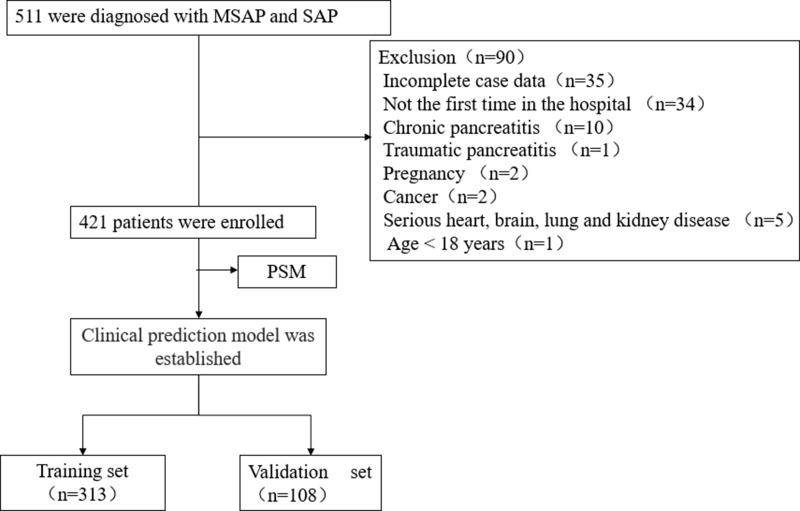
This retrospective study included patients diagnosed with MSAP and SAP at Shanxi Bethune Hospital from January 1, 2017, to December 31, 2021. Clinical data were collected, including patient demographics, 24-hour laboratory indicators, and inflammation indices. Propensity score matching (PSM) was used to compare outcomes before and after matching. Patients were randomized into training and validation sets (7:3) to develop and validate a clinical prediction model for infected pancreatic necrosis (IPN).
RESULTS
Among 421 patients, 79 had diabetes at admission. Before PSM, diabetic patients had higher incidences of peripancreatic fluid (71% vs 47%, p<0.001) and IPN (48% vs 10%, p<0.001), higher surgical intervention rates (24% vs 12%, p=0.008), and significant differences in abdominocentesis (22% vs 11%, p=0.014). After PSM, 174 patients were matched, and the diabetes group still showed higher incidences of peripancreatic fluid (69% vs 47%, p=0.008), IPN (48% vs 11%, p<0.001), and surgical intervention rates (27% vs 13%, p=0.037). Diabetes, modified CT severity index (MCTSI), serum calcium, and HDL-c were identified as independent risk factors for IPN. The prediction model demonstrated good predictive value.
CONCLUSION
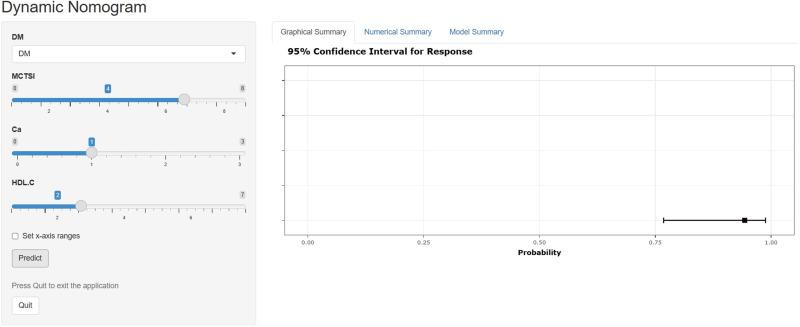
In MSAP and SAP patients, diabetes mellitus can exert an influence on their clinical outcome and is an independent risk factor for IPN. The alignment diagram and web calculator constructed on the basis of diabetes mellitus, modified CT severity index (MCTSI), serum calcium and high-density lipoprotein cholesterol (HDL-c) have good predictive value and clinical guidance for the occurrence of IPN in MSAP and SAP.
目的
分析糖尿病对中度重症急性胰腺炎(MSAP)和重症急性胰腺炎(SAP)临床结局的影响。
方法
这项回顾性研究纳入了2017年1月1日至2021年12月31日在山西白求恩医院被诊断为MSAP和SAP的患者。收集临床数据,包括患者人口统计学信息、24小时实验室指标和炎症指标。采用倾向评分匹配(PSM)来比较匹配前后的结局。将患者随机分为训练集和验证集(7:3),以开发和验证感染性胰腺坏死(IPN)的临床预测模型。
结果
421例患者中,79例入院时患有糖尿病。在PSM之前,糖尿病患者胰周积液发生率较高(71%对47%,p<0.001)和IPN发生率较高(48%对10%,p<0.001),手术干预率较高(24%对12%,p=0.008),腹腔穿刺术存在显著差异(22%对11%,p=0.014)。PSM后,174例患者进行了匹配,糖尿病组胰周积液发生率(69%对47%,p=0.008)、IPN发生率(48%对11%,p<0.001)和手术干预率(27%对13%,p=0.037)仍较高。糖尿病、改良CT严重程度指数(MCTSI)、血清钙和高密度脂蛋白胆固醇(HDL-c)被确定为IPN的独立危险因素。该预测模型显示出良好的预测价值。
结论
在MSAP和SAP患者中,糖尿病可对其临床结局产生影响,并且是IPN的独立危险因素。基于糖尿病、改良CT严重程度指数(MCTSI)、血清钙和高密度脂蛋白胆固醇(HDL-c)构建的列线图和网络计算器对MSAP和SAP中IPN的发生具有良好的预测价值和临床指导意义。


 Zotero 插件