Shi Yue, Li Shuhan, Xie Xiaolong, Feng Yue
Chengdu University of Traditional Chinese Medicine, Chengdu 610075, China.
Meishan Hospital of Traditional Chinese Medicine, Meishan 620000, China.
Int J Endocrinol. 2024 Sep 21;2024:7330133. doi: 10.1155/2024/7330133. eCollection 2024.
The metabolic effects of metabolic syndrome (MetS) on musculoskeletal metabolism are controversial. This study explored the effect of MetS on bone mineral density (BMD) and muscle quality index (MQI).
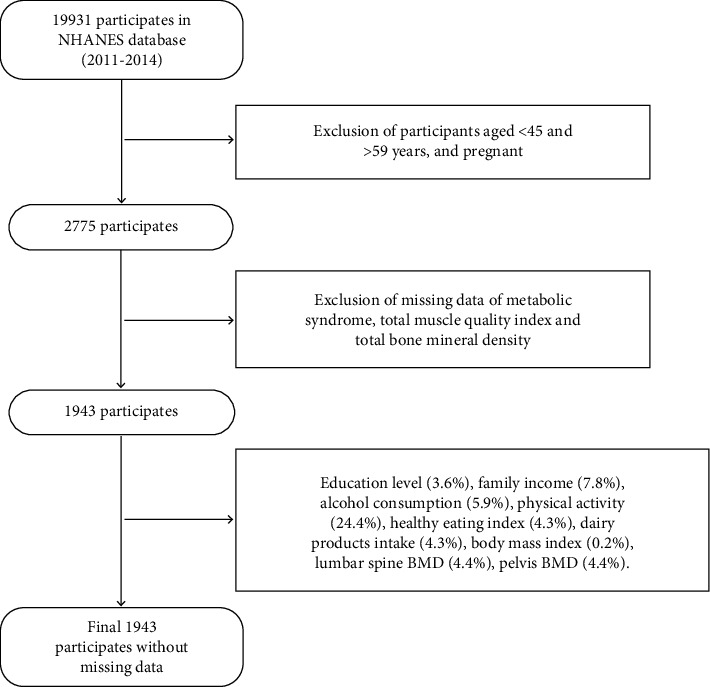
Data from the NHANES database from 2011 to 2014 were extracted, and nonpregnant participants aged 45-59 years were included. The included data were first weighted by complex sampling, and then, the effect of MetS on BMD and MQI was analyzed using multifactorial linear regression. We then performed a stratified analysis by gender and BMI classification. Moreover, a mediation analysis of MetS on BMD was conducted, with MQI as a mediating variable. A propensity score matching analysis method with a complex sampling design was additionally performed to verify the stability of the results.
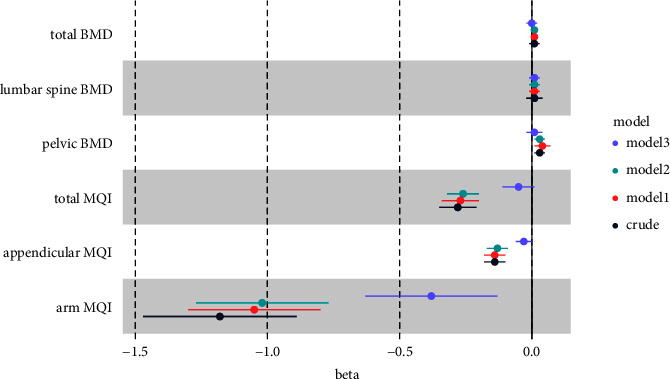
A total of 1943 participants were eventually included. After adjusting for covariates, the results of linear regression show that MetS is associated with elevated pelvic BMD (beta = 0.03; 95% CI = 0.01, 0.06; =0.02) and reduced MQI, especially arm MQI (beta = -1.02; 95% CI = -1.27, -0.77; < 0.0001). MetS is more associated with BMD in women, MQI in normal or heavyweight, and BMD in lightweight, according to stratified analysis. MQI explains the indirect effect of MetS on BMD (beta = 0.007; 95% CI = 0.003, 0.010).
This study provides evidence that MetS elevates BMD and reduces MQI, and further, that there is a mediating effect of MQI on elevated BMD.
代谢综合征(MetS)对肌肉骨骼代谢的影响存在争议。本研究探讨了MetS对骨密度(BMD)和肌肉质量指数(MQI)的影响。
提取2011年至2014年美国国家健康与营养检查调查(NHANES)数据库中的数据,纳入45 - 59岁的非妊娠参与者。首先对纳入数据进行复杂抽样加权,然后使用多因素线性回归分析MetS对BMD和MQI的影响。随后按性别和体重指数(BMI)分类进行分层分析。此外,以MQI为中介变量,对MetS对BMD的中介作用进行分析。还采用了具有复杂抽样设计的倾向得分匹配分析方法来验证结果的稳定性。
最终共纳入1943名参与者。调整协变量后,线性回归结果显示,MetS与骨盆BMD升高相关(β = 0.03;95%置信区间[CI] = 0.01,0.06;P = 0.02),与MQI降低相关,尤其是手臂MQI(β = -1.02;95% CI = -1.27,-0.77;P < 0.0001)。分层分析显示,MetS与女性的BMD、正常或超重者的MQI以及体重轻者的BMD关联更强。MQI解释了MetS对BMD的间接影响(β = 0.007;95% CI = 0.003,0.010)。
本研究提供了证据表明MetS可提高BMD并降低MQI,此外,MQI对BMD升高存在中介作用。