Khemka Abhishek, Clasen Suparna C, Loehrer Patrick J, Roberts Anna R, Golzarri-Arroyo Lilian, Badve Sunil S, Raman Subha V, Hui Siu L, Schleyer Titus K L
Division of Cardiology, Department of Medicine, Indiana University School of Medicine, Indianapolis, IN, United States.
Department of Medicine, Simon Cancer Center, Indiana University School of Medicine, Indianapolis, IN, United States.
Front Cardiovasc Med. 2024 Sep 10;11:1393631. doi: 10.3389/fcvm.2024.1393631. eCollection 2024.
Cancer patients may have increased risk for adverse cardiac events, but our understanding of cardiovascular risk in thymic cancer patients is not clear. We sought to characterize baseline cardiometabolic risk factors before thymic cancer diagnosis and the potential association between cancer treatment and subsequent cardiac events.
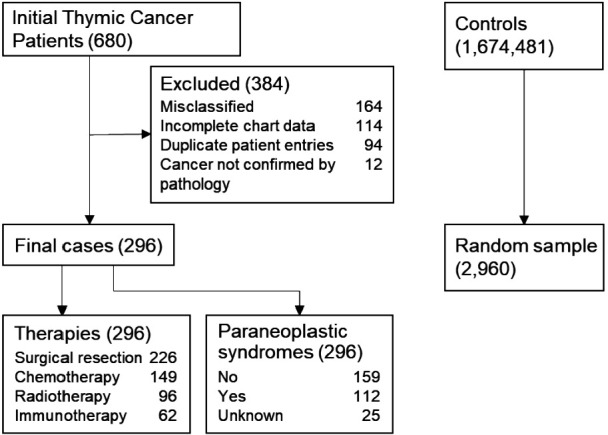
This was a retrospective cohort study evaluating patients with thymic cancer from 2003 to 2020 compared to age- and sex-matched controls without cancer. Baseline cardiovascular risk factors, cancer characteristics, and incidence of cardiac events were collected from the health information exchange. Multivariable regression was used to examine the impact of cardiovascular risk factors and cancer therapies.
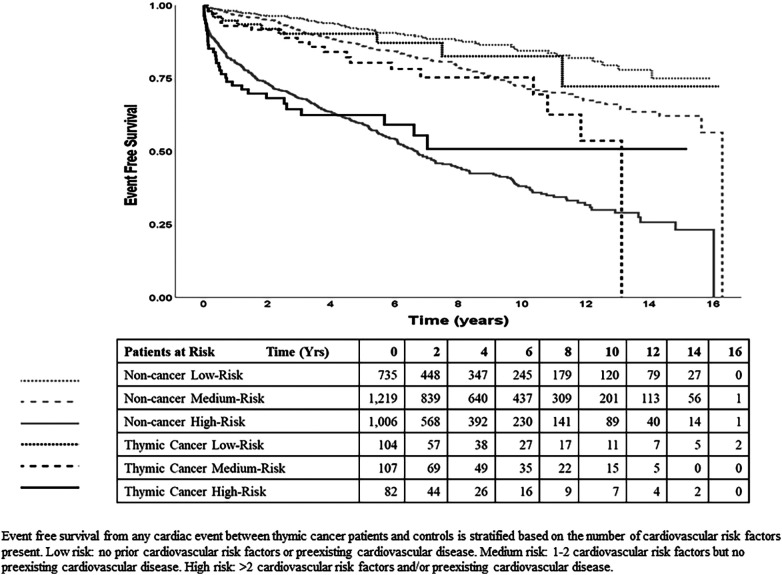
We compared 296 patients with pathology-confirmed thymic cancer to 2,960 noncancer controls. Prior to cancer diagnosis, thymic cancer patients (TCPs) had lower prevalence of hypertension, dyslipidemia, and diabetes mellitus and similar rates of obesity, tobacco use, and pre-existing cardiovascular disease (CVD) compared to controls. After diagnosis, high-risk TCPs (>2 cardiovascular risk factors or pre-existing CVD) had higher risk for cardiac events (HR 3.73, 95% CI 2.88-4.83, < 0.001). In the first 3 years after diagnosis, TCPs had higher incidence of cardiac events (HR 1.38, 95% CI 1.01-1.87, = 0.042). High-risk TCPs who received radiotherapy or chemotherapy had higher risk of cardiac events (HR 4.99, 95% CI 2.30-10.81, < 0.001; HR 6.24, 95% CI 2.84-13.72, < 0.001).
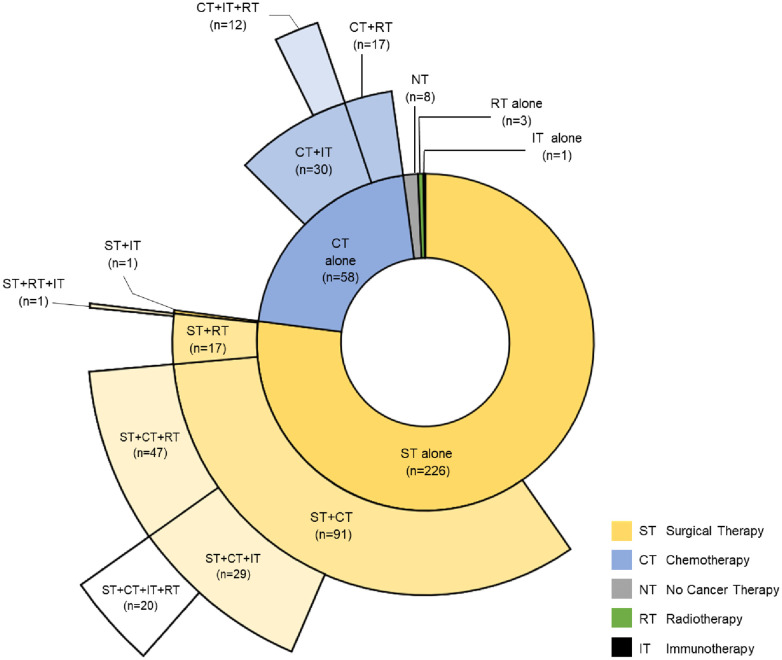
DISCUSSION/CONCLUSION: Compared to noncancer controls, TCPs experienced more cardiac events when adjusted for risk factors. Patients with multiple cardiovascular risk factors receiving radiotherapy or chemotherapy had higher incidence of cardiac events.
癌症患者发生不良心脏事件的风险可能会增加,但我们对胸腺癌患者心血管风险的了解尚不清楚。我们试图描述胸腺癌诊断前的基线心脏代谢危险因素,以及癌症治疗与随后心脏事件之间的潜在关联。
这是一项回顾性队列研究,将2003年至2020年的胸腺癌患者与年龄和性别匹配的无癌症对照进行比较。从健康信息交换中收集基线心血管危险因素、癌症特征和心脏事件发生率。采用多变量回归分析心血管危险因素和癌症治疗的影响。
我们将296例病理确诊的胸腺癌患者与2960例非癌症对照进行了比较。与对照组相比,在癌症诊断前,胸腺癌患者(TCPs)的高血压、血脂异常和糖尿病患病率较低,肥胖、吸烟和既往心血管疾病(CVD)发生率相似。诊断后,高危TCPs(>2个心血管危险因素或既往有CVD)发生心脏事件的风险更高(HR 3.73,95%CI 2.88-4.83,P<0.001)。在诊断后的前3年,TCPs发生心脏事件的发生率更高(HR 1.38,95%CI 1.01-1.87,P=0.042)。接受放疗或化疗的高危TCPs发生心脏事件的风险更高(HR 4.99,95%CI 2.30-10.81,P<0.001;HR 6.24,95%CI 2.84-13.72,P<0.001)。
讨论/结论:与非癌症对照相比,调整危险因素后,TCPs发生心脏事件的情况更多。接受放疗或化疗的具有多个心血管危险因素的患者发生心脏事件的发生率更高。