Kanabar Bhavesh, Malek Shahenaz, Piparva Kiran
Preventive and Social Medicine, Pandit Dindayal Upadhyay Medical College, Rajkot, IND.
Pharmacology, Government Medical College, Surat, Surat, IND.
Cureus. 2024 Aug 29;16(8):e68097. doi: 10.7759/cureus.68097. eCollection 2024 Aug.
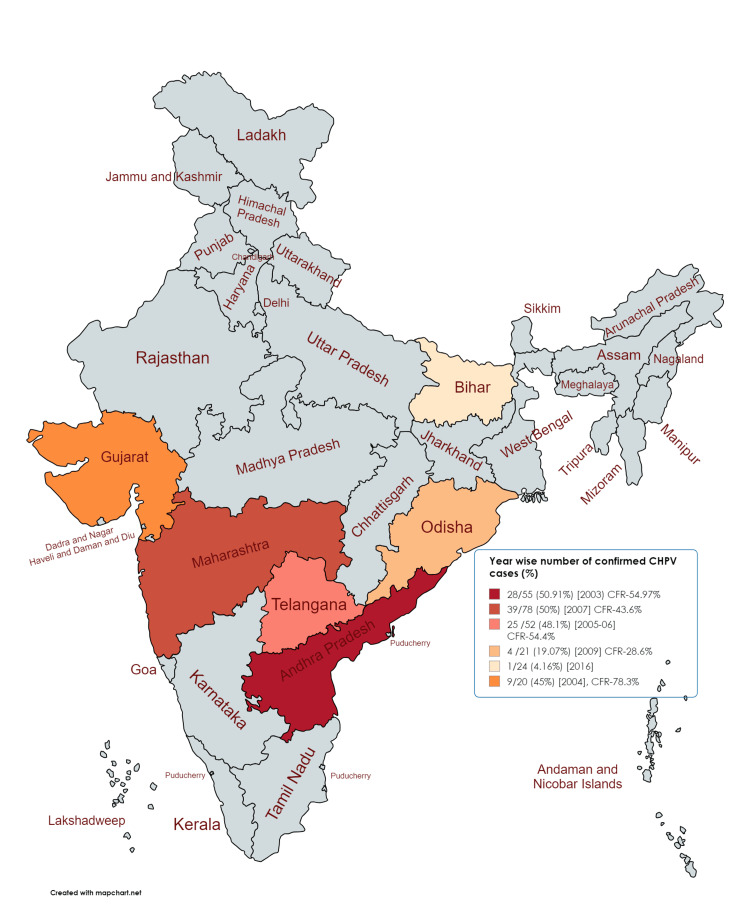
Chandipura virus (CHPV) has emerged as a significant cause of acute encephalitis in India, especially affecting pediatric populations. This study aimed to analyze the temporal trends, clinical characteristics, and epidemiological features of CHPV infections reported in outbreaks across India. A comprehensive literature search on CHPV cases was conducted using Google Scholar, PubMed, and the Cochrane Library. Original research studies on laboratory-confirmed clinical cases of CHPV infections, available as full-text articles, were included. Data on outbreak characteristics, clinical presentations, diagnostics, and epidemiological factors were extracted and analyzed. Six studies met the inclusion criteria. The review revealed a geographical expansion of CHPV outbreaks across India over time, with a consistent seasonal pattern (May to September) coinciding with the monsoon season. CHPV predominantly affects children under 15 years of age, presenting with rapid-onset encephalitis characterized by high fever, altered consciousness, and seizures. Case fatality rates were alarmingly high, ranging from 28.6% to 78.3% within the first 48 hours of symptom onset. Diagnostic approaches evolved over the study period, with increasing use of molecular techniques. Entomological investigations consistently identified sandflies, particularly as potential vectors, though their precise role in transmission remains to be fully elucidated. CHPV is an emerging public health threat, especially for children under 15 years. Early diagnosis is crucial, as CHPV is associated with high mortality within the first 24-48 hours of symptom onset. Challenges include limited long-term follow-up data, potential underreporting of mild cases, and gaps in understanding transmission dynamics.
钱迪普拉病毒(CHPV)已成为印度急性脑炎的一个重要病因,尤其影响儿童群体。本研究旨在分析印度各地疫情中报告的CHPV感染的时间趋势、临床特征和流行病学特征。使用谷歌学术、PubMed和考克兰图书馆对CHPV病例进行了全面的文献检索。纳入了以全文文章形式提供的关于CHPV感染实验室确诊临床病例的原始研究。提取并分析了疫情特征、临床表现、诊断方法和流行病学因素的数据。六项研究符合纳入标准。综述显示,随着时间的推移,CHPV疫情在印度各地呈地理范围扩大趋势,呈现出与季风季节一致的季节性模式(5月至9月)。CHPV主要影响15岁以下儿童,表现为快速发作的脑炎,其特征为高热、意识改变和癫痫发作。症状出现后的头48小时内,病死率高得惊人,在28.6%至78.3%之间。在研究期间,诊断方法不断演变,分子技术的使用越来越多。昆虫学调查一直确定白蛉是潜在的传播媒介,尽管它们在传播中的精确作用仍有待充分阐明。CHPV是一种新出现的公共卫生威胁,尤其是对15岁以下儿童。早期诊断至关重要,因为CHPV在症状出现后的头24至48小时内与高死亡率相关。挑战包括长期随访数据有限、轻症病例可能报告不足以及对传播动态的理解存在差距。