Chen Jianan, Jiang Youhai, Hou Minghui, Liu Chunliang, Liu Erdong, Zong Yali, Wang Xiang, Meng Zhengyuan, Gu Mingye, Su Yu, Wang Hongyang, Fu Jing
International Cooperation Laboratory on Signal Transduction, National Center for Liver Cancer, Ministry of Education Key Laboratory on Signaling Regulation and Targeting Therapy of Liver Cancer, Shanghai Key Laboratory of Hepato-biliary Tumor Biology, Eastern Hepatobiliary Surgery Hospital, Naval Medical University, Shanghai, China.
Cancer Research Center, The First Affiliated Hospital of USTC, Division of Life Sciences and Medicine, University of Science and Technology, Anhui, China.
Gut. 2024 Dec 10;74(1):128-140. doi: 10.1136/gutjnl-2024-332902.
The potency of T cell-mediated responses is a determinant of immunotherapy effectiveness in treating malignancies; however, the clinical efficacy of T-cell therapies has been limited in hepatocellular carcinoma (HCC) owing to the extensive immunosuppressive microenvironment.
Here, we aimed to investigate the key genes contributing to immune escape in HCC and raise a new therapeutic strategy for remoulding the HCC microenvironment.
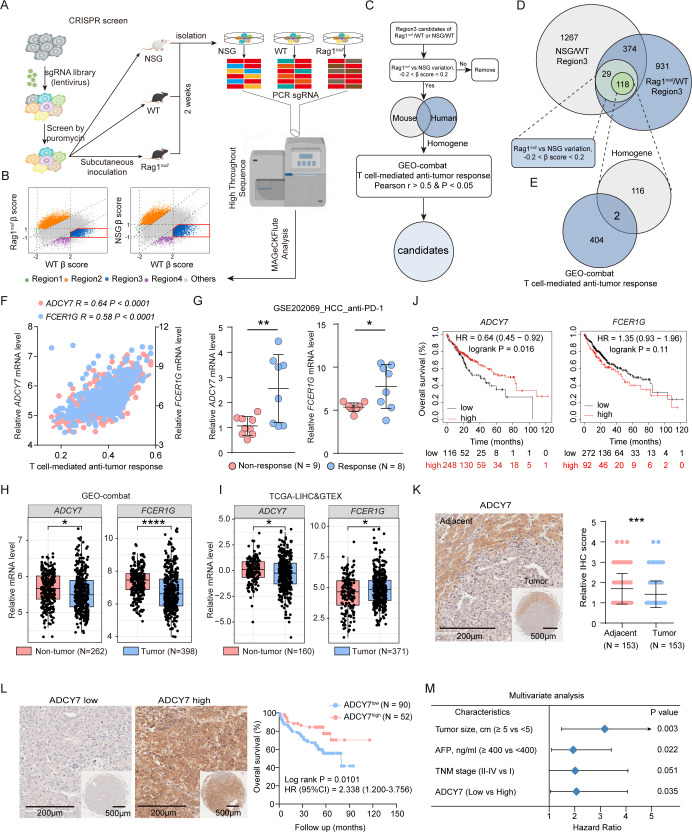
The genome-wide in vivo clustered regularly interspaced short palindromic repeats (CRISPR) screen library was conducted to identify the key genes associated with immune tolerance. Single-cell RNA-seq (scRNA-seq), flow cytometry, HCC mouse models, chromatin immunoprecipitation and coimmunoprecipitation were used to explore the function and mechanism of adenylate cyclase 7 (ADCY7) in HCC immune surveillance.
Here, a genome-wide in vivo CRISPR screen identified a novel immune modulator-ADCY7. The transmembrane protein ADCY7 undergoes subcellular translocation via caveolae-mediated endocytosis and then translocates to the nucleus with the help of leucine-rich repeat-containing protein 59 (LRRC59) and karyopherin subunit beta 1 (KPNB1). In the nucleus, it functions as a transcription cofactor of CCAAT/enhancer binding protein alpha (CEBPA) to induce transcription, thereby increasing CD8 T cell infiltration to restrain HCC progression. Furthermore, ADCY7 can be secreted as exosomes and enter neighbouring tumour cells to promote CCL5 induction. Exosomes with high ADCY7 levels promote intratumoural infiltration of CD8 T cells and suppress HCC tumour growth.
We delineate the unconventional function and subcellular location of ADCY7, highlighting its pivotal role in T cell-mediated immunity in HCC and its potential as a promising treatment target.
T细胞介导的反应强度是免疫疗法治疗恶性肿瘤有效性的一个决定因素;然而,由于广泛的免疫抑制微环境,T细胞疗法在肝细胞癌(HCC)中的临床疗效一直有限。
在此,我们旨在研究导致HCC免疫逃逸的关键基因,并提出一种重塑HCC微环境的新治疗策略。
进行全基因组体内成簇规律间隔短回文重复序列(CRISPR)筛选文库,以鉴定与免疫耐受相关的关键基因。使用单细胞RNA测序(scRNA-seq)、流式细胞术、HCC小鼠模型、染色质免疫沉淀和免疫共沉淀来探索腺苷酸环化酶7(ADCY7)在HCC免疫监视中的功能和机制。
在此,全基因组体内CRISPR筛选鉴定出一种新型免疫调节剂——ADCY7。跨膜蛋白ADCY7通过小窝介导的内吞作用进行亚细胞易位,然后在富含亮氨酸重复序列的蛋白59(LRRC59)和核转运蛋白β1亚基(KPNB1)的帮助下易位至细胞核。在细胞核中,它作为CCAAT/增强子结合蛋白α(CEBPA)的转录辅因子发挥作用以诱导转录,从而增加CD8+ T细胞浸润以抑制HCC进展。此外,ADCY7可以作为外泌体分泌并进入邻近肿瘤细胞以促进CCL5诱导。ADCY7水平高的外泌体促进肿瘤内CD8+ T细胞浸润并抑制HCC肿瘤生长。
我们阐述了ADCY7的非常规功能和亚细胞定位,突出了其在HCC中T细胞介导的免疫中的关键作用及其作为有前景的治疗靶点的潜力。