Institute of Cancer Research, Division of Genetics and Epidemiology, Sutton, UK.
Brighton and Sussex Clinical Trials Unit, Brighton and Sussex Medical School, Brighton, UK.
Br J Cancer. 2024 Nov;131(9):1506-1515. doi: 10.1038/s41416-024-02832-2. Epub 2024 Oct 1.
Genetic testing to identify germline high-risk pathogenic variants in breast cancer susceptibility genes is increasingly part of the breast cancer diagnostic pathway. Novel patient-centred pathways may offer opportunity to expand capacity and reduce turnaround time.
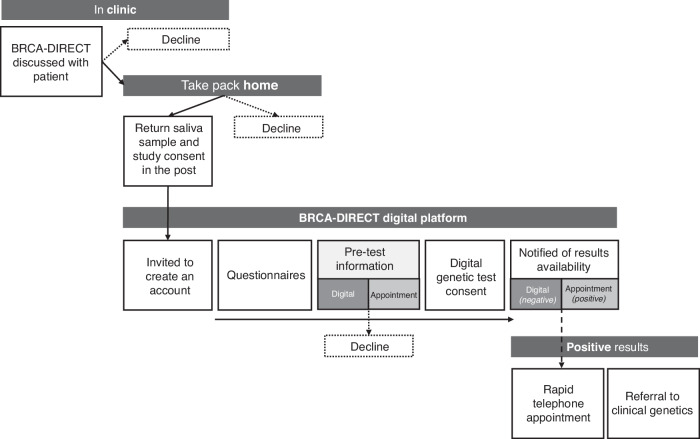
We recruited 1140 women with unselected breast cancer to undergo germline genetic testing through the BRCA-DIRECT pathway (which includes a digital platform, postal saliva sampling and a genetic counsellor telephone helpline). Ahead of consenting to the test, participants were randomised to receive information about genetic testing digitally (569/1140, 49.9%) or via a pre-test genetic counselling consultation (571/1140, 50.1%).
1001 (87.8%) participants progressed to receive their pre-test information and consented to testing. The primary outcome, uptake of genetic testing, was higher amongst participants randomised to receive digital information compared with those randomised to a pre-test genetic counselling consultation (90.8% (95% CI: 88.5% to 93.1%) vs 84.7% (95% CI: 81.8% to 87.6%), p = 0.002, adjusted for participant age and site). Non-inferiority was observed in relation to patient knowledge, anxiety, and satisfaction.
Findings demonstrate that standardised, digital information offers a non-inferior alternative to conventional genetic counselling, and an end-to-end patient-centred, digital pathway (supported by genetic counselling hotline) could feasibly be implemented into breast oncology settings.
The study is registered with, and protocol available on, ClinicalTrials.gov (NCT04842799).
为了识别乳腺癌易感基因中的种系高危致病性变异,基因检测越来越多地成为乳腺癌诊断途径的一部分。新的以患者为中心的途径可能有机会扩大能力并缩短周转时间。
我们招募了 1140 名未经选择的乳腺癌患者,通过 BRCA-DIRECT 途径(包括数字平台、邮政唾液采样和遗传咨询师电话热线)进行种系基因检测。在同意进行测试之前,参与者被随机分配接受数字(569/1140,49.9%)或预测试遗传咨询(571/1140,50.1%)信息。
1001 名(87.8%)参与者接受了测试前信息并同意进行测试。主要结果,即基因检测的接受率,在随机接受数字信息的参与者中高于随机接受预测试遗传咨询的参与者(90.8%(95%CI:88.5%至93.1%)比 84.7%(95%CI:81.8%至 87.6%),p=0.002,调整了参与者年龄和地点)。在患者知识、焦虑和满意度方面,观察到非劣效性。
研究结果表明,标准化的数字信息提供了一种不劣于传统遗传咨询的替代方案,端到端以患者为中心的数字途径(由遗传咨询师热线支持)可以切实地应用于乳腺癌肿瘤学环境中。
该研究在 ClinicalTrials.gov 上注册(NCT04842799),并提供了方案。