Division of Anatomic Pathology and Histology, Fondazione Policlinico Universitario "Agostino Gemelli"-IRCCS, Università Cattolica del Sacro Cuore, Largo Francesco Vito, 1, 00168, Rome, Italy.
Department of Pathology, All India Institute of Medical Sciences, New Delhi, India.
Virchows Arch. 2024 Nov;485(5):853-858. doi: 10.1007/s00428-024-03934-1. Epub 2024 Sep 30.
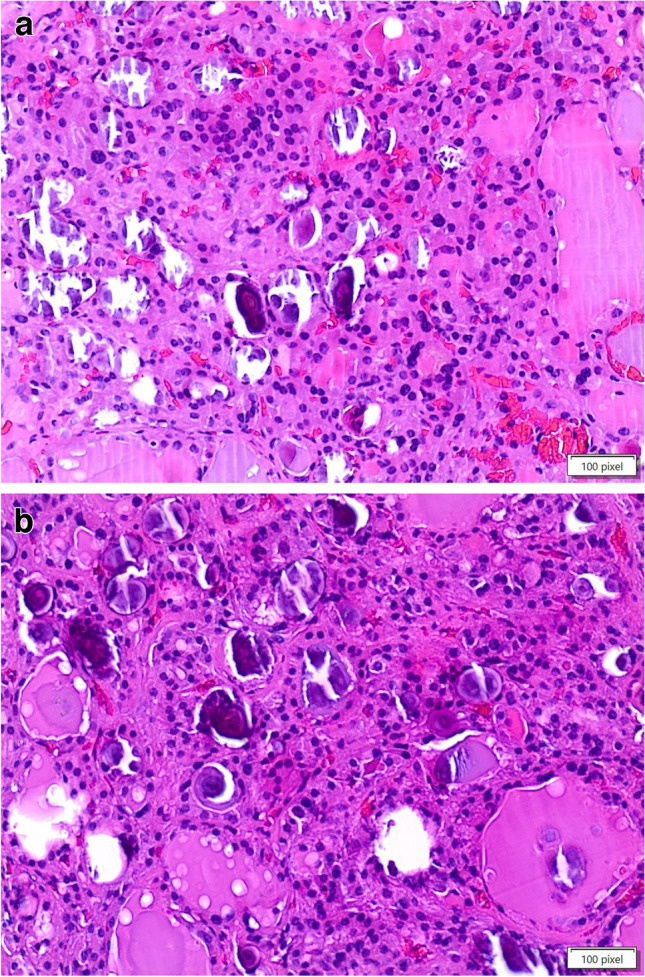
Traditionally, psammoma bodies (PB) have been considered as tale-tell evidence of papillary thyroid carcinoma (PTC) and are frequently encountered in classic and other subtypes of PTCs. However, the presence of PBs in the thyroid gland does not always indicate malignancy. The leading hypothesis on their origin suggests that PB are remnants of papillary structures that have undergone thrombosis, necrosis, and subsequent calcification. From January 2010 to May 2024, 26 patients with psammoma bodies associated with benign thyroid lesions, mainly thyroid follicular nodular disease (TFND), Hashimoto thyroiditis (HT), Graves' disease, and follicular adenomas, were found. The case cohort included 16 females and 10 males with a median age of 49.3 years. The series included 12 TFND, two HT, and 12 follicular adenomas (11 out of 12 were oncocytic adenomas). Twenty-four out of 26 underwent total thyroidectomy. In 24 out of 26 cases, the entire lobes and parenchyma were included and serial cuts at multiple levels were performed in cases with PB but without any evidence of malignancy. Even though the detection of PB is associated with a malignant thyroid lesion, especially PTC and its subtypes, our multi-institutional series showed that in a minority PB can be found in a variety of benign thyroid lesions. Evaluation of the entire thyroid parenchyma at multiple levels is mandatory to exclude sub-centimeter papillary thyroid carcinoma.
传统上,砂粒体(PB)被认为是甲状腺乳头状癌(PTC)的标志性证据,并且经常在经典型和其他 PTC 亚型中发现。然而,甲状腺中存在 PB 并不总是表明恶性肿瘤。关于其起源的主要假说表明,PB 是经历血栓形成、坏死和随后钙化的乳头状结构的残留物。从 2010 年 1 月至 2024 年 5 月,我们发现了 26 例与良性甲状腺病变相关的砂粒体,主要为甲状腺滤泡性结节性疾病(TFND)、桥本甲状腺炎(HT)、格雷夫斯病和滤泡性腺瘤。病例队列包括 16 名女性和 10 名男性,中位年龄为 49.3 岁。该系列包括 12 例 TFND、2 例 HT 和 12 例滤泡性腺瘤(12 例中的 11 例为嗜酸细胞性腺瘤)。26 例中有 24 例行全甲状腺切除术。在 26 例中有 24 例中,包括整个叶和实质,并且在有 PB 但没有任何恶性证据的情况下进行了多个水平的连续切片。尽管 PB 的检测与恶性甲状腺病变相关,特别是 PTC 及其亚型,但我们的多机构系列研究表明,在少数情况下,PB 可存在于各种良性甲状腺病变中。必须评估多个水平的整个甲状腺实质,以排除亚厘米大小的甲状腺乳头状癌。