
慢性低度炎症与中年和老年人更高的心血管代谢多病共病风险和更早发病相关:一项基于人群的队列研究。
Chronic low-grade inflammation associated with higher risk and earlier onset of cardiometabolic multimorbidity in middle-aged and older adults: a population-based cohort study.
机构信息
Zhejiang Key Laboratory of Blood-Stasis-Toxin Syndrome, Zhejiang Chinese Medical University, Hangzhou, 310053, China.
Medical Faculty, University of Leipzig, Leipzig, Germany.
出版信息
Sci Rep. 2024 Sep 30;14(1):22635. doi: 10.1038/s41598-024-72988-7.
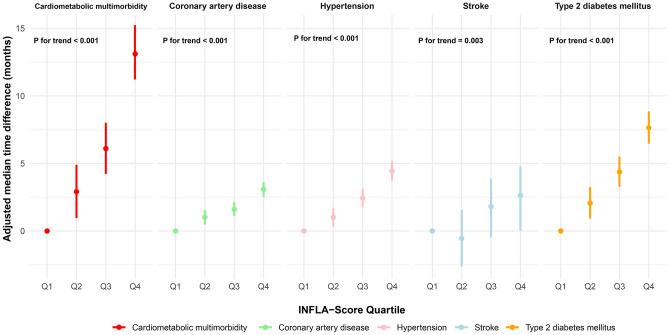
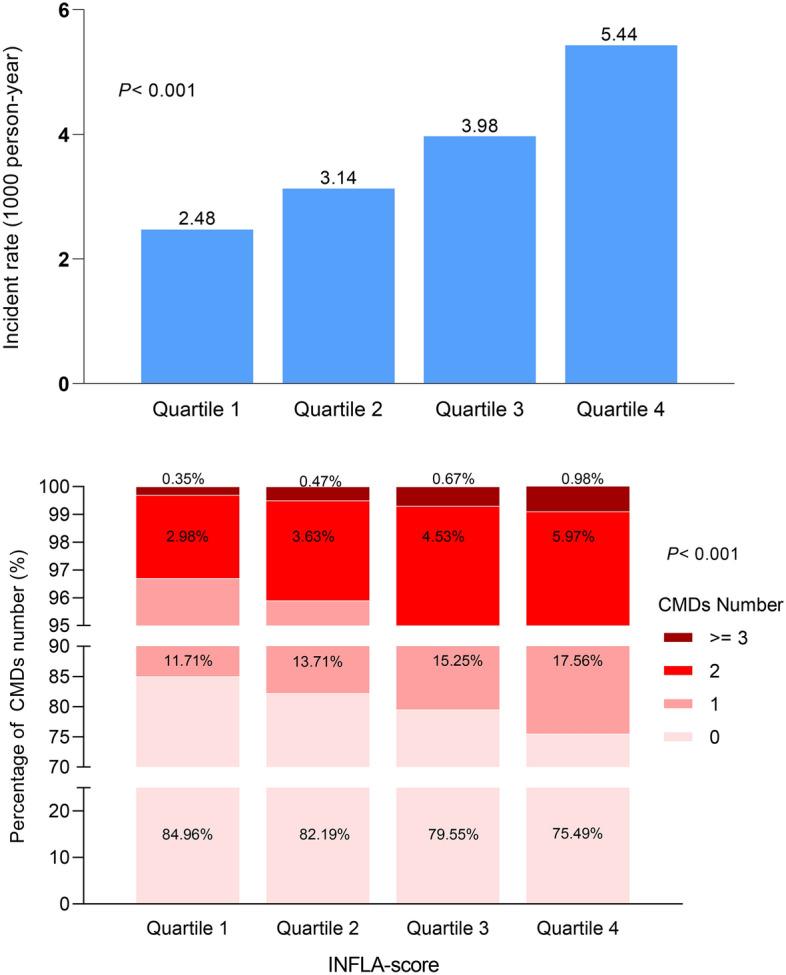
Evidence regarding the role of chronic low-grade inflammation in the progression of cardiometabolic diseases (CMDs) and cardiometabolic multimorbidity (CMM) is currently limited. This prospective cohort study, utilising data from the UK Biobank, included 273,804 adults aged 40-69 years initially free of CMD at baseline. CMM was defined as the coexistence of two or more CMDs, such as coronary artery disease, type 2 diabetes mellitus, hypertension and stroke. The aggregated inflammation score (INFLA-score), incorporating C-reactive protein, white blood cell count, platelet count and granulocyte-to-lymphocyte ratio, quantified chronic low-grade inflammation. Absolute risks (ARs), hazard ratios (HRs) and 95% confidence intervals (CIs) assessed the association of increased INFLA-score with the risk of CMMs and CMDs. The accelerated failure time model explored the effect of INFLA-score on the time to CMM onset, and a restricted cubic spline characterised the dose-dependent relationship between INFLA-score and CMM risk. After a median follow-up of 166.37 months, 13,755 cases of CMM were identified. In quartiles with increasing INFLA-score levels, CMM ARs were 4.41%, 4.49%, 5.04% and 6.01%, respectively; HR increased by 2%, 15% and 36%, respectively, compared to the lowest quartile. The INFLA-score and CMM risk relationship was nonlinear (P for nonlinear < 0.001), exhibiting a significant risk trend change at a score of 9. For INFLA-score < 9, CMM risk increased by 1.9% for each 1-point increase; for INFLA-score ≥ 9, the risk increased by 5.9% for each 1-point increase. Additionally, a higher INFLA-score was associated with an earlier onset of CMM (P < 0.001). Compared to the first INFLA-score quartile, the AFT model revealed adjusted median times to CMM occurrence were 2.92, 6.10 and 13.19 months earlier in the second, third and fourth quartile groups, respectively. Chronic low-grade inflammation is associated with a higher risk of cardiometabolic multimorbidity and earlier onset among middle-aged and older adults. Monitoring and screening the INFLA-score in adults without CMDs may improve early prevention of CMM.
目前,关于慢性低度炎症在心脏代谢疾病(CMD)和心脏代谢合并症(CMM)进展中的作用的证据有限。本前瞻性队列研究利用英国生物库的数据,纳入了 273804 名年龄在 40-69 岁、基线时无 CMD 的成年人。CMM 定义为两种或多种 CMD 的共存,如冠状动脉疾病、2 型糖尿病、高血压和中风。聚合炎症评分(INFLA 评分),包含 C 反应蛋白、白细胞计数、血小板计数和粒细胞与淋巴细胞比值,量化了慢性低度炎症。绝对风险(AR)、风险比(HR)和 95%置信区间(CI)评估了 INFLA 评分升高与 CMM 和 CMD 风险的相关性。加速失效时间模型探讨了 INFLA 评分对 CMM 发病时间的影响,限制立方样条函数描绘了 INFLA 评分与 CMM 风险之间的剂量依赖性关系。中位随访 166.37 个月后,共发现 13755 例 CMM。在 INFLA 评分水平逐渐升高的四分位数中,CMM 的 AR 分别为 4.41%、4.49%、5.04%和 6.01%;与最低四分位数相比,HR 分别增加了 2%、15%和 36%。INFLA 评分与 CMM 风险之间的关系是非线性的(P<0.001),在评分 9 时表现出显著的风险趋势变化。对于 INFLA 评分<9,每增加 1 分,CMM 风险增加 1.9%;对于 INFLA 评分≥9,每增加 1 分,风险增加 5.9%。此外,较高的 INFLA 评分与 CMM 发病时间提前相关(P<0.001)。与第一 INFLA 评分四分位数相比,AFT 模型显示第二、第三和第四四分位数组发生 CMM 的调整中位时间分别提前 2.92、6.10 和 13.19 个月。慢性低度炎症与中年和老年人更高的心脏代谢合并症风险和更早发病相关。监测和筛查无 CMD 成年人的 INFLA 评分可能有助于早期预防 CMM。



 Zotero 插件