Park Jin Young, Jun Haesung, Lee Seung-Eun, Won Ha-Kyeong, Kang Sung-Yoon, Kang Noeul, Oh Ji-Yoon, Kim Young-Chan, Park So-Young, An Jin, Yoo Youngsang, Kim Mi-Yeong, Lee Hwa Young, Shim Ji-Su, Kim Min-Hye, Kim Sae-Hoon, Kim Sang-Heon, Chang Yoon-Seok, Kim Sang-Hoon, Lee Byung-Jae, Birring Surinder S, Song Woo-Jung
University of Ulsan College of Medicine, Seoul, South Korea.
Department of Internal Medicine, School of Medicine, Pusan National University, Pusan National University Yangsan Hospital, Yangsan, Korea.
ERJ Open Res. 2024 Sep 30;10(5). doi: 10.1183/23120541.00320-2024. eCollection 2024 Sep.
Disease control in chronic diseases is an overarching concept that reflects the degree to which the goals of therapy are met. However, to date, there is no consensus on the definition of disease control in chronic cough. This study aimed to provide a conceptual exploration of patient-reported cough control in chronic cough.
This research is comprised of two subanalyses. First, patients with chronic cough receiving care at referral clinics were evaluated. Correlation analyses were performed between patient-reported cough control (a 5-point Likert scale), cough-specific patient-reported outcomes (PROs) and generic health PRO scores. Second, a survey was conducted among patients with refractory chronic cough and physicians to identify factors pertinent to cough control.
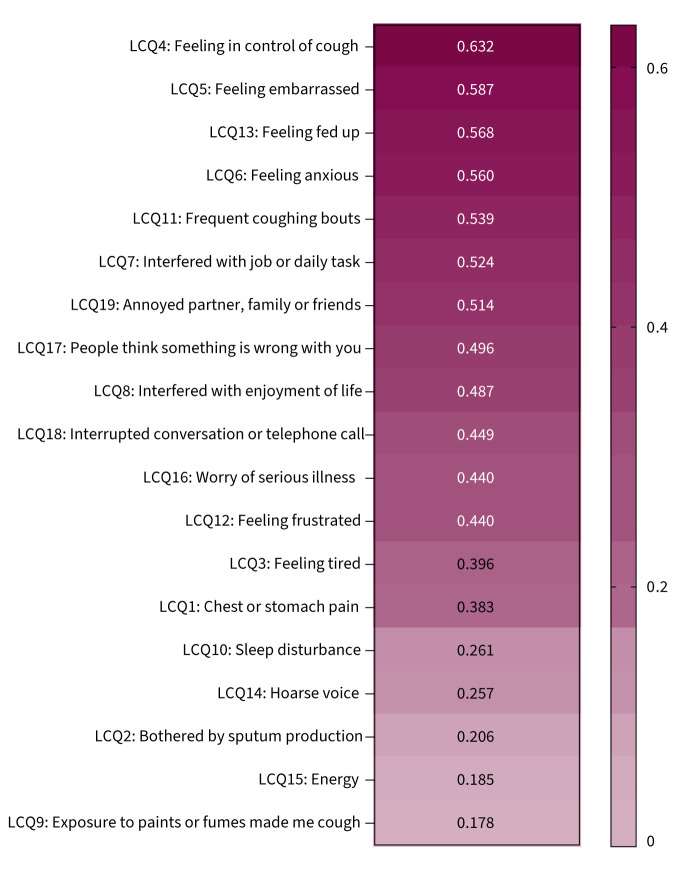
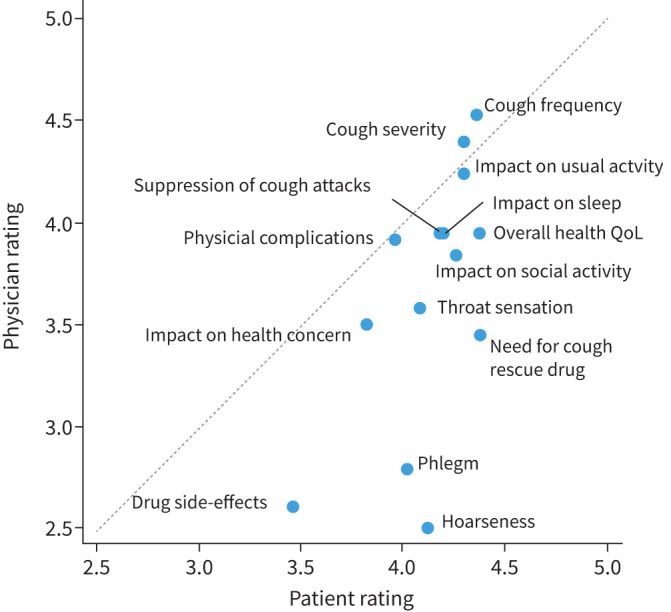
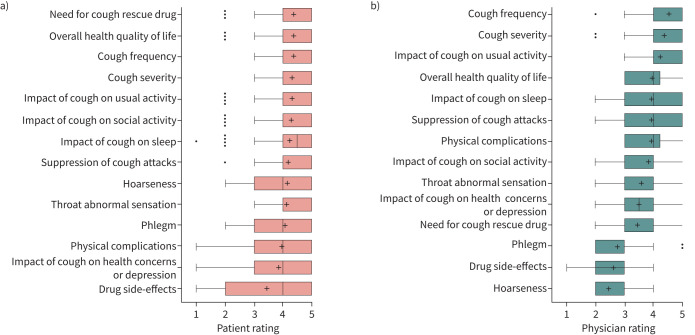
The analysis of 341 patients (mean age: 55.5±15.1 years; female: 66.6%) revealed that cough control rating was moderately correlated with cough severity visual analogue scale and Leicester Cough Questionnaire scores, while demonstrating weaker correlations with cough-associated throat symptoms, cough-related complications or general health-related quality of life (QoL). In the survey of patients and physicians, both groups considered certain factors, such as cough frequency, severity and impact on QoL, to be relevant to the concept of cough control. However, patients rated "need for cough rescue drug" notably higher than physicians.
Patient-reported cough control was associated with cough severity or impact on QoL; however, cough control may not be fully captured by conventional cough PRO measurement tools. Further studies are warranted to define the consensus and tools to measure disease control in chronic cough.
慢性病的疾病控制是一个总体概念,反映了治疗目标的实现程度。然而,迄今为止,慢性咳嗽的疾病控制定义尚无共识。本研究旨在对患者报告的慢性咳嗽控制进行概念性探索。
本研究由两项子分析组成。首先,对在转诊诊所接受治疗的慢性咳嗽患者进行评估。对患者报告的咳嗽控制(5点李克特量表)、咳嗽特异性患者报告结局(PROs)和一般健康PRO评分进行相关性分析。其次,对难治性慢性咳嗽患者和医生进行调查,以确定与咳嗽控制相关的因素。
对341例患者(平均年龄:55.5±15.1岁;女性:66.6%)的分析显示,咳嗽控制评分与咳嗽严重程度视觉模拟量表和莱斯特咳嗽问卷评分中度相关,而与咳嗽相关的咽喉症状、咳嗽相关并发症或一般健康相关生活质量(QoL)的相关性较弱。在患者和医生的调查中,两组都认为某些因素,如咳嗽频率、严重程度和对QoL的影响,与咳嗽控制概念相关。然而,患者对“需要咳嗽急救药物”的评分明显高于医生。
患者报告的咳嗽控制与咳嗽严重程度或对QoL的影响相关;然而,传统的咳嗽PRO测量工具可能无法完全反映咳嗽控制情况。有必要进一步研究以确定慢性咳嗽疾病控制的共识和测量工具。