Kang Noeul, Won Ha-Kyeong, Lee Ji-Hyang, Shim Ji-Su, Kang Sung-Yoon, Park Han-Ki, Jo Eun-Jung, Lee Seung Eun, Kim Min-Hye, Kim Sang-Heon, Kim Sae-Hoon, Chang Yoon-Seok, Lee Byung-Jae, Song Woo-Jung, Jo Min-Woo
Division of Allergy, Department of Medicine, Samsung Medical Center, Sungkyunkwan University School of Medicine, Seoul, Korea.
Department of Internal Medicine, Veterans Health Service Medical Center, Seoul, Korea.
Allergy Asthma Immunol Res. 2023 May;15(3):348-360. doi: 10.4168/aair.2023.15.3.348. Epub 2023 Jan 26.
Chronic cough (CC) is associated with health-related quality of life (HRQoL) impairment. However, the determinants of HRQoL are under-investigated.
Patients aged 19-80 years with CC were prospectively recruited from 10 referral clinics. Comparisons were made with age- and sex-matched controls (1:4 ratio) selected from a Korean general population survey database; 1) a group without current cough (non-cough controls) and 2) another group without major chronic illnesses (healthy controls). HRQoL was assessed using the EuroQoL 5-dimension (EQ-5D) index. In CC patients, cough-specific patient-reported outcomes (PROs) were additionally measured. Cross-sectional analyses were performed to evaluate demographic and clinical parameters associated with the EQ-5D index of CC patients.
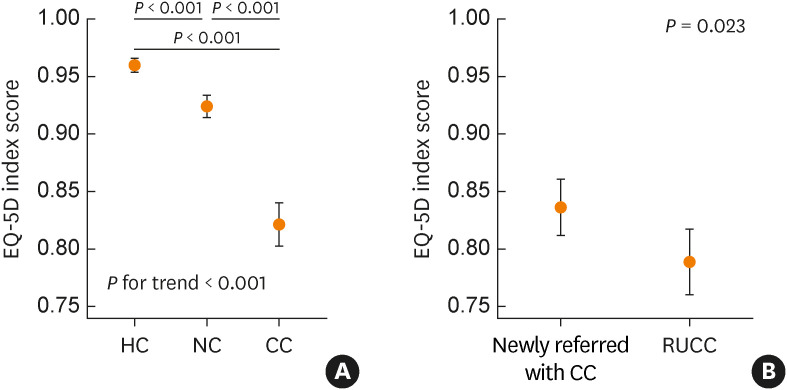
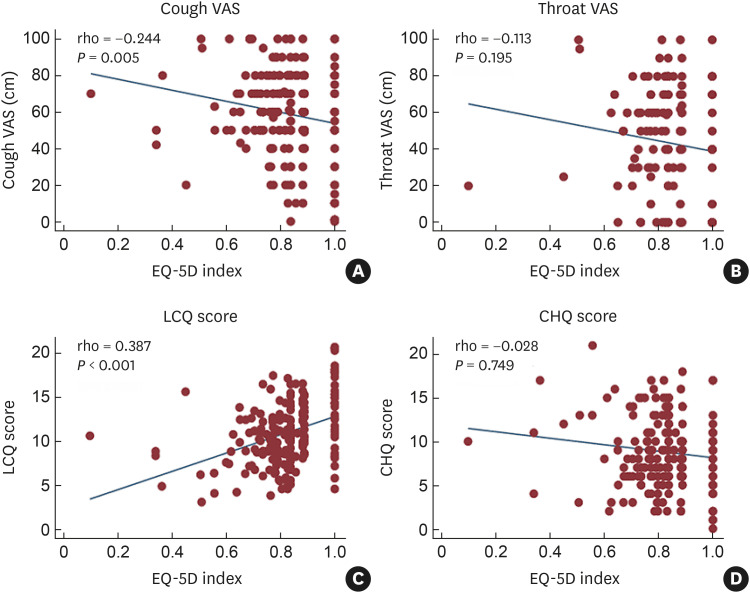
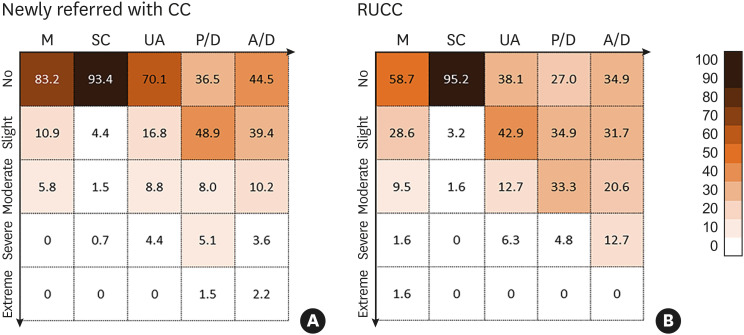
A total of 200 CC patients (137 newly referred with CC and 63 refractory or unexplained CC [RUCC] patients), 800 non-cough controls, and 799 healthy controls were analyzed. The EQ-5D index of CC patients was significantly lower than that of non-cough controls or healthy controls (0.82 ± 0.14 vs 0.92 ± 0.14/0.96 ± 0.08; < 0.001, respectively). The index was also associated with older age (≥ 60 years), female sex, and comorbidities such as asthma or depression. Among the patients with CC, the index was significantly lower in patients with RUCC than in those with newly referred CC, being treated with codeine or cough neuromodulators, or with cough-related fatigue. In Spearman analyses, the EQ-5D index correlated with cough-specific quality of life and cough severity scores, not with throat sensation or cough trigger scores.
The HRQoL impairment of CC patients was associated with older age, female sex, and comorbidities but it was also affected by cough severity, complications, treatments, and treatment responses. Longitudinal studies are warranted to further understand and improve the HRQoL of CC patients.
慢性咳嗽(CC)与健康相关生活质量(HRQoL)受损有关。然而,HRQoL的决定因素尚未得到充分研究。
从10家转诊诊所前瞻性招募年龄在19 - 80岁的CC患者。与从韩国普通人群调查数据库中选取的年龄和性别匹配的对照组(比例为1:4)进行比较;1)一组无当前咳嗽的人群(非咳嗽对照组)和2)另一组无重大慢性疾病的人群(健康对照组)。使用欧洲五维健康量表(EQ - 5D)指数评估HRQoL。在CC患者中,还额外测量了咳嗽特异性患者报告结局(PROs)。进行横断面分析以评估与CC患者EQ - 5D指数相关的人口统计学和临床参数。
共分析了200例CC患者(137例新转诊的CC患者和63例难治性或不明原因CC[RUCC]患者)、800例非咳嗽对照组和799例健康对照组。CC患者的EQ - 5D指数显著低于非咳嗽对照组或健康对照组(0.82±0.14 vs 0.92±0.14/0.96±0.08;P均<0.001)。该指数还与年龄较大(≥60岁)、女性以及哮喘或抑郁症等合并症相关。在CC患者中,RUCC患者的指数显著低于新转诊的CC患者、接受可待因或咳嗽神经调节剂治疗的患者或有咳嗽相关疲劳的患者。在Spearman分析中,EQ - 5D指数与咳嗽特异性生活质量和咳嗽严重程度评分相关,与咽喉感觉或咳嗽触发评分无关。
CC患者的HRQoL受损与年龄较大、女性以及合并症有关,但也受咳嗽严重程度、并发症、治疗及治疗反应的影响。有必要进行纵向研究以进一步了解并改善CC患者的HRQoL。