Moond Vishali, Maniyar Bhumi, Harne Prateek Suresh, Bailey-Lundberg Jennifer M, Thosani Nirav C
Department of Internal Medicine, Saint Peter's University Hospital/Robert Wood Johnson Medical School, New Brunswick, NJ 08901, USA.
Department of Anesthesiology, Critical Care and Pain Medicine, McGovern Medical School, University of Texas Health Science Center, Houston, TX 77030, USA.
Explor Target Antitumor Ther. 2024;5(5):1056-1073. doi: 10.37349/etat.2024.00263. Epub 2024 Aug 15.
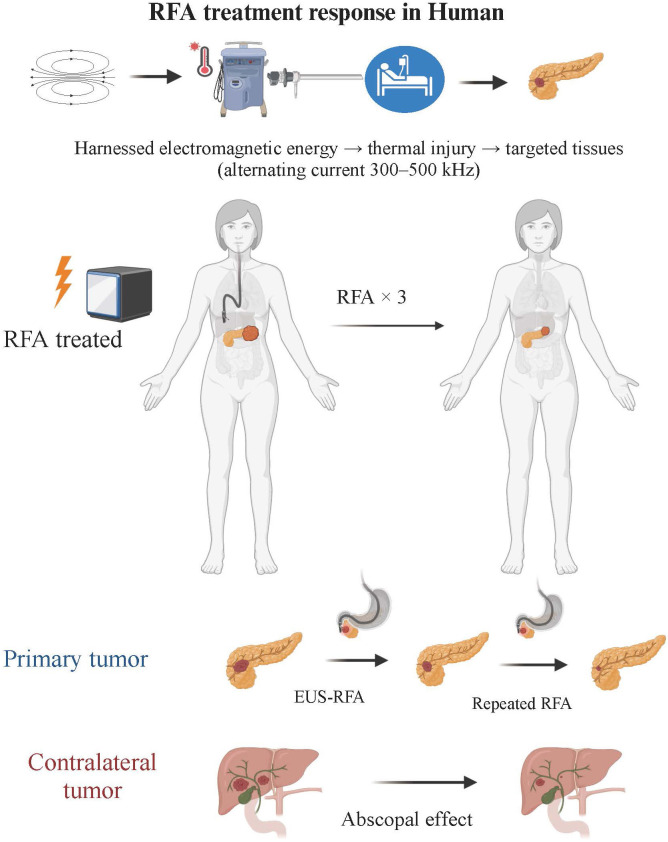
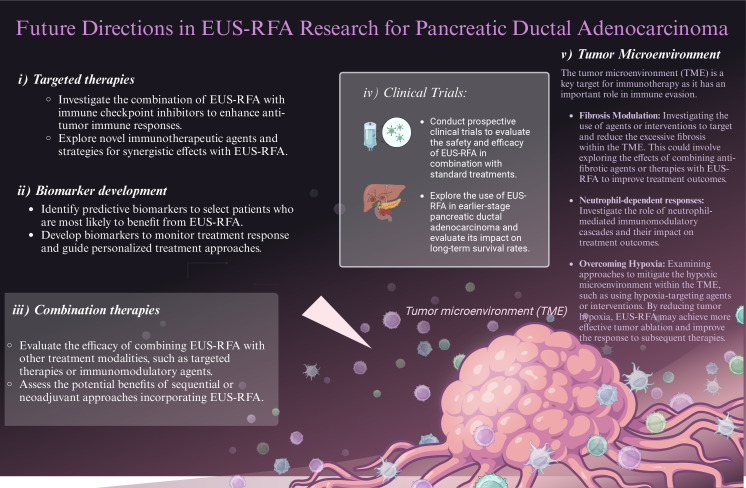
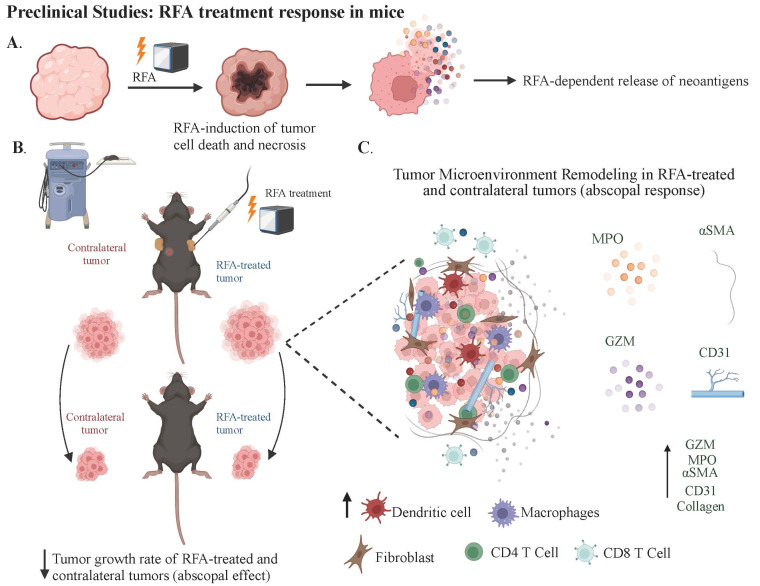
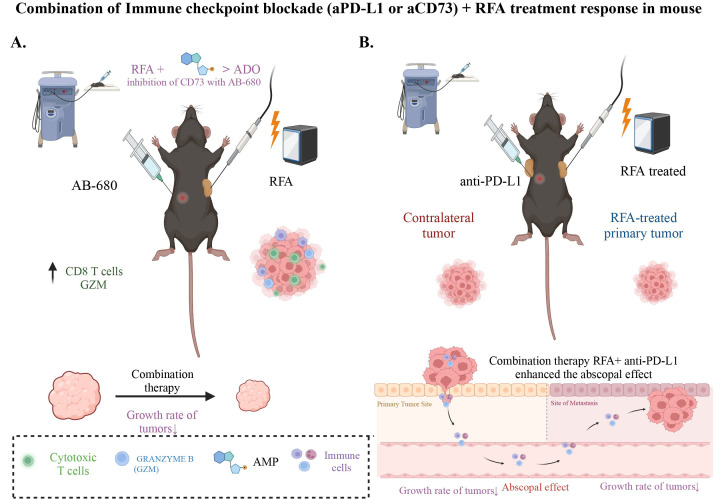
Pancreatic ductal adenocarcinoma (PDAC) is characterized by poor prognostics and substantial therapeutic challenges, with dismal survival rates. Tumor resistance in PDAC is primarily attributed to its fibrotic, hypoxic, and immune-suppressive tumor microenvironment (TME). Endoscopic ultrasound-guided radiofrequency ablation (EUS-RFA), an Food and Drug Administration (FDA)-approved minimally invasive technique for treating pancreatic cancer, disrupts tumors with heat and induces coagulative necrosis, releasing tumor antigens that may trigger a systemic immune response-the abscopal effect. We aim to elucidate the roles of EUS-RFA-mediated thermal and mechanical stress in enhancing anti-tumor immunity in PDAC. A comprehensive literature review focused on radiofrequency immunomodulation and immunotherapy in pancreatic tumors to understand the pathophysiological mechanisms of RFA and its effect on the TME, which could prevent recurrence and resistance. We reviewed clinical, preclinical, and studies on RFA mechanisms in pancreatic adenocarcinoma, discussing the unique immunomodulatory effects of EUS-RFA. Recent findings suggest that combining RFA with immune adjuvants enhances responses in pancreatic adenocarcinoma. EUS-RFA offers a dual benefit against PDAC by directly reducing tumor viability and indirectly enhancing anti-tumor immunity. Observations of neutrophil-mediated immunomodulation and programmed cell death ligand 1 (PD-L1) modulation support integrating EUS-RFA with targeted immunotherapies for managing pancreatic adenocarcinoma. Integrating EUS-RFA in PDAC treatment promises direct cytoreduction and synergistic effects with molecular targeted therapies. Prospective clinical trials are crucial to assess the efficacy of this combined approach in improving outcomes and survival rates in advanced PDAC cases.
胰腺导管腺癌(PDAC)的特点是预后不良和治疗挑战巨大,生存率极低。PDAC中的肿瘤耐药主要归因于其纤维化、缺氧和免疫抑制的肿瘤微环境(TME)。内镜超声引导下射频消融术(EUS-RFA)是一种经美国食品药品监督管理局(FDA)批准的用于治疗胰腺癌的微创技术,它利用热量破坏肿瘤并诱导凝固性坏死,释放出可能引发全身免疫反应(即远隔效应)的肿瘤抗原。我们旨在阐明EUS-RFA介导的热应激和机械应激在增强PDAC抗肿瘤免疫中的作用。通过全面的文献综述,聚焦于胰腺肿瘤的射频免疫调节和免疫治疗,以了解RFA的病理生理机制及其对TME的影响,这可能预防复发和耐药。我们回顾了关于胰腺腺癌RFA机制的临床、临床前及相关研究,讨论了EUS-RFA独特的免疫调节作用。最近的研究结果表明,将RFA与免疫佐剂联合使用可增强胰腺腺癌的反应。EUS-RFA通过直接降低肿瘤活力和间接增强抗肿瘤免疫,为PDAC带来双重益处。对中性粒细胞介导的免疫调节和程序性细胞死亡配体1(PD-L1)调节的观察结果支持将EUS-RFA与靶向免疫疗法相结合来治疗胰腺腺癌。将EUS-RFA纳入PDAC治疗有望实现直接的细胞减灭,并与分子靶向疗法产生协同效应。前瞻性临床试验对于评估这种联合方法在改善晚期PDAC病例的疗效和生存率方面的效果至关重要。