Laboratory of Immunovirotherapy, Drug Research Program, University of Helsinki Faculty of Pharmacy, Helsinki, Finland.
Institute for Molecular Medicine Finland (FIMM), Helsinki Institute for Life Sciences (HiLIFE), University of Helsinki, Helsinki, Finland.
Oncoimmunology. 2024 Sep 25;13(1):2407532. doi: 10.1080/2162402X.2024.2407532. eCollection 2024.
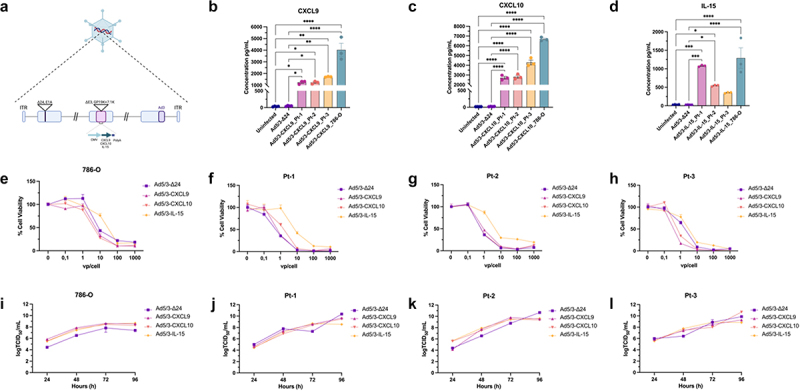
Immunotherapy has emerged as a promising approach for cancer treatment, with oncolytic adenoviruses showing power as immunotherapeutic agents. In this study, we investigated the immunotherapeutic potential of an adenovirus construct expressing CXCL9, CXCL10, or IL-15 in clear cell renal cell carcinoma (ccRCC) tumor models. Our results demonstrated robust cytokine secretion upon viral treatment, suggesting effective transgene expression. Subsequent analysis using resistance-based transwell migration and microfluidic chip assays demonstrated increased T-cell migration in response to chemokine secretion by infected cells in both 2D and 3D cell models. Flow cytometry analysis revealed CXCR3 receptor expression across T-cell subsets, with the highest percentage found on CD8+ T-cells, underscoring their key role in immune cell migration. Alongside T-cells, we also detected NK-cells in the tumors of immunocompromised mice treated with cytokine-encoding adenoviruses. Furthermore, we identified potential immunogenic antigens that may enhance the efficacy and specificity of our armed oncolytic adenoviruses in ccRCC. Overall, our findings using ccRCC cell line, humanized mice, physiologically relevant PDCs in 2D and patient-derived organoids (PDOs) in 3D suggest that chemokine-armed adenoviruses hold promise for enhancing T-cell migration and improving immunotherapy outcomes in ccRCC. Our study contributes to the development of more effective ccRCC treatment strategies by elucidating immune cell infiltration and activation mechanisms within the tumor microenvironment (TME) and highlights the usefulness of PDOs for predicting clinical relevance and validating novel immunotherapeutic approaches. Overall, our research offers insights into the rational design and optimization of viral-based immunotherapies for ccRCC.
免疫疗法已成为癌症治疗的一种有前途的方法,溶瘤腺病毒作为免疫治疗剂显示出强大的作用。在这项研究中,我们研究了表达 CXCL9、CXCL10 或 IL-15 的腺病毒构建体在透明细胞肾细胞癌 (ccRCC) 肿瘤模型中的免疫治疗潜力。我们的研究结果表明,病毒处理后会产生强烈的细胞因子分泌,提示有效表达转基因。随后使用基于抗性的 Transwell 迁移和微流控芯片分析在 2D 和 3D 细胞模型中,我们发现感染细胞分泌趋化因子后,T 细胞的迁移增加。流式细胞术分析显示 T 细胞亚群中存在 CXCR3 受体表达,CD8+T 细胞中的比例最高,突出了它们在免疫细胞迁移中的关键作用。除了 T 细胞,我们还在接受细胞因子编码腺病毒治疗的免疫缺陷小鼠的肿瘤中检测到 NK 细胞。此外,我们还鉴定了可能增强我们武装溶瘤腺病毒在 ccRCC 中的疗效和特异性的潜在免疫原性抗原。总的来说,我们使用 ccRCC 细胞系、人源化小鼠、2D 中生理相关的 PDC 和 3D 中的患者来源的类器官 (PDO) 的研究结果表明,趋化因子武装的腺病毒有望增强 T 细胞迁移并改善 ccRCC 的免疫治疗结果。我们的研究通过阐明肿瘤微环境 (TME) 中的免疫细胞浸润和激活机制,为开发更有效的 ccRCC 治疗策略做出了贡献,并强调了 PDO 用于预测临床相关性和验证新型免疫治疗方法的有用性。总的来说,我们的研究为合理设计和优化基于病毒的 ccRCC 免疫疗法提供了思路。