Division of Gastroenterology and Hepatology, Department of Medicine III, Medical University of Vienna, Vienna, Austria.
Department of Internal Medicine IV, Klinik Ottakring, Vienna, Austria.
Liver Int. 2024 Dec;44(12):3151-3163. doi: 10.1111/liv.16076. Epub 2024 Oct 1.
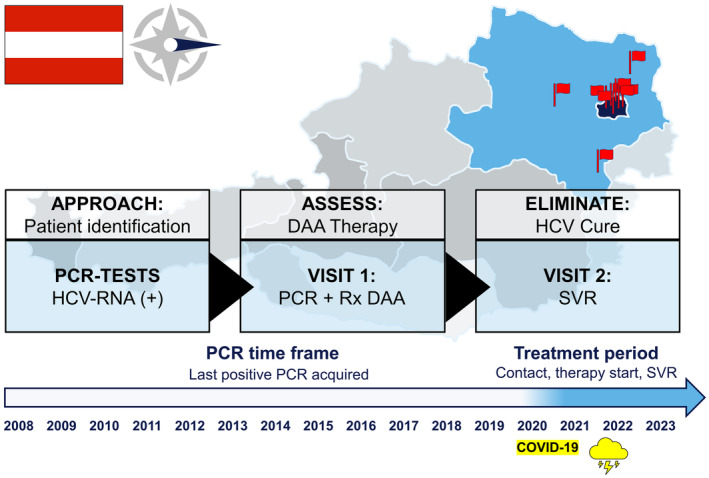
Identification of people living with hepatitis C virus (HCV) via readily available laboratory records could be a key strategy for macro-elimination, aligning with the WHO elimination goal. Therefore, the ELIMINATE(ELIMINation of HCV in AusTria East) project aimed to systematically re-link people with a 'last-positive' HCV-RNA PCR record to care.
In 10 major liver centres in Eastern Austria, a systematic readout of 'last-positive' HCV-RNA PCR test records obtained between 2008 and 2020 were conducted and linked to available patient contact data. Between 2020 and 2023, individuals were contacted first by phone, then by letter, to inform them about the availability of effective direct-acting antiviral (DAA) treatment and invite them for pre-treatment evaluation.
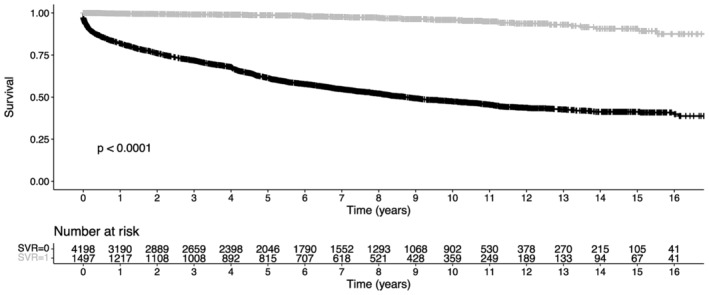
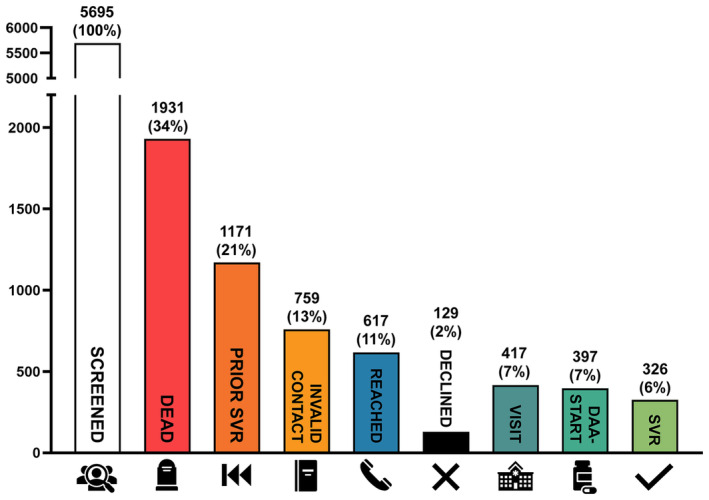
The overall cohort of last-positive HCV+ individuals included 5695 subjects (62.5% males, mean age 57.3 ± 17.3 years); of note, 1931 (34%) of them had died and 759 (13%) individuals had no valid contact information. Of the remaining 3005 individuals, 1171 (40.0%) had already achieved sustained virological response (SVR) at the time of re-call. We successfully reached 617 (20.5%), of whom 417 (67.6%) attended their pre-treatment visit, and 397 (64.3%) commenced DAA-therapy. HCV cure has been confirmed in 326 individuals, corresponding to an SVR rate of 82.1%.
The ELIMINATE project identified 5695 people living with HCV who were 'lost to care' despite documented HCV viraemia. While invalid contact data were an evident barrier to HCV elimination, premature deaths among the cohort underscored the severity of untreated HCV. The implementation of a systematic HCV-RNA PCR recorded-based re-call workflow represents an effective strategy supporting the WHO goal of HCV elimination.
通过易于获得的实验室记录来识别丙型肝炎病毒(HCV)感染者,可能是实现大规模消除的关键策略,符合世界卫生组织(WHO)的消除目标。因此,ELIMINATE(奥地利东部 HCV 消除)项目旨在系统地将具有“最后一次阳性”HCV-RNA PCR 记录的人群与护理联系起来。
在奥地利东部的 10 个主要肝脏中心,对 2008 年至 2020 年间获得的“最后一次阳性”HCV-RNA PCR 检测记录进行了系统读取,并与可用的患者联系数据进行了关联。在 2020 年至 2023 年期间,首先通过电话,然后通过信件联系个人,告知他们可用有效的直接作用抗病毒(DAA)治疗,并邀请他们进行治疗前评估。
最后一次阳性 HCV+个体的总体队列包括 5695 名受试者(62.5%为男性,平均年龄 57.3±17.3 岁);值得注意的是,其中 1931 人(34%)已经死亡,759 人(13%)没有有效的联系方式。在其余 3005 名个体中,1171 名(40.0%)在召回时已经达到持续病毒学应答(SVR)。我们成功联系到 617 名(20.5%),其中 417 名(67.6%)参加了治疗前就诊,397 名(64.3%)开始接受 DAA 治疗。在 326 名个体中已经确认 HCV 治愈,相应的 SVR 率为 82.1%。
ELIMINATE 项目确定了 5695 名患有 HCV 的“失访”人群,尽管有 HCV 病毒血症的记录。虽然无效的联系数据是消除 HCV 的一个明显障碍,但队列中的过早死亡突显了未经治疗的 HCV 的严重性。实施基于系统 HCV-RNA PCR 记录的召回工作流程是支持 WHO HCV 消除目标的有效策略。