Schwarz M, Schwarz C, Schütz A, Schwanke C, Krabb E, Schubert R, Liebich S-T, Bauer D, Burghart L, Brinkmann L, Gutic E, Reiberger T, Haltmayer H, Gschwantler M
Klinik Ottakring, Department of Internal Medicine IV, Vienna, Austria.
Medical University of Vienna, Department of Internal Medicine III, Division of Gastroenterology and Hepatology, Vienna, Austria.
J Virus Erad. 2023 Mar 2;9(1):100319. doi: 10.1016/j.jve.2023.100319. eCollection 2023 Mar.
BACKGROUND & AIMS: Despite effective direct-acting antivirals (DAAs), hepatitis C virus (HCV) prevalence is high among people who inject drugs (PWIDs) and non-adherence to therapy remains a major obstacle towards HCV elimination in this subpopulation. To overcome this issue, we have combined ongoing opioid agonist therapy (OAT) with DAAs in a directly-observed therapy (DOT) setting.
From September 2014 until January 2021 PWIDs at high risk of non-adherence to DAA therapy, who were also on OAT, were included into this microelimination project. Individuals received their OAT and DAAs under supervision of healthcare workers as DOT in a pharmacy or low-threshold facility.
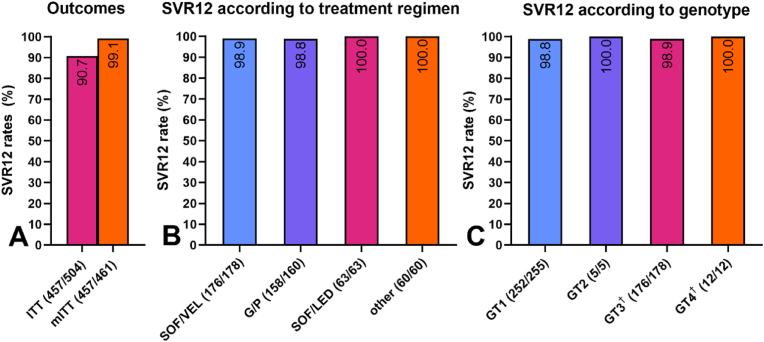
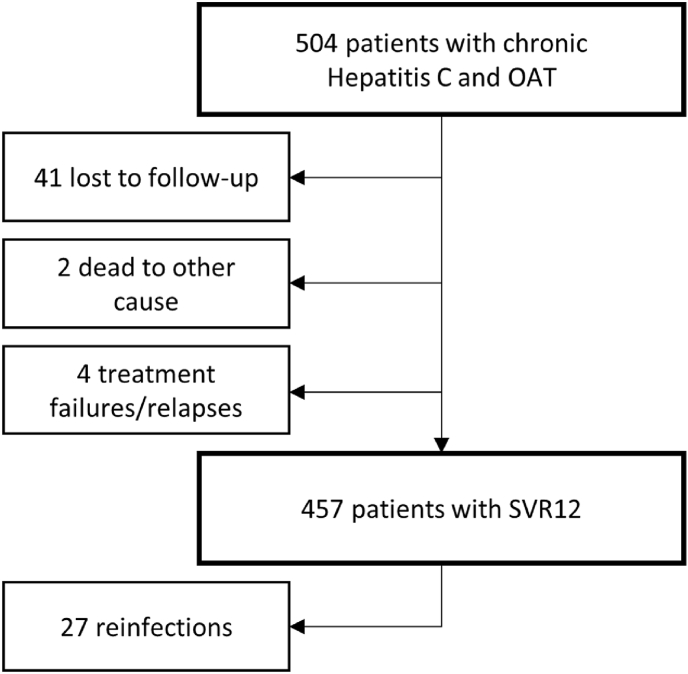
In total, 504 HCV RNA-positive PWIDs on OAT (387 men, 76.8%; median age: 38 years [IQR 33-45], HIV: 4.6%; hepatitis B: 1.4%) were included into this study. Two thirds reported ongoing intravenous drug use (IDU) and half of them had no permanent housing. Only 41 (8.1%) were lost to follow-up and two (0.4%) died of reasons unrelated to DAA toxicity. Overall, 90.7% of PWIDs achieved sustained virological response 12 weeks after treatment (SVR12) (95% CI: 88.1-93.2%). By excluding those lost to follow-up and hose who had died of causes unrelated to DAAs, the SVR12 rate was 99.1% (95% CI: 98.3-100.0%; modified intention-to-treat analysis). Four PWIDs (0.9%) experienced treatment failure. Over a median follow-up of 24 weeks (IQR 12-39), 27 reinfections (5.9%) were observed in individuals with the highest IDU rates (81.2%). Importantly, even though some were lost to follow-up, all completed their DAA treatment. By using DOT, adherence to DAAs was excellent with only a total of 86 missed doses (0.3% of 25,224 doses).
In this difficult-to-treat population of PWIDs with high rates of IDU , coupling DAA treatment to OAT in a DOT setting resulted in high SVR12 rates equivalent to conventional treatment settings in non-PWID populations.
尽管有有效的直接抗病毒药物(DAA),但丙型肝炎病毒(HCV)在注射吸毒者(PWID)中患病率很高,治疗依从性差仍是该亚人群消除HCV的主要障碍。为克服这一问题,我们在直接观察治疗(DOT)环境中将正在进行的阿片类激动剂治疗(OAT)与DAA联合使用。
从2014年9月至2021年1月,将有不依从DAA治疗高风险且正在接受OAT的PWID纳入该微消除项目。个体在药房或低门槛机构中,在医护人员监督下作为DOT接受OAT和DAA治疗。
本研究共纳入504例接受OAT的HCV RNA阳性PWID(387例男性,占76.8%;中位年龄:38岁[四分位间距33 - 45],HIV感染率:4.6%;乙肝感染率:1.4%)。三分之二的人报告仍在静脉注射吸毒(IDU),其中一半没有固定住所。仅41例(8.1%)失访,2例(0.4%)死于与DAA毒性无关的原因。总体而言,90.7%的PWID在治疗12周后实现了持续病毒学应答(SVR12)(95%置信区间:88.1 - 93.2%)。排除失访者和死于与DAA无关原因者后,SVR12率为99.1%(95%置信区间:98.3 - 100.0%;改良意向性分析)。4例PWID(0.9%)治疗失败。在中位随访24周(四分位间距12 - 39)期间,在IDU率最高(81.2%)的个体中观察到27例再感染(5.9%)。重要的是,尽管有一些人失访,但所有人都完成了DAA治疗。通过使用DOT,DAA的依从性极佳,总共仅86剂漏服(占25224剂的0.3%)。
在这个IDU率高且难以治疗的PWID人群中,在DOT环境中将DAA治疗与OAT相结合,导致SVR12率很高,与非PWID人群中的传统治疗环境相当。