Yanai Yoshinori, Mikami Shuji, Yasumizu Yota, Takeda Toshikazu, Matsumoto Kazuhiro, Kitano Shigehisa, Oya Mototsugu, Kosaka Takeo
Department of Urology, Keio University School of Medicine, Tokyo, Japan.
Department of Diagnostic Pathology, Keio University School of Medicine, Tokyo, Japan.
Int J Urol. 2025 Jan;32(1):39-44. doi: 10.1111/iju.15592. Epub 2024 Oct 1.
This study aimed to investigate the potential for using the phosphatase and tensin homolog (PTEN) gene as a prognostic marker in post-prostatectomy patients with castration-sensitive prostate cancer (PCa).
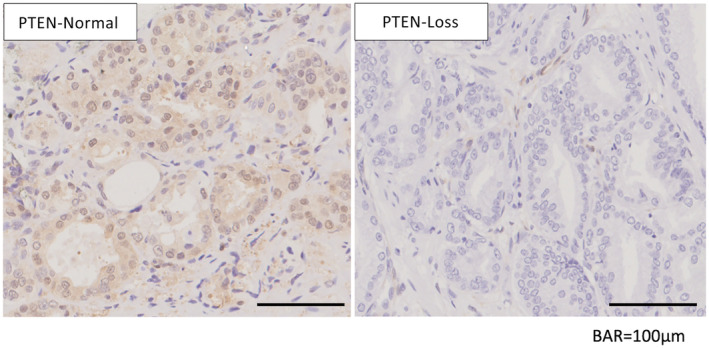
A total of 180 patients with castration-sensitive PCa who underwent radical prostatectomy at our institution were included in this study. PTEN expression was evaluated using immunohistochemistry, and patients were classified into two groups based on the staining intensity: PTEN-Normal and PTEN-Loss. The association between PTEN expression and biochemical recurrence was analyzed using the Cox proportional hazards model.
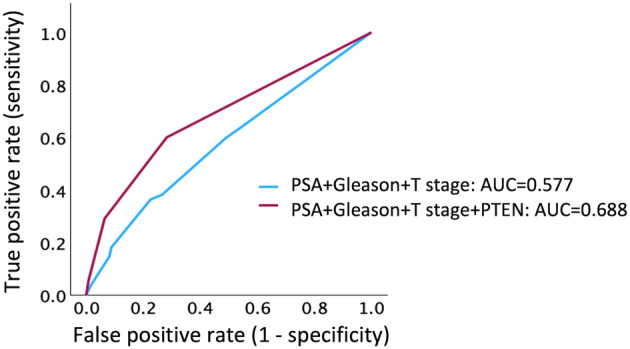
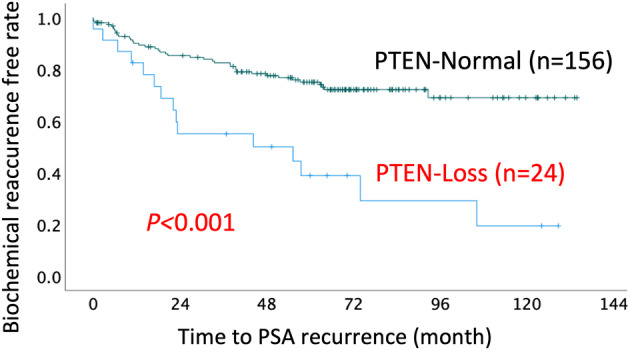
Patients in the PTEN-Loss group had a higher risk of biochemical recurrence (hazard ratio, 4.642; 95% confidence interval, 2.137-10.083; p < 0.001) and a lower recurrence-free rate compared to the PTEN-Normal group (35% vs. 75%). In addition to clinicopathological factors, such as the serum prostate-specific antigen level, Gleason score, and T stage, evaluation of PTEN expression improved the prediction of biochemical recurrence after prostatectomy (area under the curve, 0.577 vs. 0.688).
Low PTEN expression is a significant predictor of biochemical recurrence in patients with castration-sensitive PCa who have already undergone prostatectomy.
本研究旨在探讨磷酸酶和张力蛋白同源物(PTEN)基因作为去势敏感性前列腺癌(PCa)前列腺切除术后患者预后标志物的可能性。
本研究纳入了在我院接受根治性前列腺切除术的180例去势敏感性PCa患者。采用免疫组织化学法评估PTEN表达,并根据染色强度将患者分为两组:PTEN正常组和PTEN缺失组。使用Cox比例风险模型分析PTEN表达与生化复发之间的关联。
与PTEN正常组相比,PTEN缺失组患者生化复发风险更高(风险比,4.642;95%置信区间,2.137 - 10.083;p < 0.001),无复发生存率更低(35%对75%)。除血清前列腺特异性抗原水平、Gleason评分和T分期等临床病理因素外,PTEN表达评估改善了前列腺切除术后生化复发的预测(曲线下面积,0.577对0.688)。
PTEN低表达是已接受前列腺切除术的去势敏感性PCa患者生化复发的重要预测指标。